
Video content is no longer created for a single audience in a single language. A podcast recorded in English can be watched in Spain, shared in Brazil, and used in training programs across Asia within hours. Meanwhile, YouTube creators, TikTok publishers, online educators, webinar hosts, and corporate training teams are producing more videos than ever before.
As Video Editors, Post-Production Specialists, Instructional Designers, and EdTech professionals, we have witnessed a major shift. Accessibility is no longer treated as a final checklist item. Instead, it has become a core part of the production workflow. More importantly, organizations are discovering that multilingual captions improve accessibility, increase engagement, expand global reach, and reduce production waste at the same time.
The challenge is scale.
Creating captions manually for every language can quickly slow production, create bottlenecks, and introduce costly errors. Fortunately, AI-powered transcription and captioning tools are changing how teams handle accessibility.
When viewed through the lens of maximizing throughput, reducing cycle time, and minimizing scrap rate, multilingual captions become much more than an accessibility feature. They become a production efficiency strategy.
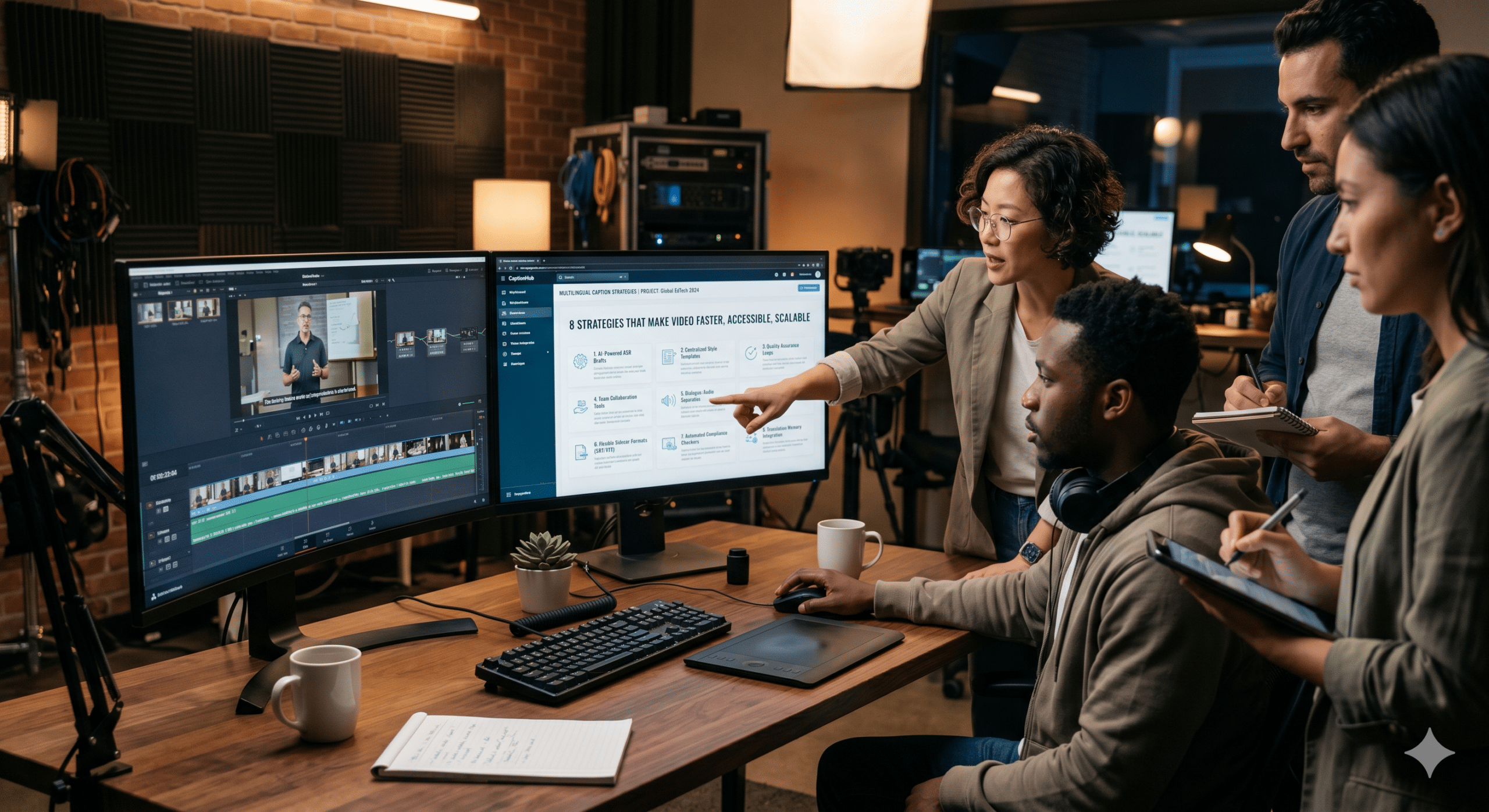
In this article, we will explore eight practical approaches that help content creators produce accessible videos faster while maintaining quality and consistency.
Why Multilingual Captions Matter More Than Ever
A few years ago, captions were often associated primarily with accessibility requirements. Today, the situation is very different.
Many viewers watch videos without sound while commuting, working, studying, or scrolling through social media feeds. Educational institutions need content that supports diverse learners. Businesses increasingly serve international audiences. Online courses frequently attract students from multiple countries.
As a result, video accessibility and language accessibility are becoming closely connected.
Captions help people who are Deaf or hard of hearing. They also help non-native speakers understand content more easily. In addition, captions improve comprehension, retention, and search visibility. Transcripts provide another layer of accessibility and can support users who prefer reading at their own pace. (Boia)
From an operations perspective, every video that lacks captions limits audience reach and reduces the return on production investment.
That is why more organizations are treating multilingual captions as a standard part of content production rather than an optional enhancement.
Strategy 1: Build Accessibility into the Workflow from Day One
One of the most common mistakes in video production is treating accessibility as a final editing task.
When captions are added only after the video has been completed, editors often need to revisit finished projects, re-export files, and make additional revisions. Consequently, cycle time increases and production efficiency decreases.
Instead, accessibility should be integrated into pre-production planning.
A well-written script becomes the foundation for transcription, captioning, translation, and localization. Furthermore, structured scripts make AI-generated transcripts significantly more accurate.
From an instructional design perspective, planning accessibility early also improves learning outcomes. Videos become easier to understand because the language is clearer and the information is better organized.
Most importantly, early planning reduces rework.
Every avoided revision represents lower scrap rates and faster project completion.
Strategy 2: Use AI Transcription as the First Draft, Not the Final Product
Modern AI transcription tools have become remarkably effective. They can process large volumes of content in minutes rather than hours.
For organizations publishing dozens or even hundreds of videos per month, this dramatically increases throughput.
However, experienced editors know that automated transcripts are not perfect.
Industry guidance consistently recommends using automatic transcription as a starting point rather than a final deliverable. Technical terminology, speaker names, accents, and industry-specific language often require human review. (Greater Lowell Technical High School)
The most efficient workflow combines AI speed with human quality control.
Instead of spending hours creating transcripts from scratch, editors spend minutes reviewing and correcting automatically generated text.
This approach reduces production time while maintaining accuracy.
As a result, teams achieve higher output without sacrificing quality.
Strategy 3: Create a Master Transcript Before Translating
Many organizations make the mistake of translating directly from audio.
This often leads to inconsistencies, misunderstandings, and duplicated effort.
A more efficient approach begins with a carefully reviewed master transcript.
Once the primary transcript has been cleaned and approved, it becomes the single source of truth for all language versions.
This simple step creates several operational benefits.
First, translators work from accurate content rather than interpreting spoken audio.
Second, terminology remains consistent across languages.
Third, future updates become easier because only one master document requires revision.
From a throughput perspective, a centralized transcript eliminates repetitive work and accelerates multilingual production.
Consequently, teams can support more languages without proportionally increasing production costs.
Strategy 4: Prioritize High-Impact Languages First
Many organizations attempt to translate videos into every possible language immediately.
While ambitious, this strategy often creates unnecessary workload.
Instead, focus first on the languages that generate the greatest impact.
For example, analytics may reveal that a significant percentage of viewers come from Spanish-speaking countries. Educational programs might attract learners from specific regions. Corporate training content may need support for a limited set of workforce languages.
By prioritizing high-demand languages first, teams can deploy resources more efficiently.
This approach reduces bottlenecks while delivering the greatest accessibility benefit.
Furthermore, it prevents unnecessary production waste.
Not every language version will generate the same level of engagement.
Therefore, strategic prioritization helps maximize return on effort while maintaining accessibility goals.
Strategy 5: Standardize Caption Formatting Across Projects
Inconsistent caption formatting creates confusion for viewers and additional work for editors.
Every project should follow a standardized caption style guide.
This guide should define formatting rules, timing conventions, speaker identification methods, and language standards.
According to accessibility best practices, captions should be synchronized accurately, easy to read, and formatted consistently. Important sounds, speaker changes, and relevant audio information should also be included when necessary. (W3C)
Standardization provides significant operational advantages.
Editors spend less time making formatting decisions.
Review cycles become shorter.
Quality control becomes more predictable.
Additionally, consistent formatting strengthens brand identity across educational, corporate, and marketing content.
Over time, standardization dramatically reduces production friction.
Strategy 6: Turn Captions into Multiple Content Assets
One of the biggest opportunities in modern content production is asset reuse.
A transcript should never exist solely for accessibility purposes.
Instead, it should become the foundation for additional content creation.
For example, transcripts can be repurposed into blog posts, knowledge base articles, social media posts, learning materials, FAQs, downloadable resources, and searchable archives.
This approach transforms a single production effort into multiple deliverables.
From a throughput perspective, asset reuse increases output without increasing recording time.
From a scrap reduction perspective, it ensures that valuable content is never wasted.
Educational organizations benefit particularly well from this strategy because learners often prefer consuming information through multiple formats.
Some users watch videos.
Others read transcripts.
Many use both.
Providing multiple access points improves learning outcomes while maximizing production value.
Strategy 7: Use AI Translation to Scale Global Accessibility Faster
Global audiences expect content in their preferred language.
Traditionally, creating multilingual captions required significant manual effort.
Today, AI-assisted translation dramatically reduces the time required to produce multilingual content.
Modern captioning platforms increasingly support multilingual subtitle generation and translation workflows that help organizations localize content quickly. (Vimeo)
However, the goal should not be fully automated localization.
The most effective process combines AI-generated translations with human review.
This hybrid workflow delivers several advantages.
Translation speed increases significantly.
Production costs decrease.
Quality remains high.
Cycle times become shorter.
Most importantly, accessibility expands rapidly across global audiences.
Organizations can reach more viewers without dramatically expanding production teams.
Strategy 8: Measure Accessibility Performance Like Any Other Production Metric
Many organizations track views, watch time, and engagement.
Far fewer measure accessibility performance.
That is a missed opportunity.
Accessibility should be evaluated using the same operational mindset applied to other production processes.
For example, teams can track:
- Caption accuracy rates
- Translation turnaround times
- Number of supported languages
- Accessibility-related revision requests
- Transcript completion speed
- Viewer engagement by language
- Caption usage rates
These metrics reveal workflow bottlenecks and identify opportunities for improvement.
When accessibility becomes measurable, it becomes manageable.
Consequently, teams can continuously optimize production efficiency while improving user experience.
The Hidden Cost of Poor Captions
Poor captions create more problems than many organizations realize.
Inaccurate transcripts confuse viewers.
Translation errors damage credibility.
Missing captions exclude audiences.
Late accessibility fixes extend production schedules.
All of these issues contribute to higher scrap rates.
In manufacturing, scrap refers to wasted materials.
In video production, scrap often appears as rework, revisions, corrections, delayed publishing, and duplicated effort.
The goal should always be preventing accessibility problems before they occur.
Therefore, investing in efficient captioning workflows delivers benefits far beyond compliance.
It improves quality, productivity, audience reach, and long-term scalability.
How Multilingual Captions Support Online Learning
As instructional designers, we have seen firsthand how captions improve educational experiences.
Students learn differently.
Some absorb information through listening.
Others retain information better through reading.
Many learners benefit from using both simultaneously.
Multilingual captions add another layer of support.
Non-native speakers gain confidence.
Complex terminology becomes easier to understand.
Learning barriers decrease.
Furthermore, transcripts create searchable learning resources that help students revisit specific concepts without rewatching entire videos.
This flexibility improves both accessibility and learning effectiveness.
As online education continues to expand globally, multilingual accessibility will become increasingly important.
The Future of AI Captions and Accessibility
The future of video production is not simply about creating more content.
It is about creating more accessible content without increasing production complexity.
AI transcription, translation, and captioning technologies will continue improving.
However, the winning workflow will not replace human expertise.
Instead, successful teams will combine automation with editorial oversight.
AI will handle repetitive tasks.
Editors will ensure accuracy.
Instructional designers will ensure clarity.
Accessibility specialists will ensure inclusivity.
Together, these roles create a workflow that maximizes throughput, reduces cycle time, and minimizes scrap.
That combination ultimately delivers the greatest value for creators and audiences alike.
Conclusion
The demand for accessible video content is growing rapidly.
Podcasts are becoming video shows. Online learning continues to expand. Businesses are creating multilingual content for global audiences. Social media platforms increasingly depend on captions for engagement.
In this environment, multilingual captions are no longer optional.
They are a strategic advantage.
Organizations that integrate AI transcription, multilingual captioning, accessibility planning, and standardized workflows into their production process can publish more content, reach more viewers, and reduce costly rework.
Most importantly, they can create videos that are accessible to everyone.
When accessibility becomes part of the workflow instead of an afterthought, efficiency and inclusion grow together.
Frequently Asked Questions
What are multilingual captions?
Multilingual captions are video captions translated into multiple languages, allowing viewers to understand content in their preferred language while maintaining accessibility.
Do multilingual captions improve SEO?
Yes. Captions and transcripts create searchable text that can help search engines understand video content more effectively while improving discoverability. (Boia)
Are AI-generated captions accurate enough?
AI-generated captions are an excellent starting point, but they should be reviewed and edited by humans to ensure accuracy and accessibility compliance. (Adobe Blog)
Why are captions important for accessibility?
Captions provide access to spoken dialogue and important audio information for people who are Deaf or hard of hearing. They also help viewers who watch videos without sound and support non-native speakers. (W3C)
What is the difference between captions and transcripts?
Captions are synchronized with video playback, while transcripts provide a text version of the audio and sometimes visual information that users can read separately. (Boia)
Recommended Further Reading
1. W3C Web Accessibility Initiative (Highest Authority)
Making Audio and Video Media Accessible
Why it’s valuable: W3C is the global authority behind web accessibility standards and provides guidance on captions, transcripts, subtitles, and accessible media workflows.
2. W3C Captions and Subtitles Guide
Captions/Subtitles for Video Accessibility
Why it’s valuable: Covers captioning standards, subtitle implementation, transcript integration, and accessibility requirements.
3. Phrase Localization Blog
Localization and Accessibility Share the Same Mission
Why it’s valuable: Excellent resource connecting localization, multilingual content, accessibility, and AI-assisted translation workflows. Perfect for supporting multilingual captions discussions.
4. TransPerfect Blog
Best Practices for Multilingual Closed Captioning
Why it’s valuable: Focused specifically on multilingual caption workflows, translation quality, localization consistency, and global audience accessibility.
5. BOIA (Bureau of Internet Accessibility)
Why Do I Need Both Transcripts and Captions for Accessibility?
Why it’s valuable: Explains the relationship between transcripts, captions, accessibility compliance, and audience engagement.
6. Verbit Accessibility Hub
Video Accessibility Guidelines: Requirements and Benefits
Why it’s valuable: Covers accessibility requirements, captioning best practices, compliance considerations, and scalable workflows.
7. Happy Scribe Blog
The Future of Multilingual Accessibility: AI Subtitling in Global Media
Why it’s valuable: Strong article on AI subtitling, multilingual accessibility, localization, and the future of automated caption workflows.
8. Vimeo Blog
AI Subtitle Generators for Accessible Videos
Why it’s valuable: Practical overview of AI subtitle generation, video accessibility, and scalable captioning solutions for creators and businesses.