
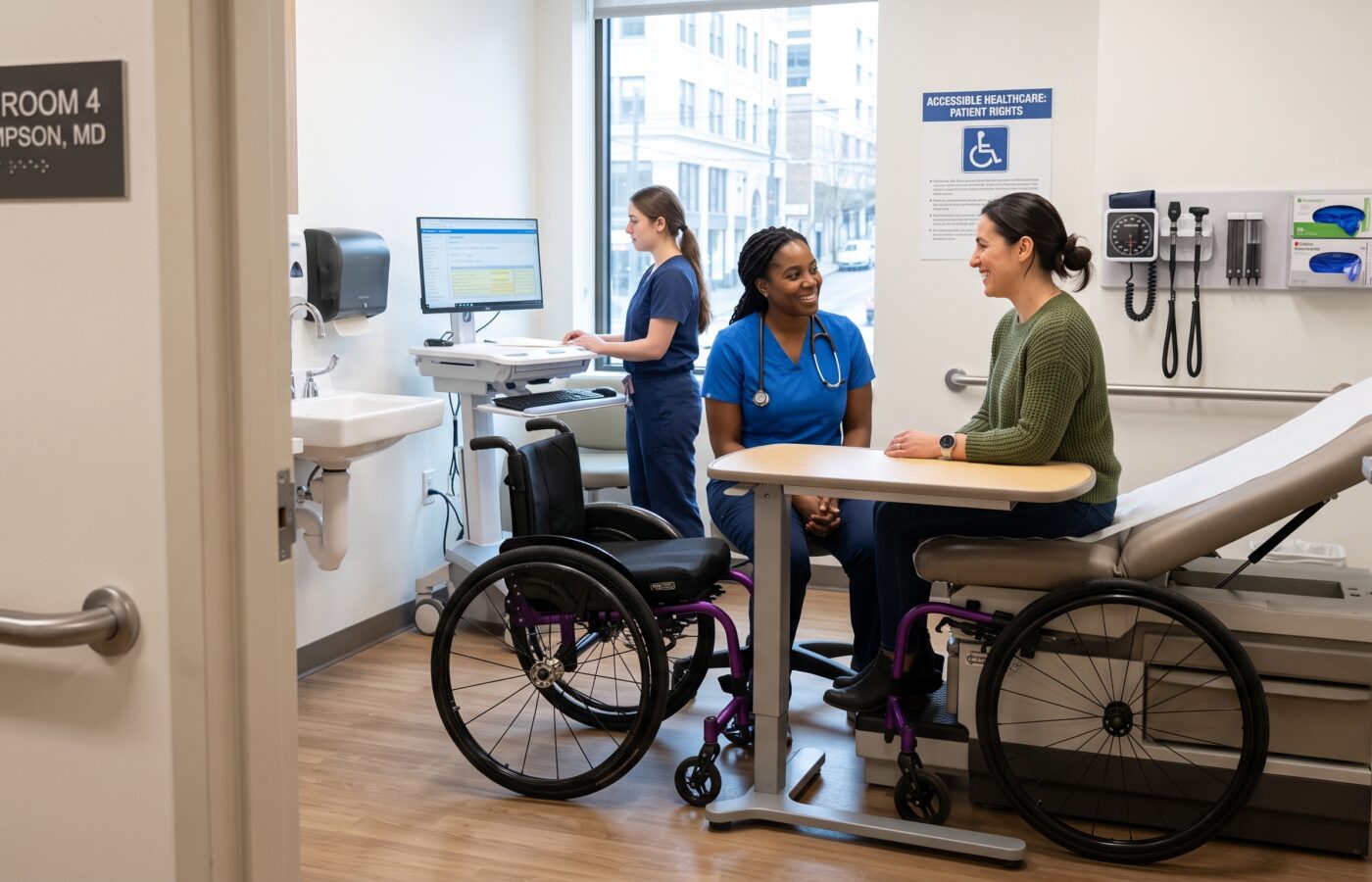
Accessible Healthcare: The Barriers Patients Still Face and How Providers Can Fix Them

Ask any person who uses a wheelchair how their last annual physical went, and there is a good chance you will hear a story about the scale. Or the exam table. Or the receptionist who spoke to their companion instead of to them. Stories like these show how far accessible healthcare still has to go, and they are not rare. In our work as healthcare accessibility consultants, we hear versions of them almost every week, from patients, from families, and increasingly from clinicians who know their practices fall short but are not sure where to begin.
Accessible healthcare is one of those phrases that sounds settled until you look closely. Most providers believe their facility is accessible because it has a ramp, a wide door, and a parking space with the familiar blue sign. Those things matter. But accessibility does not end at the front entrance. It runs through the scheduling phone call, the intake forms, the patient portal, the exam room, the conversation about a diagnosis, and the discharge instructions that go home in a folder. A barrier at any one of those points can mean a missed screening, a misunderstood prescription, or a patient who simply stops coming back.
We wrote this article for health system leaders, practice managers, clinicians, and policy professionals who want to understand where the real gaps are and how to close them. We also speak directly to patients and caregivers, because accessible healthcare improves fastest when the people who need it know what to ask for.
Why Accessible Healthcare Still Falls Short
The Size of the Population
People tend to underestimate the scale of the issue. In the United States, CDC data from 2022 show that roughly one in four adults report having a disability. Globally, the World Health Organization estimates that about 1.3 billion people, around 16 percent of the world’s population, live with a significant disability. That is not a niche population. It is a core part of every patient panel, every emergency department census, and every community a hospital serves.
The Outcome Gap
The outcomes tell a troubling story. According to WHO, people with disabilities face double the risk of developing conditions like depression, asthma, diabetes, stroke, obesity, and poor oral health. CDC figures point in the same direction: 16.6 percent of adults with a disability have diabetes, compared with 7.9 percent of adults without one, and heart disease shows a similar gap.
Underlying conditions explain some of that difference. A great deal of it, they do not. WHO states plainly that these inequities come from unfair conditions such as stigma, discrimination, poverty, exclusion from school and work, and barriers inside the health system itself. In other words, much of the gap is avoidable. It exists because people designed health systems around a narrow idea of who the patient would be.
Uneven Access by Age and Disability Type
Access also varies by age and disability type. CDC reports that one in four adults with disabilities between 18 and 44 lack a usual healthcare provider, and the same share went without needed care in the past year because of cost. CDC’s analysis also found that adults with vision disability generally reported the least access to care, a useful reminder that accessible healthcare is not only about mobility.
The Barriers We See Most Often
When we audit a hospital, clinic, or health plan, we organize what we find into a handful of categories. CDC uses a similar framework and notes that multiple barriers often stack on top of one another, sometimes making participation nearly impossible. Here is how those barriers tend to show up in real care settings.
Physical and Equipment Barriers
The building itself is usually the first thing people think about, and many facilities have made real progress there. The bigger problem today sits inside the exam room. A fixed height exam table that stands well above wheelchair seat level forces an awkward, sometimes unsafe transfer. Many patients simply decline to get on the table, so the clinician examines them seated in their chair. That might sound like a reasonable workaround, but it quietly changes the quality of care. Clinicians skip skin checks. Pelvic exams do not happen. Abdominal exams stay partial at best.
Scales present another persistent gap. If a clinic has no way to weigh a person who cannot stand, nobody records that patient’s weight for years. Weight drives medication dosing, anesthesia planning, and nutrition decisions. A missing number is not a minor data issue. It is a clinical risk.
Imaging tells the same story at a higher cost. HHS has pointed out that exam tables that cannot lower, mammography machines that require standing, and scales that cannot hold a wheelchair all shut people with disabilities out of basic health services and contribute to poorer outcomes.
Communication Barriers
Communication failures often stay invisible to the provider while feeling painfully obvious to the patient. A front desk worker hands a Deaf patient a clipboard and tells them to write down any questions. A nurse gives a patient with low vision a printed medication schedule in small type. A clinician rushes a person with an intellectual disability through a consent form full of clinical jargon.
CDC describes these barriers well, pointing to technical language, long sentences, and multisyllabic words that create real obstacles for people with cognitive impairments. These are also core health literacy problems. The fix rarely costs much. It usually comes down to planning ahead and asking the patient what works for them.
The legal expectations here are clearer than many providers realize. The Department of Justice notes that in a doctor’s office, a patient who uses sign language generally needs an interpreter for the medical history or for a conversation about a serious diagnosis and treatment options. The same guidance makes the point that the ADA puts the duty to provide effective communication, including interpreters, directly on the provider. Asking a patient to bring their teenage child to interpret a cancer diagnosis is not a workaround. It is a compliance failure and an ethical one.
Attitudinal Barriers
This category is the hardest to talk about, and probably the most important. Medical training teaches clinicians to stay objective, but they carry the same assumptions about disability that the rest of society does.
The landmark research here is a 2021 national survey that Lisa Iezzoni and colleagues published in Health Affairs. Among 714 practicing physicians, more than four in five said people with significant disability have a worse quality of life than people without disability, and only about two in five felt very confident they could provide the same quality of care to disabled patients. The authors concluded that large numbers of practicing physicians may hold biased or stigmatized views of people with disability.
We share this finding in nearly every training we lead, not to shame anyone, but because it explains so much. If a clinician quietly assumes a patient’s life is diminished, that belief can shape how aggressively they pursue a diagnosis, how they frame treatment options, and how much time they spend in the room. Patients feel it, even when nobody says anything unkind.
Digital Barriers
Healthcare moved online faster than accessibility followed. Patient portals, online scheduling, telehealth platforms, remote patient monitoring tools, intake kiosks, and billing systems now serve as the front door for many patients. When developers do not build those tools for screen readers, keyboard navigation, captioning, or plain language, that front door stays locked.
We regularly test portals where a blind patient cannot complete check in without sighted help, or where a video visit platform offers no captioning. These problems have solutions, and our telehealth accessibility guide covers many of them, but someone has to own them.
Policy and Programmatic Barriers
Finally, quiet rules make accessible healthcare harder. Fixed 15 minute appointment slots ignore transfer time and interpreter use. Intake forms skip any question about accommodation needs. Cancellation policies penalize patients who rely on paratransit and arrive late through no fault of their own. CDC notes that programmatic barriers limit how well a healthcare program reaches people with different types of impairments, and in our experience scheduling policy is the most common culprit.
What the Law Now Requires
For years, accessibility in healthcare relied heavily on general principles and voluntary guidance. That has changed. In May 2024, HHS released a long awaited final rule implementing Section 504 of the Rehabilitation Act, and it put measurable standards behind many of the barriers described above.
Accessible Exam Tables and Scales
The rule adopts the U.S. Access Board’s standards for accessible medical diagnostic equipment and requires recipients that use exam tables or weight scales to have at least one accessible version of each within two years of the effective date. That deadline has now passed. By July 8, 2026, entities receiving HHS funding needed an accessible exam table if they use exam tables and an accessible weight scale if they use weight scales. Public entities had until August 9, 2026 under the parallel Justice Department rule.
The standards get specific. The rule treats a low transfer height between 17 and 19 inches as acceptable for exam tables, roughly the seat height of most wheelchairs. Owning the equipment is not enough, either. The rules also require qualified staff who can operate the accessible equipment and help patients transfer onto it. A height adjustable table sitting in a storage closet with a dead battery does not count, since the rule also requires facilities to keep accessible features and equipment in working order.
Website and Patient Portal Deadlines
The digital picture shifted this year. The 2024 rule set WCAG 2.1 AA as the standard for websites and mobile apps, but a May 7, 2026 interim final rule moved the compliance date for recipients with 15 or more employees from May 11, 2026 to May 11, 2027, and for smaller recipients from May 10, 2027 to May 10, 2028.
We caution clients not to read that as a pause. As one accessibility analysis noted, the broader Section 504 protections, including bans on denying treatment based on disability and the equipment requirements, remain fully in force. Patients can still file complaints about inaccessible portals today.
Medical Decisions and Accountability
The rule also addresses medical decision making. It prohibits discriminatory medical decisions, which connects directly to the attitudinal bias problem described earlier. It also carries administrative expectations, including a designated Section 504 compliance employee and formal grievance procedures.
The Global Direction
For organizations outside the United States, the direction of travel is the same. WHO has published 40 key actions countries can take to strengthen health systems and reduce inequities for people with disabilities, and in 2024 it released a practical guide for action that serves as a roadmap for more inclusive health systems.
A Practical Roadmap for Providers
Compliance is the floor. The organizations we see doing this well treat accessible healthcare as a quality, safety, and patient experience issue, not a legal checkbox. Here is the sequence we typically recommend.
Start With an Honest Audit
Walk the full patient journey, not just the building. Call your own scheduling line and ask for an interpreter. Try to book an appointment using only a keyboard. Try to use your portal with a screen reader turned on. Sit in a wheelchair and try to reach the check in counter, the restroom, and the exam table. Count how many accessible exam tables and scales you actually have and whether staff know how to use them.
The most valuable audits include people with disabilities on the team. Lived experience catches things that checklists miss every single time.
Fix Equipment and Space First
If you have not met the July 2026 equipment requirements, make that your priority. Beyond the minimum, think about where accessible equipment lives. One accessible table at the far end of a large clinic meets the letter of the rule but does little good if scheduling does not route patients to that room. Build the equipment into your scheduling logic so the system books the right room automatically whenever a patient’s chart flags a need.
Ask Every Patient About Accommodations
This single change does more for accessible healthcare than almost anything else we recommend. Add a simple question at registration and in the portal: “Do you need any accommodations to make your visit easier?” Offer examples like an interpreter, extra time, large print, help with transfers, or a quieter waiting area. Then store the answer where every staff member will see it, and carry it forward to future visits.
Patients should not have to explain their needs from scratch every time they walk in. When they do, it signals that the system never had them in mind. Getting this right is also one of the simplest ways to improve patient satisfaction across a practice.
Rethink Scheduling
Build flexibility into appointment length. Schedulers should book a longer slot for any patient who needs a transfer, an interpreter, or extra time to process information, without making that patient argue for it. Review late arrival and cancellation policies for their impact on people who depend on paratransit or caregivers.
Plan Communication Before the Visit
Book interpreters and captioning services when you schedule the appointment, not when the patient arrives. Keep large print, plain language, and audio versions of common documents ready. Train staff to speak directly to the patient, not to the companion. Teach clinicians to use teach back, where the patient explains the plan in their own words, which helps everyone, not just people with disabilities.
DOJ guidance helps here because it reminds providers that the right aid depends on how the person usually communicates, since sign language interpreters only help people who use sign language. A late deafened adult may need real time captioning instead. Ask, do not assume.
Train for Attitudes, Not Just Procedures
Most disability training in healthcare focuses on logistics. That is necessary but not sufficient. Given the Health Affairs findings, effective training also needs to address assumptions about quality of life, the risk of diagnostic overshadowing (when a clinician wrongly blames new symptoms on an existing disability), and the right of disabled patients to make their own decisions. Training that people with disabilities lead or help design consistently works better than training that outsiders deliver alone.
Make Digital Access Part of Procurement
Do not wait for the 2027 deadline. Require WCAG 2.1 AA conformance in every contract for portals, telehealth, kiosks, and patient communication tools. Ask vendors for accessibility conformance reports and test their claims with real users. Retrofitting an inaccessible platform costs far more than buying the right one.
Name an Owner
Accessible healthcare improves when someone owns it. Designate a Section 504 coordinator with real authority, a budget, and a direct line to leadership. Give that person a clear grievance process to manage and require regular reports on what complaints reveal.
What Patients and Families Can Do
Patients should never carry the burden of fixing a system that excludes them. Still, knowing your rights makes accessible healthcare easier to claim, and we encourage patients and caregivers to take a few steps.
Request Accommodations When You Book
Ask about accommodations when you book, not when you arrive. If you need an accessible exam table, a scale you can use seated, an interpreter, or extra time, say so on the phone and ask the scheduler to note it in your record. Disability Rights North Carolina, for example, suggests that patients call at least a week ahead to request an interpreter and explain that they need one to communicate effectively.
Ask About Accessible Equipment by Name
Ask whether the practice has accessible equipment, by name. Since the 2026 deadlines have passed, most covered practices should have it. As one patient advocacy publication noted, covered providers cannot deny care because they lack accessible equipment.
Document Refusals and Escalate
Keep notes. If staff refuse a request, write down the date, the person you spoke with, and what they said. Ask for the practice’s Section 504 coordinator or grievance process. If the practice does not resolve the issue, you can file a complaint with the HHS Office for Civil Rights or the Department of Justice.
Measuring Progress
You cannot improve accessible healthcare without measuring it. We encourage organizations to track a small set of indicators over time:
- The share of patients that staff ask about accommodation needs at registration.
- The number of accessible exam tables and scales per site, and how often staff actually use them.
- Interpreter request fulfillment rates and average wait times.
- Screening completion rates (mammograms, cervical cancer screening, colorectal screening) for patients with disabilities compared with the overall patient population.
- Portal and telehealth accessibility test results.
- Disability related grievances, and how quickly staff resolve them.
The screening gap often reveals the most. When an organization stratifies its preventive care data by disability status for the first time, the results usually sober everyone in the room. They also tend to make the most persuasive case for leadership investment.
The Bottom Line
Accessible healthcare is not a special service for a small group of patients. It is good care, delivered in a way that works for everyone who walks through the door. Many of the changes that help people with disabilities, such as clearer communication, flexible scheduling, adjustable equipment, and easier digital tools, improve the experience for older adults (especially alongside the right assistive technology for seniors), patients recovering from surgery, and busy families too.
The regulatory deadlines gave many organizations the push they needed. But the providers who make real progress stop treating accessibility as a project and start treating it as part of how they define quality. When staff can weigh a patient who uses a wheelchair, examine them on the table, and speak to them directly, without that patient having to fight for any of it, accessible healthcare stops being a policy goal and becomes ordinary practice.
Frequently Asked Questions
What does accessible healthcare mean?
Accessible healthcare means patients with disabilities can get the same quality of care as anyone else, from scheduling and communication to exams, equipment, and digital tools. CDC’s overview of barriers to inclusion offers a helpful starting point: CDC Disability Barriers to Inclusion
Are doctors required to have accessible exam tables and scales?
Under the HHS Section 504 rule, most providers receiving federal funding that use exam tables or weight scales needed at least one accessible unit of each by July 8, 2026. See the HHS Section 504 Final Rule Fact Sheet
Does my doctor have to provide a sign language interpreter?
Healthcare providers must ensure effective communication, which often means a qualified interpreter for important conversations like a medical history or a serious diagnosis. Read the DOJ Effective Communication Guidance
When must healthcare websites and patient portals be accessible?
HHS moved the WCAG 2.1 AA compliance date to May 11, 2027 for recipients with 15 or more employees and May 10, 2028 for smaller recipients, though broader nondiscrimination duties still apply. Details: LeadingAge on the Section 504 Web Deadline
How common is disability worldwide?
WHO estimates about 1.3 billion people, or 16 percent of the global population, experience significant disability. See the WHO Disability and Health Fact Sheet
Do physicians hold biases about patients with disabilities?
A 2021 national survey found that many physicians rated disabled patients’ quality of life as worse and felt less than fully confident caring for them. Read the Health Affairs Study
References
- Centers for Disease Control and Prevention. Disability and Health Information for Healthcare Providers. https://www.cdc.gov/disability-and-health/about/disability-and-health-information-for-healthcare-providers.html
- Centers for Disease Control and Prevention. Prevalence of Disabilities and Health Care Access by Disability Status and Type Among Adults. https://www.cdc.gov/disability-and-health/articles-documents/disabilities-health-care-access.html
- Centers for Disease Control and Prevention. Disability Barriers to Inclusion. https://www.cdc.gov/disability-inclusion/barriers/
- Centers for Disease Control and Prevention. Disability Impacts All of Us Infographic. https://www.cdc.gov/disability-and-health/media/pdfs/disability-impacts-all-of-us-infographic.pdf
- World Health Organization. Disability and Health Fact Sheet. https://www.who.int/news-room/fact-sheets/detail/disability-and-health
- World Health Organization. WHO Launches New Toolkit to Advance Health Equity for Persons With Disabilities. https://www.who.int/news/item/26-11-2024-who-launches-new-toolkit-to-advance-health-equity-for-persons-with-disabilities
- U.S. Department of Health and Human Services. Section 504 of the Rehabilitation Act of 1973 Part 84 Final Rule: Fact Sheet. https://www.hhs.gov/civil-rights/for-individuals/disability/section-504-rehabilitation-act-of-1973/part-84-final-rule-fact-sheet/index.html
- Administration for Community Living. Final Rule Implementing Section 504 of the Rehabilitation Act of 1973. https://acl.gov/504rule
- Saul Ewing. Deadlines Approach for Health Care Providers to Ensure Accessible Medical Diagnostic Equipment. https://www.saul.com/insights/alert/deadlines-approach-health-care-providers-ensure-accessible-medical-diagnostic
- Center for American Progress. Toolkit: Ensuring State Implementation of HHS’ Updated Section 504 Rule. https://www.americanprogress.org/article/toolkit-ensuring-state-implementation-of-hhs-updated-section-504-rule/
- LeadingAge. Web Accessibility Compliance Date Delayed Under HHS’ Section 504 Regulations. https://leadingage.org/web-accessibility-compliance-date-delayed-under-hhs-section-504-regulations/
- Converge Accessibility. HHS Delays the Section 504 Web Accessibility Deadline. https://convergeaccessibility.com/2026/05/11/hhs-delays-504-rule/
- Iezzoni LI, et al. Physicians’ Perceptions of People With Disability and Their Health Care. Health Affairs, 2021. https://www.healthaffairs.org/doi/10.1377/hlthaff.2020.01452
- U.S. Department of Justice. ADA Requirements: Effective Communication. https://www.ada.gov/resources/effective-communication/
- U.S. Department of Justice. Communicating Effectively With People With Disabilities. https://www.ada.gov/topics/effective-communication/
- Disability Rights North Carolina. Sign Language Interpreters in Healthcare. https://disabilityrightsnc.org/resources/sign-language-interpreter/
- Autism Digest. Ask for the Accessible Scale Before the Appointment. https://www.autismdigest.com/post/ask-for-the-accessible-scale