
What Is Remote Patient Monitoring? A Practical Guide to RPM That Actually Works

Remote patient monitoring is what I do for a living, and when I say that at dinner parties, I get one of two looks. The first is polite confusion. However, the second is the look of someone whose mother just came home from the hospital with a blood pressure cuff and a tablet she has no idea how to use.
I have spent years on the operations side of telehealth, and most of that time has been spent running RPM programs. In fact, I manage the people, the workflows, the device logistics, the billing rules, and the very human problem of getting a 78 year old to step on a scale every morning before coffee. So when I was asked to sit down and answer the questions I hear most often, I said yes, on one condition: I get to be honest about what works and what doesn’t.
What follows is that conversation, cleaned up a little.
So, What Is Remote Patient Monitoring, Really?
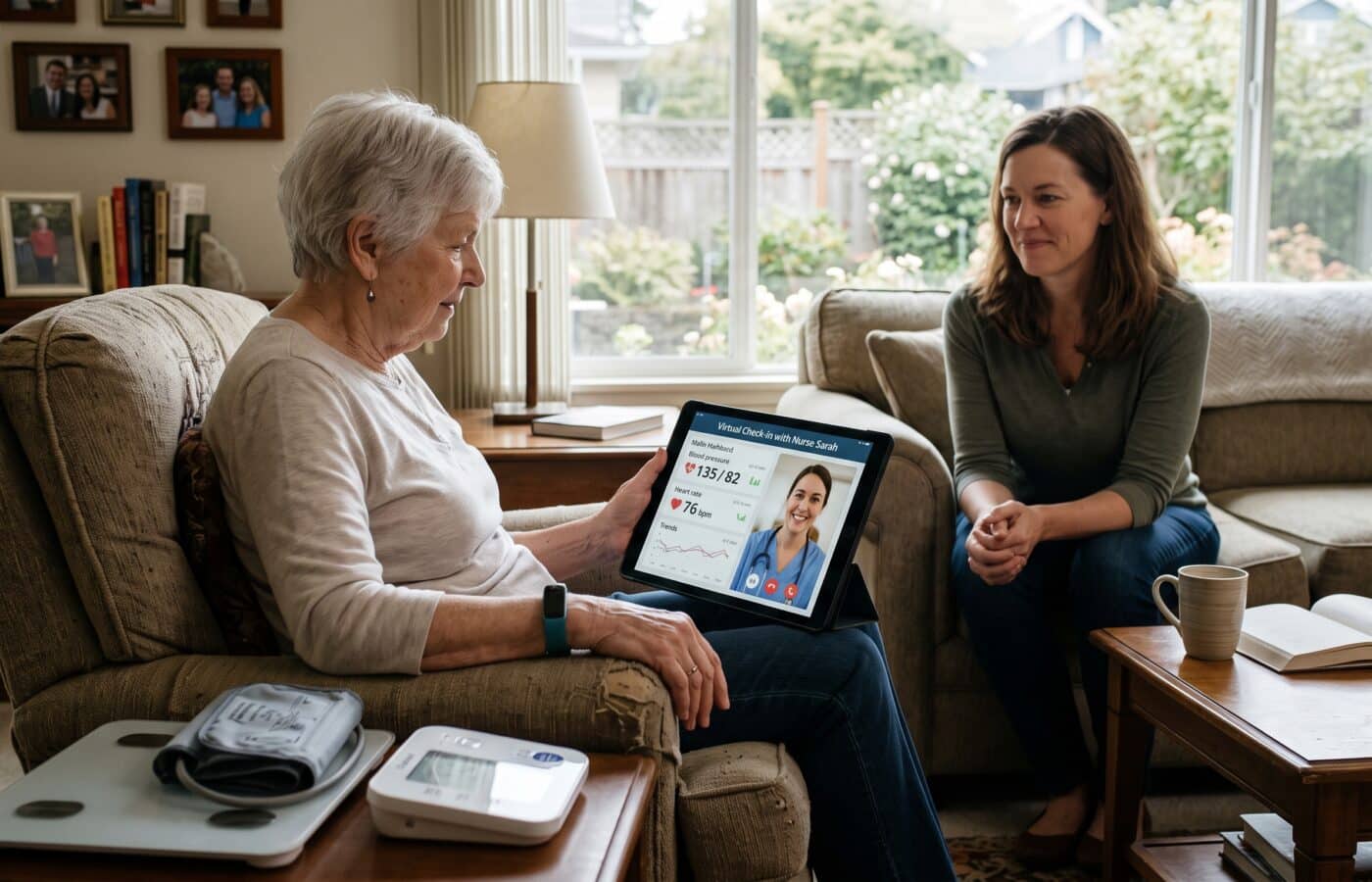
Strip away the vendor brochures and remote patient monitoring is simple. First, a patient uses a medical device at home. Then that device sends the reading to their care team. Finally, someone on the care team looks at it, and if something is off, they do something about it.
That last part is the whole point. The device is not the program. Similarly, a reading on its own isn’t the program either. Instead, what makes it a program is the clinician who notices that Mr. Alvarez has gained four pounds in three days and calls him before his heart failure lands him back in the emergency room.
The federal telehealth site run by HHS describes it in plain terms: RPM uses digital devices to keep track of a patient’s health, letting patients and providers manage both acute and chronic conditions by collecting and sharing health information. That’s accurate, but I always add one sentence when I explain it to new staff: if nobody acts on the data, you don’t have remote patient monitoring. Instead, you have an expensive diary.
One quick note on terms, because it confuses people. Medicare officially calls this service remote physiologic monitoring. For example, the HRSA guide points out that CMS uses the phrase “remote physiologic monitoring” in its billing codes, which describe monitoring that happens without a face to face visit. Meanwhile, everyone else, including most patients, just says RPM. In other words, it’s the same thing.
What Devices Are We Actually Talking About?
Fewer than you would think. In my program, the vast majority of patients use one of these:
- Blood pressure cuffs. This is the workhorse of remote patient monitoring because hypertension is common, the readings are meaningful, and the cuffs are easy to use once someone shows you how to sit properly.
- Weight scales. For heart failure, a daily weight is one of the earliest warning signs that fluid is building up. As a result, a scale that transmits automatically has saved more of our patients from hospital stays than any fancy wearable.
- Glucometers. For diabetes, connected meters let us see patterns instead of the single number a patient remembers to mention at their quarterly visit.
- Pulse oximeters. These are useful for COPD and some post discharge patients, and they also became familiar to a lot of households during the pandemic years.
Most of our devices use cellular connections rather than WiFi or Bluetooth. That decision alone cut our setup failures dramatically, since a patient doesn’t need a smartphone, doesn’t need a password, and doesn’t need a grandson to come over and pair anything. Instead, they take the reading and it shows up on our dashboard. Moreover, HHS notes that some devices can be configured to send data to the provider automatically, with no action needed from the patient. In my experience, that’s the single biggest factor in whether someone sticks with the program past the first month. The same rule holds for all assistive technology for seniors: the simpler it is, the more it gets used.
Walk Me Through What Happens After a Patient Takes a Reading
This is the part nobody sees, and honestly it’s the part I’m proudest of.
Every morning, our monitoring team opens a queue. Readings then come in sorted by priority. Our thresholds are set per patient by their physician, not by some generic rule, so a systolic reading of 160 might be urgent for one patient and expected for another who is mid titration.
Sorting the Daily Queue
Here’s roughly how a day looks:
- Critical readings get handled first. For instance, that could be a blood pressure above the patient’s emergency threshold, a dangerously low glucose, or an oxygen saturation that drops into a range the doctor flagged. Our nurses call those patients right away. Furthermore, if the patient has symptoms, we follow the escalation protocol, which can mean telling them to call 911.
- Trending readings come next. These are the ones that aren’t scary today but are moving in the wrong direction, such as three days of creeping weight gain or a week of morning glucose numbers drifting up. Consequently, these usually lead to a call, a medication question routed to the provider, or a scheduled telehealth visit.
- Missing readings are their own category, and they matter more than people expect. When a patient goes quiet, something has usually changed. Perhaps they were admitted somewhere, the device stopped working, they got discouraged, or they simply forgot. For example, one published cohort study described a program where care navigators reached out whenever a patient’s blood pressure fell outside the goal range or no data had come through for over three consecutive days. We use almost the same rule, and therefore I’d recommend it to anyone building a program.
Documentation Behind Every Call
After that comes documentation. Every interaction gets logged: who called, what was discussed, how long it took, and what action came out of it. Ultimately, that record protects the patient, protects the clinician, and is what allows the service to be billed correctly.
Does Remote Patient Monitoring Actually Improve Care? Or Is It Just Hype?
Fair question, and I’ll answer it like someone who has watched programs succeed and also watched programs flop.
High Blood Pressure
This is where the evidence is strongest. For instance, a retrospective cohort study cited a meta analysis of 18 randomized controlled trials showing remote monitoring reduced systolic pressure by 4.2 mm Hg, reduced diastolic pressure by 2.4 mm Hg, and raised the share of patients with controlled hypertension by 11% after one year.
Four points of systolic pressure may not sound dramatic to a patient. To a cardiologist, however, it is. In fact, a separate meta analysis notes that even a 2 mmHg drop in systolic pressure has been linked to a 7% lower incidence of ischemic cardiovascular disease and stroke. So when you multiply that across thousands of patients, you are talking about strokes that never happen.
More recently, a study in the American Journal of Managed Care looked at Medicare patients with stage 2 hypertension. It found that remote monitoring paired with care coaching was associated with a 75% reduction in stage 2 hypertension across 12 months, based on 652 patients.
Notice the phrase “paired with care coaching.” That’s not an accident. Likewise, the same retrospective study I mentioned found better blood pressure control among patients who took readings more often and who were followed by nurses, measured at 4, 8, and 12 weeks. In short, the human touch is not optional. It is the mechanism.
Heart Failure
Heart failure is where I have the most personal stories, although it’s also where the research is more mixed. Still, I’ll be straight about both.
A meta analysis presented through the European Society of Cardiology looked at which program components actually move the needle. Specifically, the components linked to stronger effects were monitoring at least once a day, including blood pressure, and using video calls. That lines up with everything I’ve seen: daily weights plus daily blood pressure plus an actual face on a screen when something looks wrong.
But I’d be doing you a disservice if I didn’t mention BEAT HF, published in JAMA Internal Medicine. It is among the largest randomized trials of telemonitoring in heart failure, and yet it did not show a meaningful drop in 180 day readmissions overall. That’s why, when I talk to administrators who think buying devices will fix their readmission numbers, I bring that trial up. Devices alone don’t do it. Rather, adherence, fast response, and medication adjustments do.
On the other hand, when programs are built well, the results can be striking. For example, AJMC reported that UMass Memorial Health Harrington cut 30 day readmissions for congestive heart failure in half using a remote care team supported by AI. That’s the kind of outcome you get when the operations side is taken seriously.
Diabetes and Post Discharge Care
For diabetes, the benefit is often about visibility. A patient might come in every three months with an A1C, but that number doesn’t tell you that their overnight lows are happening every Tuesday after dialysis. Remote glucose data, by contrast, shows those patterns.
Similarly, for patients coming home from the hospital, remote patient monitoring acts like a safety net during the most fragile weeks. HHS’s chronic disease guidance highlights that telehealth supports continuous tracking of symptoms, vital signs, and treatment progress through virtual check ins and remote devices. In practice, this means the first sign of trouble is a phone call from us, not an ambulance ride.
What Changed in 2026, and Why Should Anyone Outside Billing Care?
This year brought the biggest shift in RPM rules I’ve seen since I started, and as a result it changes who we can serve.
Before 2026, Medicare only paid for device supply if a patient sent at least 16 days of readings in a 30 day period. That rule shaped everything. Programs quietly favored patients who were already good at taking readings, because patients who took 12 readings in a month generated work but no payment for the device side.
The Two New Codes
Fortunately, the 2026 Physician Fee Schedule fixed that. According to McDonald Hopkins, the final rule introduced new and revised codes so Medicare can pay when data is collected on 2 to 15 days within a 30 day window, and for 10 minutes of treatment management in a calendar month, whereas earlier codes required 16 days and 20 minutes.
The two new codes are 99445 and 99470. CPT 99445 covers 2 to 15 days of device supply and data transmission inside a 30 day window, while 99470 covers 10 to 19 minutes of monthly treatment management. What surprised a lot of us, though, is that per Rimidi’s summary, 99445 is paid at the same rate as 99454 even though it requires fewer transmission days.
Why Patients Should Care
Why does this matter to patients and not just to billing teams? Because the patients who struggle to take 16 readings a month are often the ones who need monitoring most. Think of someone working two jobs, a patient with early memory issues, or someone who spent five days in the hospital in the middle of the month. Under the old rules, those patients were a financial liability to the program. Now, however, they aren’t.
The Operational Catch
There’s an operational catch, though. If a patient sends 16 or more days, you bill 99454; if they send 2 to 15 days, you bill 99445, and never both. Therefore, your reporting has to count transmission days accurately for every patient, every month. That sounds obvious. Even so, it’s not easy when you have hundreds of patients on multiple device types.
What Are the Problems Nobody Talks About?
Let me be the one who talks about them.
Programs That Exist Mostly on Paper
The federal government has been watching remote patient monitoring closely, and for good reason. Notably, the HHS Office of Inspector General found that Medicare RPM enrollees grew more than tenfold, from 55,000 in 2019 to 570,000 in 2022. That growth is not all bad. Nevertheless, the same report found that roughly 43 percent of enrollees did not receive all three components of the service, which raised doubts about whether it was being used as intended.
The three components are setup and education, device supply, and treatment management. So if a patient gets a device but no one ever reviews their data or talks to them, that’s not care. In addition, OIG flagged that CMS had reported concerns about companies cold calling beneficiaries to sell RPM services without any existing relationship between the patient and a practitioner.
Spending kept climbing after that. Indeed, a later OIG data snapshot reported that Medicare RPM payments hit $536 million in 2024, up 31% from 2023.
I bring this up because if you are a patient or a family member, you deserve to know what a real program looks like. Above all, your own doctor or their practice should be involved. Someone should call you, and someone should explain what happens when your numbers are high. Otherwise, if a company calls you out of nowhere offering a free device, be careful.
Alert Fatigue
This one is internal. If thresholds are set too tight, nurses drown in alerts that don’t matter, and consequently the ones that do matter get buried. For that reason, I review alert volumes every week. If a single patient is generating six alerts a day for readings their doctor considers acceptable, we take that back to the provider and adjust. After all, a monitoring nurse who trusts the queue is a monitoring nurse who acts quickly.
The First 30 Days
Most patients who drop out of remote patient monitoring do it in the first month. Usually the device feels strange, the numbers feel scary, or nobody ever told them their data was actually being read. That’s why HHS gives a recommendation I wish every program followed: when patients first begin using a device, someone on staff should confirm to them that their information was received. We make that call within the first three days for every new patient. Honestly, it is the cheapest retention tool I have ever used, and it does more for patient satisfaction than almost anything else we do.
What Does a Good Program Look Like From the Patient’s Side?
If I were enrolling my own father tomorrow, here’s what I’d want him to experience. These are the details that shape the whole patient experience of RPM.
- A real conversation before the device shows up. HHS advises that patients meet with their provider or care team first, either in person or by telehealth. During that visit, the team should explain how to use the device, how often, what numbers to expect, and what to do if a reading looks too high or low. Unfortunately, that last item is the one most often skipped. Good programs use plain language and teach back here, because health literacy decides whether a patient can act on what they hear. Instructions should also come in accessible formats for patients with vision or hearing loss, one of the most common barriers to accessible healthcare.
- A clear answer about cost. Medicare coverage generally comes with standard cost sharing, while private insurance varies. Patients should therefore ask before enrolling, not after the first statement arrives.
- A named point of contact. Not a general phone tree, but rather a nurse or care coordinator whose name the patient knows.
- Feedback. Patients do better when they can see their own trends. For instance, many of our patients started taking readings more consistently once we began sending a simple monthly summary, by mail or through the patient portal, showing their blood pressure moving down.
- A path out. Remote patient monitoring doesn’t have to last forever. Eventually, some patients get stable, their medications get dialed in, and they graduate. That is a success, not a lost enrollment.
What Would You Tell Someone Building an RPM Program Right Now?
Three things.
First, hire for the clinical layer before you buy devices. The research is consistent: the gains come from people responding to data. In other words, a great device with a slow response team underperforms a basic device with a fast one.
Second, build your reporting around the 2026 rules from day one. Count transmission days per patient per month. Also log interactive communication time as it happens. Then keep a record of every component of the service so you never become part of that 43 percent statistic.
Third, follow the established patient relationship rule and the medical necessity rule without shortcuts. Specifically, HHS guidance states that Medicare RPM requires an established patient relationship, must monitor an acute or chronic condition, and must be medically reasonable and necessary. Those requirements aren’t red tape. Instead, they describe what good care looks like anyway.
Final Thoughts
Remote patient monitoring isn’t magic, and anyone who sells it that way is selling you something. When done right, though, it is a way to see what happens to patients between appointments, which is where most of their life, and most of their health, actually happens.
The blood pressure cuff on a kitchen table, the scale next to the bathroom sink, the nurse who calls on a Thursday morning because the numbers looked off: that’s what care at home looks like now. My job, then, is to make sure every one of those pieces works, every day, for every patient. On the good days, nobody notices we were there. And that’s exactly how it should be.
Frequently Asked Questions About Remote Patient Monitoring
What is remote patient monitoring in simple terms?
It’s a service where you use a medical device at home, like a blood pressure cuff or scale, and your readings are then sent to your care team so they can spot problems early and adjust your treatment. Learn more in the HHS patient guide to home health devices.
Who is a good candidate for remote patient monitoring?
Patients with chronic conditions such as hypertension, heart failure, diabetes, or COPD, as well as patients recently discharged from the hospital, tend to benefit most. However, Medicare requires an established relationship with the billing provider. See the HHS Medicare billing requirements.
Does Medicare cover remote patient monitoring?
Yes, when it is medically necessary and ordered by a provider you have an existing relationship with. In most cases, standard cost sharing applies. See the HHS best practice guide for providers.
How many days do I need to take readings each month?
Starting in 2026, Medicare pays for monitoring when readings are sent on as few as 2 days in a 30 day period, although your provider will tell you how often you should actually measure. See the McDonald Hopkins summary of the 2026 rule.
What are the new RPM codes for 2026?
CPT 99445 covers 2 to 15 days of device data, while CPT 99470 covers the first 10 minutes of monthly treatment management. See Rimidi’s 2026 reimbursement breakdown.
Is remote patient monitoring proven to work?
The strongest evidence is in high blood pressure, where studies show meaningful reductions in systolic pressure. In heart failure, by contrast, results depend heavily on how the program is run. See this hypertension cohort study on PubMed Central.
How can I tell if an RPM offer is legitimate?
A legitimate program comes through your own doctor’s practice, includes education and setup, and also involves a clinician actually reviewing your readings. Therefore, be cautious of unsolicited calls offering free devices. See the AHA report on federal oversight findings.
References
Government and Regulatory Sources
- U.S. Department of Health and Human Services. Telehealth and Remote Patient Monitoring. Telehealth.HHS.gov
- U.S. Department of Health and Human Services. How Can I Use Remote Patient Monitoring? Telehealth.HHS.gov
- U.S. Department of Health and Human Services. Preparing Patients for Remote Patient Monitoring. Telehealth.HHS.gov
- U.S. Department of Health and Human Services. Billing for Remote Patient Monitoring. Telehealth.HHS.gov
- Health Resources and Services Administration. Leveraging Remote Patient Monitoring in Your Practice (PDF). HRSA PDF
- American Hospital Association. OIG: More Oversight Needed on Remote Patient Monitoring in Medicare. AHA News
Clinical Research
- Remote Patient Monitoring Program Components and Short Term Hypertension Control: Retrospective Cohort Study. PubMed Central
- Remote Patient Monitoring Is Associated with Improved Outcomes in Hypertension: A Large, Retrospective, Cohort Analysis. PubMed Central
- An Updated Meta Analysis of Remote Blood Pressure Monitoring in Urban Dwelling Patients with Hypertension. PubMed Central
- American Journal of Managed Care. Effect of Remote Patient Monitoring on Stage 2 Hypertension. AJMC
- American Journal of Managed Care. Remote Monitoring Program Cuts Heart Failure Readmissions in Half. AJMC
- European Journal of Preventive Cardiology. Remote Patient Monitoring in Heart Failure: A Comprehensive Meta Analysis and Systematic Review. Oxford Academic
- JAMA Internal Medicine. Effectiveness of Remote Patient Monitoring After Discharge of Hospitalized Patients With Heart Failure: The BEAT HF Randomized Clinical Trial. JAMA Network
Industry and Legal Analysis
- McDonald Hopkins. CMS Lowers Time Thresholds for Remote Patient Monitoring. McDonald Hopkins
- Rimidi. 2026 RPM and CCM Reimbursement Codes and Payment Updates. Rimidi
- Circle Healthcare. RPM CPT Codes Just Changed for 2026. Circle Healthcare
- Nixon Peabody. OIG Report Recommends Increased Oversight of Medicare’s Reimbursement for RPM. Nixon Peabody
- The FCA Insider. OIG Issues Remote Patient Monitoring Report: Billing Pitfalls and Compliance Risks. The FCA Insider