
Health Literacy: Why It Matters and How Providers Can Improve It

Health literacy is something I first understood not from a textbook, but from a diabetes education class I sat in on early in my career. The nurse was excellent. She knew her material, and she clearly cared. At the end of the session, she asked the room, “Does everyone understand?” Every head nodded. Two weeks later, however, one of those nodding patients came back with dangerously high blood sugar. As it turned out, he had been taking his medication with lunch only, because the handout said “take with your largest meal,” and lunch was the only real meal he could afford most days.
Nobody failed that man on purpose. Still, he failed to understand, and we failed to check. That gap, between what we say and what people can actually do with it, is the whole story of health literacy. In fact, it is one of the most underrated forces in patient safety, chronic disease management, and health equity today.
I have spent years writing patient materials, training clinical teams, and reviewing public health campaigns. So what follows is what I wish every provider, practice manager, and health communicator knew about health literacy, along with what I have seen actually move the needle.
What Health Literacy Really Means
Most people assume health literacy is about reading ability. Reading is part of it; however, the definition has grown, and the shift matters.
When the federal government updated its national health objectives, it split the concept into two pieces. Personal health literacy now describes how well individuals can find, understand, and use information and services to make health decisions for themselves and others, while organizational health literacy describes how well organizations equitably enable people to do the same.
That second definition is the one I want every reader to sit with. After all, it puts real responsibility on us, the people who design the forms, write the discharge instructions, record the voicemail menus, and build the patient portals. By adopting it, Healthy People acknowledged that personal health literacy depends on context and that the producers of health information and services have a role in improving it.
The wording changed in smaller ways too. For example, the newer definitions emphasize a person’s ability to use health information rather than just understand it, and they focus on making well informed decisions rather than “appropriate” ones. That is a meaningful move. A patient can understand every word on a page and still be unable to act on it, because the instructions assume a pharmacy nearby, a refrigerator for insulin, or a boss who allows time off for appointments.
The Scale of the Health Literacy Problem
Here is the number I quote in almost every training I run, because it surprises people every single time.
In the national adult literacy assessment, the majority of adults (53 percent) had Intermediate health literacy and only 12 percent were Proficient. Another 22 percent, roughly 47 million adults, had Basic health literacy, and 14 percent, about 30 million adults, scored Below Basic.
Read that again. In other words, nearly nine out of ten adults struggle with at least some of the health information we hand them every day. This is not a niche population. On the contrary, it is most of your waiting room.
Admittedly, the data is old, and I am always upfront about that. Even so, it has held up. A decade later, the 2012 international adult competencies assessment confirmed the 12% figure, and found that just 9% of U.S. adults showed proficient numeracy skills. Numeracy matters enormously in health care, since dosing, risk percentages, lab values, insurance deductibles, and nutrition labels are all math problems disguised as health information.
Moreover, the burden falls unevenly. Among adults covered by Medicare and Medicaid, 27 percent and 30 percent respectively had below basic health literacy. These are the very patients who tend to carry the heaviest load of chronic conditions, medications, and specialist referrals.
Why Health Literacy Matters for Patient Outcomes
If low health literacy only meant some confusion at the front desk, it would be an inconvenience. The evidence, however, says it is much more than that.
The most cited review on this subject looked at years of research across patient populations. Its conclusion was that low health literacy is associated with poorer health outcomes and poorer use of health care services. Likewise, clinicians who work in hospital medicine see it daily. Limited health literacy is linked to more hospitalizations, greater use of emergency care, lower adherence to treatment, and worse overall health outcomes, and people with inadequate health literacy have trouble navigating complex systems, understanding prescription instructions, and making sense of discharge summaries.
The Prescription Label Study
One study changed the way I write instructions forever. Researchers showed patients ordinary prescription labels and then asked them what the labels meant. Although 70.7% of patients with low literacy correctly stated the instruction “Take two tablets by mouth twice daily,” only 34.7% could demonstrate the number of pills to be taken daily.
That finding is the heart of the matter. Patients could repeat the words, yet they could not turn the words into action. So if you have ever asked “Do you have any questions?” and taken silence as understanding, this study should keep you up at night. It certainly kept me up.
Consequently, medication errors, missed follow up appointments, poorly controlled chronic disease, and preventable readmissions all trace back, in part, to this gap. For that reason, health literacy belongs in the same patient safety conversation as hand hygiene and medication reconciliation.
The Economic Cost of Low Health Literacy
Administrators often ask me for the business case. Fair enough, because good intentions do not fund staff training.
A widely referenced economic analysis from George Washington University attempted to put a price on the problem. It estimated the annual cost of low health literacy to the U.S. economy at between $106 billion and $238 billion, and when future costs resulting from current inaction are included, the real present day cost rises to somewhere between $1.6 trillion and $3.6 trillion.
Of course, you can debate the exact figures, and researchers do. Nevertheless, the direction is not in doubt. Every avoidable emergency visit, every readmission caused by a misunderstood discharge plan, and every complication from a medication taken wrong costs money. That cost lands on the patient, the payer, and increasingly the provider, especially under value based contracts where outcomes affect reimbursement.
Who Is Affected? Almost Everyone, at Some Point
One mistake I see repeatedly is the assumption that health literacy is a problem for “other people.” For instance, patients who did not finish school, or who do not speak English.
Those groups do face higher risk. Personal health literacy is associated with racial and ethnic minority status, age, poverty, health insurance coverage, educational attainment, language spoken before starting school, and self reported health.
That said, I have watched physicians, attorneys, and engineers fall apart in a cardiologist’s office. Fear, pain, exhaustion, and grief all crush our ability to absorb information. A college professor who just heard the word “malignant” is not going to retain the next ten minutes of conversation, no matter how educated she is.
Therefore, health literacy cannot be a box you tick based on how someone looks, talks, or fills out an intake form. Rather, it is situational, and that leads to the single most important mindset shift for providers.
From Patient Deficit to Organizational Responsibility
For a long time, the conversation about health literacy focused on fixing patients. The idea was to screen them, identify the ones with low skills, and give those people special treatment.
Fortunately, the field has largely moved past that approach, and for good reason. Screening is time consuming, it can embarrass people, and it misses the situational nature of the problem. More importantly, even people with high personal health literacy can suffer ill effects from low organizational health literacy.
Instead, the better model borrows a concept every clinician already knows: universal precautions. You do not decide which patients might carry a bloodborne infection before putting on gloves; you protect everyone, every time. Similarly, health literacy universal precautions mean you assume any patient may struggle to understand, and you design every interaction, document, and system so that it works for the person having the hardest day.
The Agency for Healthcare Research and Quality built an entire free toolkit around this idea, and I recommend it to every practice I work with. Better still, it is practical, it is organized into discrete tools, and you do not need a grant to start using it.
How Providers Can Improve Health Literacy
Here is where the work actually happens. Below are the strategies I have seen produce real change in clinics, hospitals, and public health departments.
1. Use Teach Back With Every Patient
If you adopt only one strategy from this article, make it this one.
What Teach Back Sounds Like
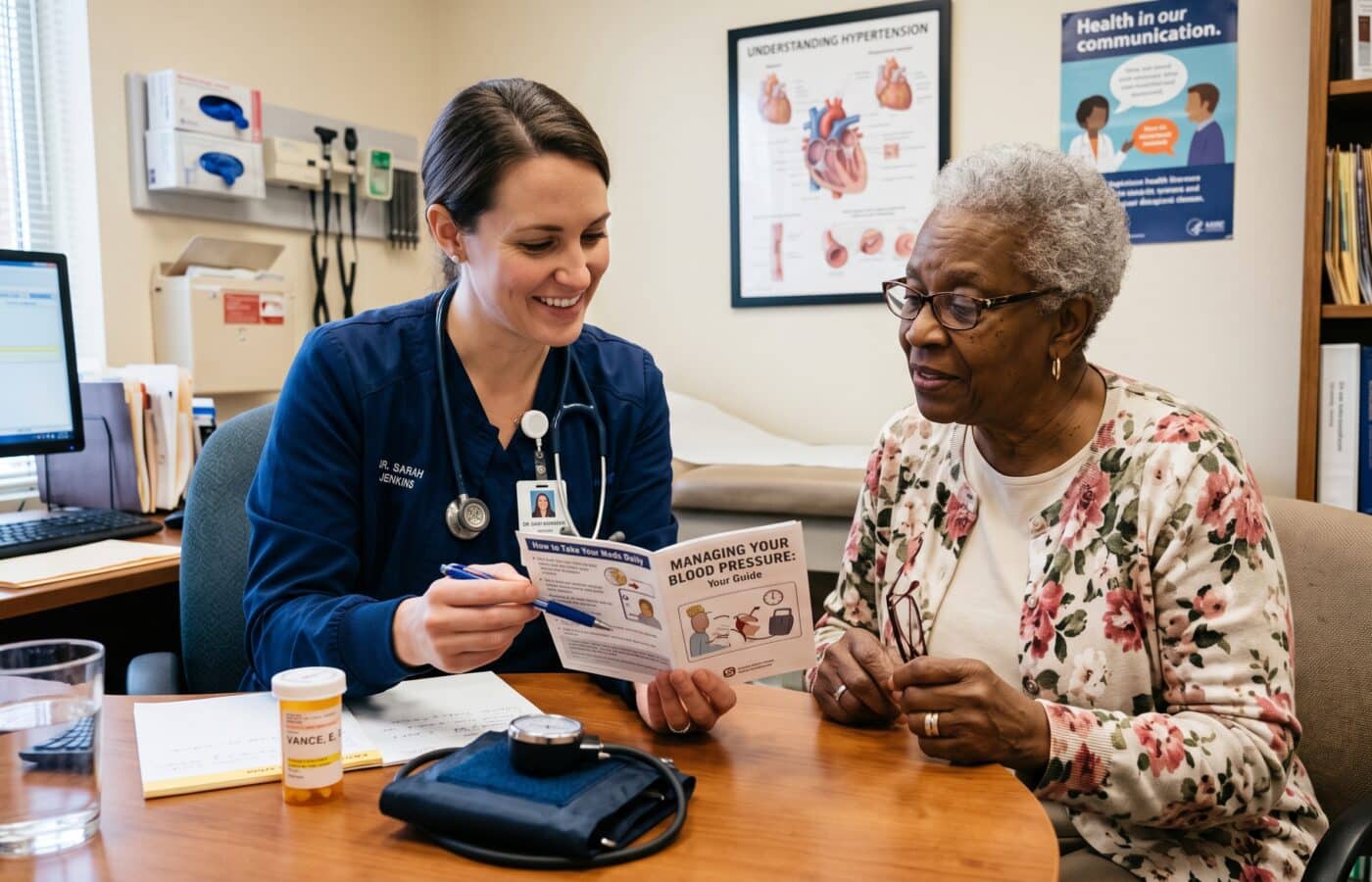
The teach back method checks understanding by asking patients to state in their own words what they need to know or do about their health. It is not “Do you understand?” and it is not “Can you repeat that?” Instead, it sounds more like this: “I want to make sure I explained this clearly. When you get home tonight, how are you going to take this new medicine?”
Notice the framing. Here, the burden sits with the clinician. AHRQ makes this point directly: teach back is not a test of the patient’s knowledge, but a test of how well you explained the concept. As a result, patients feel less quizzed or judged.
When teach back reveals a gap, do not simply repeat yourself louder. If it uncovers a misunderstanding, explain things using a different approach and ask the patient to teach back again. For example, draw a picture, use the actual pill bottle, or show them on their own phone where the portal message will appear.
Why the Evidence Supports It
The research behind this technique is strong. In a landmark study of diabetic patients with low health literacy, physicians who used interactive communication to assess recall or comprehension had patients with better glycemic control. Besides, teach back is faster than most clinicians fear. Once it becomes habit, it adds very little time, and it actually saves time downstream by preventing the phone calls, errors, and return visits that come from confusion.
2. Chunk and Check
A close cousin of teach back is the practice of breaking information into small pieces. Specifically, AHRQ recommends you chunk out information into small segments and have your patient teach it back as you go, rather than saving everything for the end of a visit.
In practice, I coach clinicians to limit any visit to two or three key messages. What is the problem? What do you need to do? Why does it matter? Everything else can go in writing, on the after visit summary, or into a follow up call. After all, when we pour fifteen instructions into a ten minute appointment, we are not being thorough. We are simply guaranteeing that the most important point gets lost.
3. Speak in Living Room Language
Clinical vocabulary is so familiar to us that we stop hearing it. Think of words like “benign,” “negative result,” “hypertension,” “NPO after midnight,” “ambulate,” and “titrate.”
I keep a running list of words that confuse patients, and “negative” is near the top. For most people, negative means bad. Consequently, telling someone their biopsy was negative can trigger panic before you finish the sentence. Say “The test found no cancer” instead.
A few practical habits help:
- Choose common words, such as “high blood pressure” instead of “hypertension,” or “swelling” instead of “edema.”
- Keep sentences short, ideally with one idea per sentence.
- Focus on what to do, not on the biology, because patients need the action more than the mechanism.
- Avoid acronyms entirely unless the patient used them first.
None of this is “dumbing down.” On the contrary, plain language is clear language for busy, stressed, distracted people, which describes every one of us in a medical setting.
4. Fix Your Written Materials
Most patient handouts I review were written by experts, for experts, and then photocopied for a decade. As a result, they are dense, they bury the main message, and they often read like legal disclaimers.
The best tool I know for fixing this is free. The CDC Clear Communication Index is a research based tool with four introductory questions and 20 scored items drawn from communication science, representing the characteristics that most improve people’s understanding of information. In addition, it helps communicators assess materials across seven areas: main message and call to action, language, information design, state of the science, behavioral recommendations, numbers, and risk.
When I run a materials audit, I start with three questions drawn from that framework. First, what is the one thing we want the reader to do, and is it in the first few lines? Second, could a stressed person on a phone screen find it in five seconds? Finally, are we using numbers the reader can actually use?
After that, I test the material with real patients before we print it. Not staff, and not physicians, but patients. You will be amazed what they catch.
5. Handle Numbers With Extra Care
Given that so few adults show proficient numeracy, every number in a patient interaction deserves scrutiny. Here are habits that consistently help:
- Use whole numbers instead of percentages when possible. “About 1 in 10 people” is easier to grasp than “a 10% risk.”
- Keep the same denominator when comparing risks, because switching from “1 in 100” to “5 in 1,000” confuses almost everyone.
- Do the math for the patient. Rather than writing “Take 0.5 mL per kilogram,” write “Give 4 mL. Use the syringe that came with the medicine.”
- Pair numbers with pictures. Icon arrays, simple charts, and color coded dosing schedules can carry meaning that numbers alone cannot.
6. Make the Whole System Easier to Navigate
Health literacy is not only about conversations in the exam room. In fact, it lives in every part of the patient journey.
So walk through your own system as if you were a new patient. Call the main number and count the menu options before you reach a human. Next, look at the intake forms and notice whether you ask for the same information three times. Then try finding the radiology department from the parking garage, and finally log into the patient portal on a basic phone with a weak connection.
Every point of friction is a place where someone with limited time, skills, or energy will give up. Organizational health literacy, therefore, means removing those friction points on purpose. Clear signage, simplified forms, staff who offer help proactively, and portals tested with real users all count. It is the same work that removes the wider barriers to accessible healthcare.
7. Respect Language and Culture
Health literacy and language access are tightly linked, but they are not the same thing. A patient can be fluent in English and still have limited health literacy. Conversely, a patient with limited English proficiency may have excellent health literacy in their own language.
Use qualified medical interpreters, not family members, and especially not children. Likewise, translate materials professionally and then test them with native speakers from the community you serve, because direct translations often miss cultural meaning. A food guide built around foods your patients never eat will not change anyone’s diet.
Cultural humility matters too. Patients bring beliefs about illness, medicine, family decision making, and trust in institutions. For this reason, asking “What do you think is causing this?” or “Who helps you make health decisions at home?” can reveal more than any literacy screening tool.
8. Create a Shame Free Environment
People with limited health literacy are often very good at hiding it. Over the years, they develop coping strategies such as “I forgot my glasses,” “I’ll read this at home,” or “My daughter handles that.”
Shame keeps people quiet, so the environment has to make asking questions feel normal. Some clinics hang signs that say “Ask us anything. We want you to understand.” Others train front desk staff to offer help with forms to everyone, without singling anyone out. Meanwhile, many clinicians open every visit with a simple statement: “Many of my patients find this confusing, so please stop me anytime.”
Small signals, repeated often, change the culture of a practice, and they are among the simplest ways to improve patient satisfaction.
9. Train Everyone, Not Just Clinicians
The person at the front desk, the scheduler on the phone, the pharmacy technician, and the billing specialist all shape a patient’s understanding. Accordingly, AHRQ is explicit that all staff who interact with patients should use teach back.
Some practices have gotten creative with keeping momentum going. For instance, one suggestion from the AHRQ implementation guide is to designate a day of the week to emphasize teach back, such as “Teach Back Tuesdays,” which builds awareness as the method becomes part of the practice’s culture. It sounds a bit gimmicky until you see it work.
10. Measure What You Change
Improvement without measurement is just activity. Instead, pick one or two things to track. How often do clinicians use teach back, based on observation? How do patients rate the clarity of discharge instructions on your patient experience surveys? Are readmissions or missed appointments shifting after you redesign a process?
Fortunately, AHRQ’s toolkit includes observation forms and improvement planning worksheets. Start small, test one change, watch what happens, and adjust. That approach respects the reality of busy practices far more than a giant overhaul ever could.
A Word About Digital Health Literacy
The old literacy studies were conducted before smartphones, patient portals, telehealth, remote patient monitoring, and AI symptom checkers became part of everyday care. Today, however, health literacy increasingly includes digital skills: logging in, finding a lab result, joining a video visit, and judging whether a website or social media post is trustworthy.
This layer adds new risks. For example, a patient who could follow a printed instruction sheet may be completely lost when the same information lives behind a password, a verification code, and a menu labeled “Clinical Summaries.” Older adults, rural residents, and people with low incomes are especially likely to be left behind, which is why hands-on setup help and the right assistive technology for seniors matter so much.
So when you move a service online, keep a human path available. Offer portal setup help in person, and send critical results with a phone call, not just a portal notification. Above all, apply the same plain language standards to digital content that you would apply to print.
Where to Start If You Only Have One Week
I know most providers reading this are already stretched thin. With that in mind, here is a realistic starting plan.
- Monday: Have every clinician use teach back with their last two patients of the day. Just two.
- Tuesday: Pull your three most frequently used patient handouts and score them using the CDC Clear Communication Index.
- Wednesday: Call your own main phone number and note every point of confusion.
- Thursday: Ask five patients in the waiting room what confuses them most about your practice, and write down exactly what they say.
- Friday: Meet with your team for twenty minutes, share what you found, and pick one thing to fix next month.
That is it. No consultant, no budget, and no new software. Ultimately, health literacy improvement is built from small, repeated, visible changes.
Final Thoughts on Health Literacy
I think often about that patient taking his diabetes medication only with lunch. In reality, he did exactly what the handout told him. Careless he was not, and unintelligent he was not. Instead, he was a reasonable person following unclear instructions within the limits of his life.
That is what health literacy work really asks of us. We need to stop treating confusion as a patient problem and start treating clarity as a professional obligation. In practice, that means checking understanding instead of assuming it, and designing for the person having the hardest day in our building.
Health literacy is not a soft skill or a nice extra. Rather, it is a safety practice, an equity practice, and a quality practice. Best of all, it is one of the few improvements in health care that costs almost nothing to begin.
Frequently Asked Questions About Health Literacy
What is health literacy in simple terms?
Health literacy is a person’s ability to find, understand, and use health information and services to make decisions about their health. In addition, Healthy People 2030 defines organizational health literacy, which is how well health organizations make that information easy to find, understand, and use. Learn more from Healthy People 2030.
How many adults have limited health literacy?
According to the national adult literacy assessment, only about 12 percent of U.S. adults have proficient health literacy. As a result, most adults have difficulty with at least some health information. See the NCES report.
Why is health literacy important for patient safety?
Limited health literacy is linked to medication errors, more hospitalizations, more emergency visits, and poorer health outcomes. For example, research on prescription labels shows that many patients can read instructions but still cannot follow them correctly. Read the Annals of Internal Medicine review.
What is the teach back method?
Teach back is a way of confirming understanding by asking patients to explain, in their own words, what they need to know or do. Importantly, it tests the clarity of the explanation, not the patient. See AHRQ Tool 5.
How can healthcare providers improve health literacy?
Providers can use teach back, speak in plain language, limit each visit to a few key messages, simplify written materials, handle numbers carefully, use qualified interpreters, and train all staff. The AHRQ Health Literacy Universal Precautions Toolkit is a free place to start.
Is there a tool to check whether health materials are easy to understand?
Yes. The CDC Clear Communication Index scores materials on 20 research based items covering the main message, language, design, numbers, and risk. You can access it at the CDC Clear Communication Index.
References
- Office of Disease Prevention and Health Promotion. Health Literacy in Healthy People 2030. https://odphp.health.gov/healthypeople/priority-areas/health-literacy-healthy-people-2030
- Office of Disease Prevention and Health Promotion. Health Literacy: Social Determinants of Health Literature Summary. https://odphp.health.gov/healthypeople/priority-areas/social-determinants-health/literature-summaries/health-literacy
- National Institutes of Health. Clear Communication: Health Literacy. https://www.nih.gov/institutes-nih/nih-office-director/office-communications-public-liaison/clear-communication/health-literacy
- Kutner M, et al. The Health Literacy of America’s Adults: Results From the 2003 National Assessment of Adult Literacy. National Center for Education Statistics. https://nces.ed.gov/pubs2006/2006483.pdf
- Proceedings of the Surgeon General’s Workshop on Improving Health Literacy, Panel 1. NCBI Bookshelf. https://www.ncbi.nlm.nih.gov/books/NBK44260/
- Michigan State University Extension. National Measures of Health Literacy. https://www.canr.msu.edu/news/national_measures_of_health_literacy
- Berkman ND, Sheridan SL, Donahue KE, Halpern DJ, Crotty K. Low Health Literacy and Health Outcomes: An Updated Systematic Review. Annals of Internal Medicine, 2011. https://www.acpjournals.org/doi/abs/10.7326/0003-4819-155-2-201107190-00005
- Davis TC, Wolf MS, Bass PF, et al. Literacy and Misunderstanding Prescription Drug Labels. Annals of Internal Medicine, 2006. https://pubmed.ncbi.nlm.nih.gov/17135578/
- Vernon JA, Trujillo A, Rosenbaum S, DeBuono B. Low Health Literacy: Implications for National Health Policy. George Washington University, 2007. https://hsrc.himmelfarb.gwu.edu/cgi/viewcontent.cgi?article=1173&context=sphhs_policy_facpubs
- Schillinger D, Piette J, Grumbach K, et al. Closing the Loop: Physician Communication With Diabetic Patients Who Have Low Health Literacy. Archives of Internal Medicine, 2003. https://jamanetwork.com/journals/jamainternalmedicine/fullarticle/214905
- Agency for Healthcare Research and Quality. Use the Teach Back Method: Tool 5. https://www.ahrq.gov/health-literacy/quality-resources/tools/literacy-toolkit/healthlittoolkit2-tool5.html
- Agency for Healthcare Research and Quality. Health Literacy Universal Precautions Toolkit, 3rd Edition. https://www.ahrq.gov/sites/default/files/publications2/files/health-literacy-universal-precautions-toolkit-3rd-edition.pdf
- Agency for Healthcare Research and Quality. Implementing the Health Literacy Universal Precautions Toolkit. https://www.ahrq.gov/sites/default/files/wysiwyg/professionals/quality-patient-safety/quality-resources/tools/literacy-toolkit/impguide/healthlit-guide.pdf
- Centers for Disease Control and Prevention. The CDC Clear Communication Index. https://www.cdc.gov/ccindex/index.html
- CommunicateHealth. Other Things We Love: National Assessment of Adult Literacy. https://communicatehealth.com/wehearthealthliteracy/other-things-we-%E2%9D%A4-national-assessment-of-adult-literacy/
- The Hospitalist. Recognizing and Addressing Health Literacy Barriers. https://www.the-hospitalist.org/hospitalist/article/39923/patient-care/recognizing-and-addressing-health-literacy-barriers/