


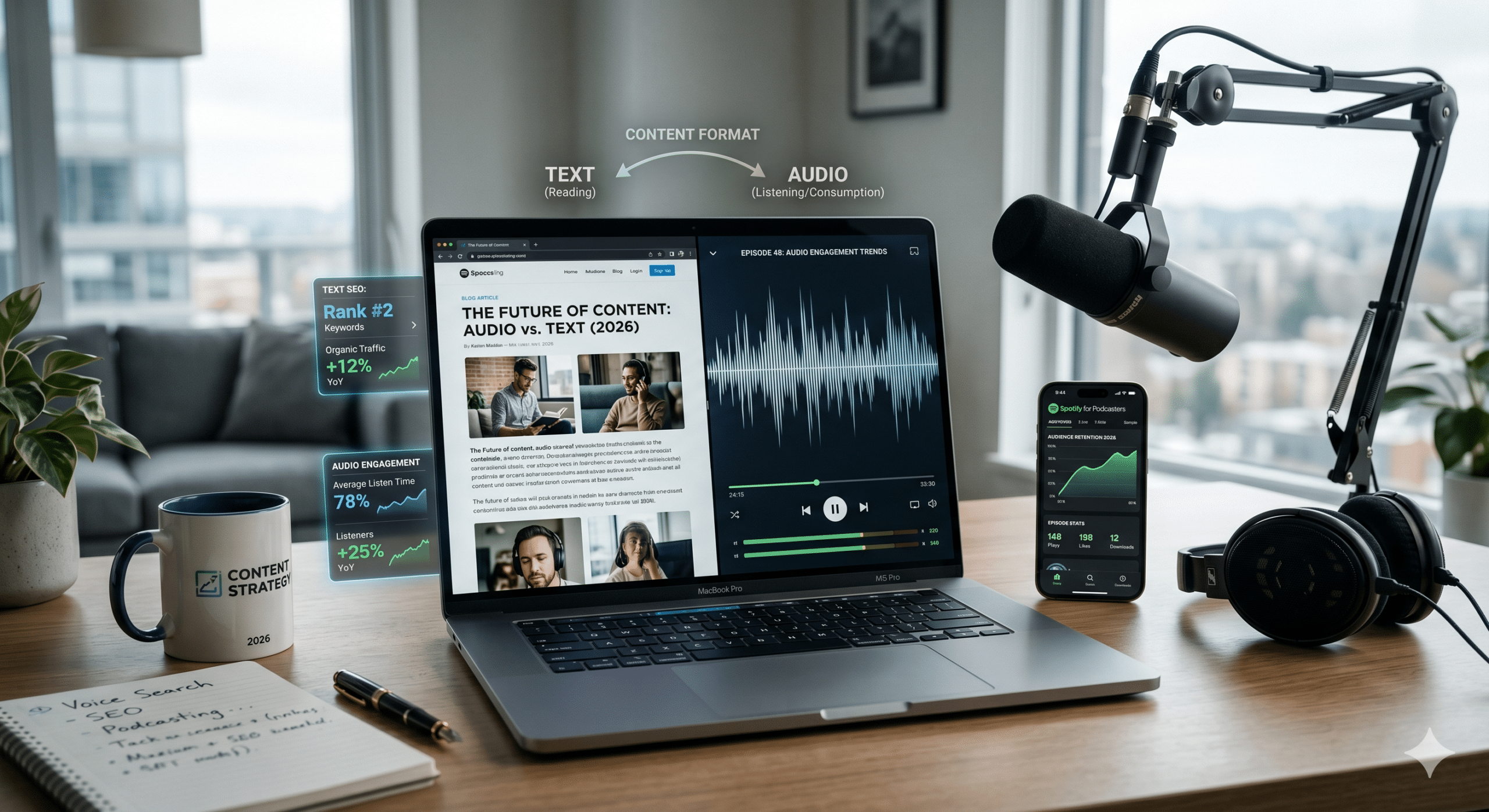
Content formats are evolving quickly, and creators are no longer choosing between one medium or another—they are building ecosystems. As highlighted in The Future of SEO and Content Marketing in 2026, modern content strategies now extend beyond traditional text to include audio, video, and multi-channel experiences.
The answer is not as simple as picking a winner. Each format serves a different purpose, audience behavior, and stage in the user journey. In this expert guide, you will learn how audio and text compare across engagement, SEO, scalability, and conversions—and how to use both effectively.
What Is Audio Content?
Audio content includes any form of spoken information delivered through digital channels. This includes:
- Podcasts
- Audio articles
- Voice-based content
- Text-to-speech conversions
- Streaming audio experiences
Audio allows users to consume information without needing to look at a screen, making it ideal for multitasking.
What Is Text Content?
Text content refers to written material published online, such as:
- Blog posts
- Articles
- Guides and tutorials
- Product descriptions
- Email content
Text has been the foundation of digital content for decades and remains essential for SEO and information clarity.
Audio vs Text Content: Key Differences
Understanding how these formats differ helps you choose the right approach.
Consumption Behavior
- Audio: Passive, multitasking-friendly
- Text: Active, requires focus
Accessibility
- Audio: Ideal for users on the go or with visual limitations
- Text: Easier for quick scanning and reference
Engagement Style
- Audio: Emotional and immersive
- Text: Informational and structured
Speed of Consumption
- Audio: Slower but more immersive
- Text: Faster for skimming and scanning
Engagement: Which Format Performs Better?
When it comes to engagement, audio often has an advantage.
Why Audio Wins Engagement
- Creates a personal connection through voice
- Keeps users engaged longer
- Encourages deeper listening
Where Text Excels
- Quick answers and information retrieval
- Easy navigation and scanning
- Better for short attention spans
Key Insight: Audio builds depth, while text delivers speed.
SEO Impact: Audio vs Text Content
Search engine optimization remains a major factor in content strategy.
Text Content and SEO
Text content is highly indexable and easy for search engines to understand.
Benefits:
- Keyword optimization
- Structured headings
- Internal linking
- Fast indexing
Audio Content and SEO
Audio alone is not easily indexed, but when combined with transcripts, it becomes powerful.
Benefits:
- Increased dwell time
- Enhanced user experience
- Additional keyword opportunities through transcripts
Best Practice:
Always pair audio with a written transcript for maximum SEO value.
User Experience: Choosing the Right Format
User experience depends on context and intent.
When to Use Audio
- Long-form storytelling
- Educational content
- Interviews and discussions
- On-the-go consumption
When to Use Text
- Step-by-step instructions
- Technical documentation
- Quick answers
- Search-driven queries
Content Creation and Scalability
Audio Content Production
Audio production can require:
- Recording equipment
- Editing tools
- Voice talent or AI
However, AI tools have made audio creation faster and more scalable.
Text Content Production
Text is easier to produce and edit quickly.
Advantages:
- Faster updates
- Lower production cost
- Easier collaboration
Conversion and Business Impact
Audio Conversion Strengths
- Builds trust through voice
- Encourages loyalty and repeat engagement
- Effective for storytelling and brand positioning
Text Conversion Strengths
- Clear calls to action
- Easy to scan for key points
- Better for transactional content
Cost and Resource Comparison
| Factor | Audio Content | Text Content |
|---|---|---|
| Production Cost | Medium to High | Low to Medium |
| Time Investment | Higher | Lower |
| Scalability | Increasing with AI | Highly scalable |
| Editing Ease | Moderate | Easy |
Audience Preferences in 2026
User behavior is shifting toward flexibility.
- Many users prefer audio while multitasking
- Others still rely on text for quick information
- Hybrid consumption is becoming the norm
The Rise of Hybrid Content Strategy
The real opportunity lies in combining both formats.
Why Hybrid Wins
- Maximizes reach
- Improves accessibility
- Enhances SEO
- Increases engagement
Example Workflow
- Publish a blog post
- Convert it into audio
- Embed audio into the article
- Share across platforms
This approach ensures your content is accessible in multiple ways.
Best Practices for Combining Audio and Text
1. Add Audio to Blog Posts
Embedding audio increases time on page.
2. Use Transcripts
Transcripts improve SEO and accessibility.
3. Repurpose Content
Turn text into audio and vice versa.
4. Optimize for Both Formats
Use keywords in text and natural speech in audio.
Common Mistakes to Avoid
Ignoring One Format
Relying on only audio or text limits your reach.
Poor Audio Quality
Low-quality sound reduces credibility.
Overcomplicated Text
Dense content reduces readability.
Lack of Integration
Content should work together, not separately.
Future Trends: Audio vs Text Content
AI Integration
AI is bridging the gap between formats through automation.
Personalized Content
Users will receive content tailored to their preferences.
Voice Search Growth
Audio content will align with conversational queries.
Multi-Format Publishing
Content will be created once and distributed in multiple formats.
Which One Should You Choose?
The real question is not audio vs text content—it is how to use both effectively.
Choose Audio When:
- You want deeper engagement
- Your audience consumes content on the go
- You are building a personal brand
Choose Text When:
- You need SEO visibility
- Your content is technical or instructional
- Users need quick answers
Conclusion
In 2026, the debate between audio vs text content is no longer about choosing one over the other. The most successful strategies combine both formats to deliver a flexible, engaging, and accessible experience.
Audio builds connection and retention. Text drives discovery and clarity. Together, they create a powerful content ecosystem that supports both users and search engines.
If your goal is growth, visibility, and engagement, the answer is clear—use both strategically.