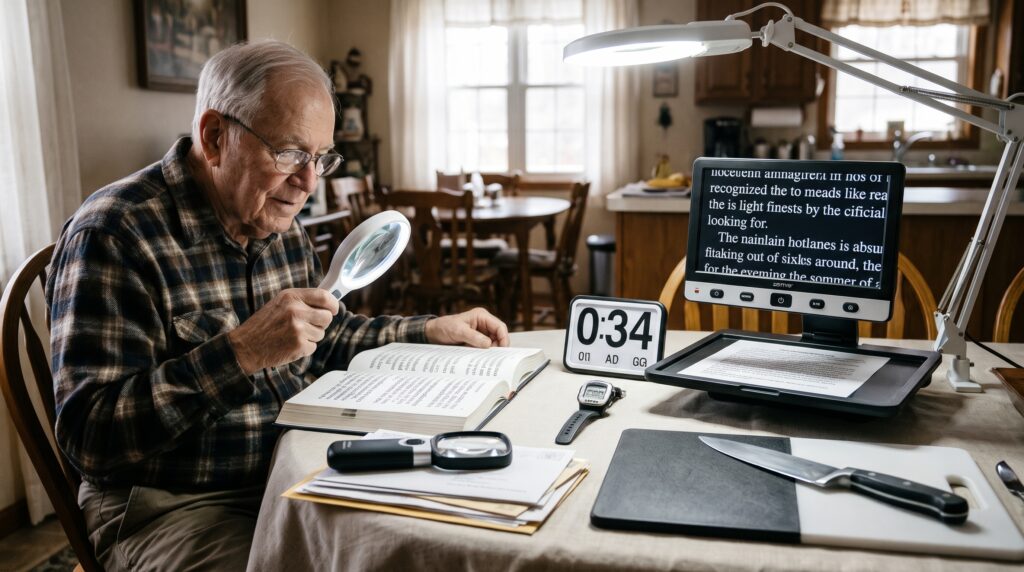
Most people who come to my low vision clinic for the first time have already heard the same sentence from another eye doctor: “There is nothing more we can do.” Usually, the doctor meant it kindly. In other words, they meant that no new glasses prescription, injection, or surgery would bring the person’s sight back to where it used to be. Even so, that sentence leaves out everything that low vision aids can do.
However, what the patient hears is very different. They hear that the morning newspaper is gone, the handwritten recipe cards are gone, and the job they spent twenty years building is probably gone too.
Where Low Vision Aids Begin to Matter
I have spent my career working on the other side of that sentence. As a low vision optometrist, my job starts where standard eye care leaves off. In fact, I am not trying to cure the eye disease at all. Instead, the retina specialist, the glaucoma surgeon, and the cornea team handle that part, and they do it well. My role, on the other hand, is to take whatever vision is left and help the person use it for the things they actually care about.
Low vision aids are a big part of how I do that. Some of these tools cost less than a takeout dinner, while others cost as much as a used car. Still, the best one is rarely the most expensive one. Rather, the best choice is the one that matches the task, the eye condition, and the person who will be using it every day.
So in this article, I will explain how I think about choosing low vision aids, what works for reading, cooking, and working, and why so many good devices end up forgotten in a kitchen drawer.
What Low Vision Actually Means
Low vision is not the same as blindness, and it is also not the same as needing stronger glasses. The National Eye Institute describes it as a situation where even with regular glasses, contact lenses, medicine, or surgery, people find everyday tasks difficult to do.
Most of my patients, therefore, still have some useful vision. For example, a person with macular degeneration might lose the center of their sight but still see well enough to the sides to walk through a parking lot. Meanwhile, someone with glaucoma might read the bottom of the eye chart but keep bumping into door frames because their side vision has narrowed. Similarly, diabetic retinopathy can leave scattered blurry patches that change from week to week.
Clearly, these are completely different problems, and so they need different solutions. That is the first thing I want every reader to understand. In short, there is no single “low vision device” that works for everyone.
The Numbers Behind Low Vision
The numbers are also bigger than most people expect. According to a report cosponsored by the National Institutes of Health, 2.9 million Americans are living with low vision. The number is projected to increase 72 percent by 2030 when the last of the baby boomers turn 65. Likewise, researchers at Johns Hopkins found that the number of new cases of low vision and blindness each year is estimated to more than double in 30 years.
Despite those numbers, very few people ever get help. In fact, federal health data shows that 4.3 percent of adults 18 years and over with visual impairment used vision rehabilitation services in 2017. That figure frustrates me more than any other statistic in my field, because the help really works when people actually get it.
Why I Always Start With the Question “What Do You Miss Doing?”
The first appointment in my office does not look like a regular eye exam. Of course, I check visual acuity, but I use special charts that measure much lower levels of vision than the standard chart on the wall. In addition, contrast sensitivity testing often tells me more about how someone functions in daily life than acuity alone. Next comes a map of the visual field. Finally, I look for blind spots near the center of vision and find out whether the person has started using a different part of the retina to look at things without realizing it.
Turning Goals Into a Prescription
Before any of that, though, I ask one question: “What do you miss doing?”
The answers are always specific. For instance, one person wants to read the music at church again. Another wants to see the numbers on the stove dial without bending down with a flashlight. Meanwhile, a bookkeeper wants to keep doing spreadsheets for three more years until retirement. And a grandmother wants to read bedtime stories without holding the book two inches from her face.
Those answers then become my prescription. Because low vision aids are task specific, a goal like “I want to see better” is too broad to work with. By contrast, “I want to read my mail and pay my bills by myself” is a goal I can build a plan around.
Low Vision Aids for Reading
Reading is the number one reason people come to see me. It is also, not surprisingly, the area where the right tool makes the biggest difference.
Optical Low Vision Aids
Optical aids use lenses to make things look bigger. Although they are the oldest category of low vision aids, they are still the backbone of my practice. All About Vision, in a guide reviewed by an optometrist, explains that optical aids like low vision magnifiers come in a range of options, including spectacles, handheld magnifiers and telescopes. Some are illuminated and some are not.
High powered reading glasses. These look like regular glasses but are much stronger than drugstore readers. In some cases, they include built in prisms that help both eyes work together at close range. The big advantage is that your hands stay free. However, the tradeoff is that you have to hold the page much closer than you are used to, sometimes only a few inches away. As a result, many people try them once, decide the distance feels wrong, and give up. Yet with a little coaching, a lot of those same people end up loving them.
Handheld magnifiers. These are great for short tasks like price tags, menus, and medicine bottles. Indeed, The Vision Council Foundation notes that they are very portable, versatile and economical. Their weakness, however, is long reading. After all, holding a magnifier steady at the right distance for twenty minutes is tiring, especially for someone with arthritis or a tremor.
Stand Magnifiers and Choosing the Right Power
Stand magnifiers. These sit right on the page, so the lens stays at the correct distance automatically. For that reason, I often recommend them for people with shaky hands or for anyone who wants to read a full letter rather than a single line. Many stand magnifiers also have a built in LED light, which helps more than people expect.
There is one thing I explain to every patient: stronger magnification is not always better. As the power goes up, the area you can see through the lens gets smaller, and you also have to hold it closer. Consequently, too much power means you see only two or three letters at a time, and reading turns into a slow, frustrating crawl. My goal, then, is to find the lowest power that lets someone read comfortably at the size of print they actually need.
Electronic Low Vision Aids and Video Magnifiers
Electronic magnifiers use a camera and a screen to enlarge print. For example, a desktop video magnifier, which many people still call a CCTV, places the reading material on a sliding tray under a camera, and the image then shows up on a large monitor. Portable versions, on the other hand, fit in a purse and work well for grocery labels, receipts, and restaurant menus. There are also wearable electronic magnifiers and smart glasses, a fast growing corner of wearable health devices.
The big advantage of electronic magnification goes beyond size, though. These devices let you change contrast. For many of my patients with glaucoma, cataracts, or retinal disease, reversing the display to white or yellow letters on a black background cuts down glare and makes reading much more comfortable. In addition, most units let you freeze the image, so you can snap a photo of a label on a high shelf and then read it up close.
Smartphone and Text to Speech Low Vision Aids
Some of my patients actually do better when they stop trying to read with their eyes and start reading with their ears. Text to speech devices and apps use a camera to scan printed text and read it aloud. This is especially helpful for someone with advanced macular degeneration, where even strong magnification makes reading slow. If you will be relying more on your ears, make sure your hearing is in good shape too. Over the counter hearing aids are now an affordable option for adults with mild to moderate hearing loss.
Moreover, the smartphone in your pocket may already be one of the best low vision aids you own. Both iPhone and Android phones include built in magnifier tools, screen zoom, large text settings, and screen readers. Likewise, free apps, many of them powered by artificial intelligence, can read printed text out loud, describe objects, and identify currency. As it turns out, I spend a lot of time in my exam room simply showing people settings that were on their phone the whole time. The same settings also make patient portals and telehealth visits much easier to use.
Finally, for readers who love books, the National Library Service for the Blind and Print Disabled lends talking books and playback devices free of charge to eligible people in the United States. Many of my patients tell me this program gave them back a hobby they had already mourned.
Lighting and Contrast: The Cheapest Low Vision Aids
If I could give every person with low vision just one thing, it would be a good lamp.
That is because aging eyes need far more light than younger eyes. Over time, the lens inside the eye gets cloudier, the pupil gets smaller, and so less light makes it to the retina. Add a retinal disease on top of that, and normal room lighting simply is not enough for close work. For this reason, a training lesson from the Older Individuals who are Blind Technical Assistance Center lists simple helpers such as reading stands, supplemental lighting, glare control sunglasses, typoscopes, and tactile locator dots.
Task Lighting Tips
Here is what I tell patients about task lighting:
- Use a flexible gooseneck lamp with an LED bulb.
- Place the lamp on the side of your better eye, angled so the light lands on the page and not in your eyes.
- Bring it closer than feels normal, since light gets weaker quickly as you move it away.
- Also try a few color temperatures, because some people prefer warm white light while others read better under cool daylight bulbs.
Controlling Glare and Boosting Contrast
Glare, meanwhile, is the other half of the lighting story. Many people with low vision are bothered by bright light from windows, glossy magazines, or white kitchen counters. In these cases, glare control filters, which are tinted lenses in amber, yellow, or plum shades, can sharpen contrast and make outdoor walking more comfortable. Similarly, a typoscope, which is a simple black card with a window cut out of it, blocks the glare from the white page around the line you are reading. It costs almost nothing, and yet it works.
Contrast matters for writing, too. For instance, bold lined paper and a thick black felt pen will help most people more than a regular ballpoint on thin blue lines.
Low Vision Aids for Cooking and the Kitchen
The kitchen is where I see a lot of fear. Family members worry about burns and cuts, and as a result, the person with vision loss often stops cooking quietly. They don’t stop because they want to, but because it starts to feel unsafe. Losing the ability to make your own meals is a real blow to independence. In my experience, it also often leads to poorer nutrition and more isolation. Some families also add a medical alert system for peace of mind when a parent lives alone.
Fortunately, most kitchen adaptations are cheap and simple.
Organize and Mark Everything
Organize first. Perkins School for the Blind puts it well in its first cooking tip: A place for everything and everything in its place. After all, when the salt is always in the same spot, you do not need to read the label.
Mark the dials. Raised bump dots are small adhesive bumps you can feel. For example, I suggest putting one on the “off” position of each stove knob and another at 350 degrees on the oven dial. That way, you can set the temperature by touch.
Use contrast on purpose. Cut onions on a dark cutting board, but cut chicken or dark vegetables on a light one. Likewise, pour coffee into a white mug and milk into a dark one. You can also put a strip of bright tape on the edge of the counter.
Kitchen Low Vision Aids That Use Sound and Touch
Let your ears and hands help. A liquid level indicator hangs on the edge of a cup and beeps when the liquid gets close to the top. In addition, talking kitchen scales, talking thermometers, and large print measuring cups are easy to find. A smart speaker, meanwhile, can set timers and read recipes aloud while your hands are busy.
Protect yourself. Long oven mitts that cover the forearm, a cut resistant glove for slicing, and knives stored in a block rather than loose in a drawer all lower the risk of injury.
Keep a magnifier in the kitchen. A small illuminated stand magnifier that lives near the stove makes package directions and oven settings much easier to check.
Beyond devices, I also recommend that people who are newly adjusting work with a vision rehabilitation therapist. These specialists come to the home, look at the actual kitchen, and then teach practical techniques that a device alone cannot teach.
Low Vision Aids at Work
Many of my patients are still working, and in many cases the fear of losing a job is what finally brings them into my office. That fear is understandable. Envision, a nonprofit vision rehabilitation center, reports that in 2023, the Bureau of Labor Statistics reported that 8% of individuals aged 16 to 64 with vision difficulties were unemployed, nearly double the rate for those without such challenges.
Thankfully, the tools to stay productive exist, and many are already built into the computer on your desk.
Low Vision Aids for the Computer and Office
Screen magnification. Windows has Magnifier, and Mac computers have Zoom. Both can enlarge the whole screen or just a portion that follows the mouse. Dedicated magnification software, in turn, offers more control, smoother text, and better pointer visibility.
Screen readers. For people who find long reading too tiring, a screen reader speaks the text on the screen instead. In practice, many of my patients combine the two, using magnification for layout and speech for long documents. Screen readers work best on sites built to accessibility standards, which is why ADA compliant websites matter so much.
Bigger monitors and better setups. A larger monitor on an adjustable arm lets the user bring the screen close without hunching over. That change alone can relieve neck pain and eye strain.
Distance tools. Similarly, a small handheld monocular telescope helps with reading whiteboards in meetings, signs in a warehouse, or a projected slide in a conference room.
Lighting and glare control. As the American Printing House for the Blind points out, a person with low vision may need accommodations regarding lighting in their immediate work area. Depending on specific visual needs, they may need more or less lighting.
Workplace Rights and Support
In the United States, the Americans with Disabilities Act requires many employers to provide reasonable accommodations. Furthermore, the Job Accommodation Network offers free, confidential guidance for both employees and employers, which is why it is the first resource I hand to anyone worried about their job. State vocational rehabilitation agencies can also sometimes help pay for devices and training for people who want to keep working or return to work.
My honest advice, therefore, is to have the conversation with your employer early, before performance slips. In my experience, employers are usually more flexible when they understand what is going on and see that the fix is a lamp, a monitor, and some software rather than a huge expense.
Low Vision Aids for Distance and Getting Around
Although reading is the top request in my clinic, distance vision matters too. Handheld telescopes, for example, help people read street signs, bus numbers, and menu boards. Some people also use telescopes mounted on their glasses to watch a grandchild’s soccer game or a play.
In some states, people with certain levels of vision can even qualify to drive using bioptic telescopes, which are small telescopes mounted in the top of a pair of glasses. However, the rules vary a lot from state to state, and the person needs training and evaluation. So this is a conversation to have with a low vision specialist and your state licensing office.
For peripheral vision loss, on the other hand, the approach changes completely. In fact, magnification can make things harder for someone with tunnel vision, because it shrinks what they can see even further. Instead, these patients usually do better with scanning training, careful lighting, and a referral to an orientation and mobility specialist who teaches safe travel techniques, including use of a white cane when appropriate.
Why Good Low Vision Aids End Up in a Drawer
Every low vision doctor has heard this story. A patient bought a magnifier online or at a pharmacy, used it twice, and then put it away because “it didn’t work.”
Common Reasons a Device Fails
Usually, though, the device was not the problem. Instead, the problem was one of these:
- Wrong power. If it is too weak, the print is still too small. On the other hand, if it is too strong, the view is tiny and jumpy.
- Wrong task. For example, a pocket magnifier is perfect for price tags but terrible for reading a novel.
- No training. Every optical device has a correct distance and technique. With high powered reading glasses, for instance, the page has to be very close. Likewise, with a handheld magnifier, you move the lens across the page rather than moving your head. These skills simply take practice.
- No eccentric viewing training. People with central vision loss often read better by looking slightly to the side of the word. Admittedly, this technique feels odd at first, but it can make a real difference with any device.
- The eye changed. Macular degeneration, glaucoma, and diabetic eye disease can progress. Consequently, a device that worked two years ago may need an update.
What the Research Shows
The research, in turn, supports structured care over guesswork. A resolution from the American Medical Association notes that vision rehabilitation with LVAs has been shown to have a positive impact on visual functioning in up to 45 to 50 percent of patients with low vision. In my experience, the people who see the best results are the ones who stay engaged in their care: they come back for follow up visits, practice at home, and tell me honestly what isn’t working.
What Do Low Vision Aids Cost?
Cost is one of the biggest barriers to accessible care, and I won’t pretend it isn’t. As All About Vision explains, Medicare does not cover costs associated with most low vision aids, so many Americans are forced to pay out of pocket for low vision services and devices. While the exam itself is often covered as a medical visit, the devices usually are not.
Even so, a few things help:
- Many clinics offer loaner devices so you can try something at home before buying.
- Simple aids like lamps, bump dots, bold pens, and typoscopes cost very little.
- Your smartphone or tablet may already do much of what an expensive device does.
- Veterans may qualify for comprehensive low vision services through the VA.
- State agencies, Lions Clubs, and other charitable groups sometimes help with costs.
Above all, I tell patients not to buy an expensive electronic device before a proper evaluation. Sadly, I have seen people spend thousands on equipment that did not fit their eye condition, when a much cheaper option would have worked better.
How to Find a Low Vision Specialist
According to the National Eye Institute, a low vision specialist is an ophthalmologist or optometrist who specializes in the care of patients with low vision. To find one, ask your current eye doctor for a referral, or look for university eye clinics, vision rehabilitation agencies, and doctors who list low vision care as a specialty.
Before your first visit, I suggest you:
- Make a list of the three to five tasks you most want to do again.
- Bring your current glasses and any magnifiers you already own, even the ones you gave up on.
- Gather samples of what you want to read, such as a pill bottle, a bank statement, or sheet music.
- Invite a family member, friend, or patient advocate if you can, since they often remember details you miss and can help with practice at home.
- Plan for a longer appointment than a typical eye exam, because a good low vision evaluation takes time.
A Final Word From the Exam Chair
The moment I look forward to most in my work is a quiet one. It happens when someone who has not read a full paragraph in a year finishes one in front of me, looks up, and doesn’t say anything for a second. Then, some of them laugh. Others cry a little. And now and then, a patient just asks, “Can I take this home today?”
Low vision certainly changes how you do things. However, it does not have to decide what you do. The right low vision aids, paired with good lighting, practical training, and a doctor who listens, can keep you reading, cooking, working, and living the way you want to live. For more everyday tools beyond the eye clinic, see our guide to assistive technology for seniors.
So if someone has told you there is nothing more to be done, I hope you will get a second opinion from a low vision specialist. In most cases, there is a lot more that can be done.
Frequently Asked Questions About Low Vision Aids
What are low vision aids?
Low vision aids are devices and techniques that help people make the most of their remaining sight. They include optical aids such as magnifiers and telescopes, electronic aids such as video magnifiers and text to speech tools, and simple non optical aids such as task lamps, bold pens, and bump dots. For a good overview of the main types, see the All About Vision magnifier guide.
Who should see a low vision specialist?
Anyone who still struggles with daily tasks after getting the best possible glasses, medical treatment, or surgery should consider a low vision evaluation. In fact, the National Eye Institute low vision guidance encourages people with low vision to seek guidance from a specialist.
Can I just buy a magnifier at the drugstore?
You can, and for small tasks it may help. For regular reading, however, a professional evaluation usually leads to a better match in power, style, and lighting. Otherwise, store bought magnifiers often end up unused because the power or technique is wrong for the person’s eye condition.
Does Medicare cover low vision aids?
In most cases, no. Medicare may cover the medical eye exam, but it usually does not pay for the devices themselves. The All About Vision guide to finding a low vision doctor explains coverage and also lists organizations that may help.
What low vision aids help most in the kitchen?
Bump dots on stove and oven dials, high contrast cutting boards, liquid level indicators, talking scales and thermometers, and good task lighting are some of the most useful. As a starting point, try the Perkins School for the Blind cooking tips.
Can I keep working with low vision?
Many people do. Screen magnification, screen readers, larger monitors, better lighting, and workplace accommodations make a big difference. In addition, the Job Accommodation Network and the APH CareerConnect employer guide both offer practical guidance.
How often should low vision aids be reevaluated?
Because many eye conditions change over time, I recommend a follow up at least once a year, or sooner if reading or daily tasks get harder. After all, a device that worked well last year may need a stronger power or a different approach now.
References
- National Eye Institute. Help for People With Vision Loss.
- National Institutes of Health. NEI Resources to Help People Adapt to Life With Low Vision.
- Chan T, et al. JAMA Ophthalmology. Estimated Incidence and Prevalence of Low Vision and Blindness in the United States.
- Healthy People 2030. Increase Use of Vision Rehabilitation Services by People With Vision Loss.
- American Medical Association House of Delegates. Resolution 807: Addressing the Need for Low Vision Aid Devices.
- All About Vision. Guide to Buying Low Vision Magnifiers.
- All About Vision. How to Find a Low Vision Doctor.
- The Vision Council Foundation. Low Vision Devices.
- American Academy of Ophthalmology. Home Adjustments for Low Vision.
- OIB Technical Assistance Center. Techniques for Maximizing Low Vision.
- Perkins School for the Blind. Eight Cooking Tips for People Who Are Visually Impaired.
- Envision. The Rising Need for Low Vision Rehabilitation.
- American Printing House for the Blind. Employer’s Guide to Accommodations for Blind and Low Vision Employees.
- Job Accommodation Network. Accommodating Cooks With Low Vision.
- Research to Prevent Blindness. Low Vision Resources.
You may also like
-
What Is Informed Consent? A Plain Guide for Patients and Families
-
Patient Rights: What Every Patient Should Know Before Their Next Visit
-
OTC Hearing Aids vs. Prescription: Which Is Right for You?
-
What a Patient Advocate Does, When You Need One, and How to Hire the Right One
-
Medical Alert Systems for Aging Parents: How to Choose One Your Parent Will Actually Use