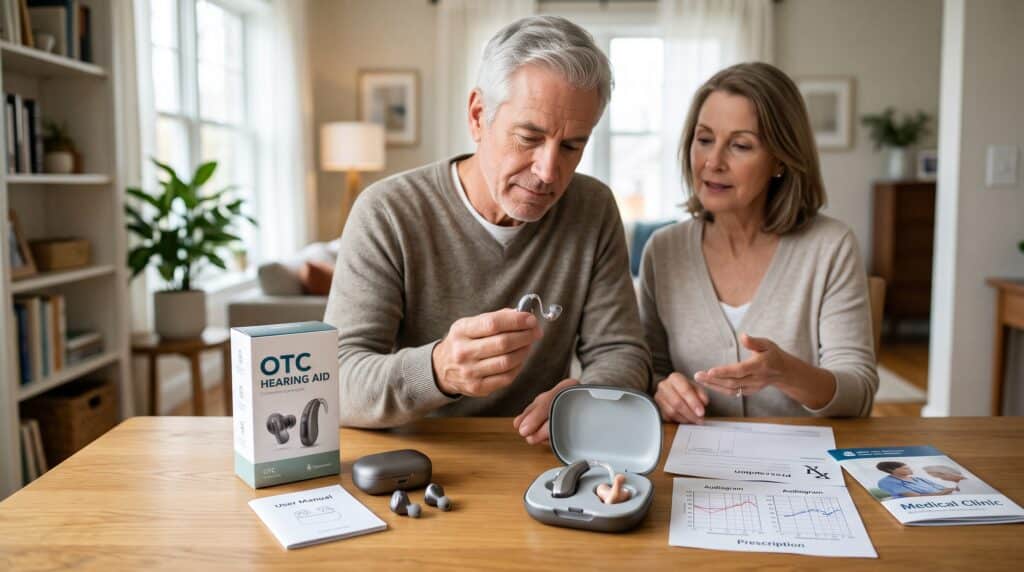
At least once a week, someone sits down across from me, sets a small retail box on my desk, and asks some version of the same question: “I bought these OTC hearing aids at the pharmacy. Did I waste my money?”
Sometimes the honest answer is no. They chose well, the devices fit their hearing, and they just want reassurance from someone who does this for a living. Other times the answer is harder to give. The box never had a real chance of helping them, and nobody told them that before they paid for it.
I have been testing ears and fitting hearing aids long enough to remember when the only path to a hearing aid ran through a clinic like mine. When the rules changed and OTC hearing aids arrived on store shelves, I was skeptical. I’m less skeptical now, but I’m more specific about who these devices are actually for. That’s what this article is about. No sales pitch in either direction, just the way I explain the choice to my own patients.
What Actually Changed With OTC Hearing Aids
In August 2022, the U.S. Food and Drug Administration finalized a rule that created a new category of over the counter hearing aids. The rule took effect on October 17, 2022. Since then, adults 18 and older with perceived mild to moderate hearing loss have been able to buy hearing aids online or in stores with no medical exam, no prescription, and no fitting appointment with a licensed professional.
That was a major change. Congress first passed the legislation in 2017, and it took the FDA years to write the rules. The agency built some guardrails into the final version. OTC hearing aids have a cap on maximum sound output, to protect people from overamplification. They must have a volume control the user can adjust. The rule also limits how deep a device can sit in the ear canal.
Two Types of OTC Hearing Aids
There are two broad kinds of OTC hearing aids on the market. The simpler kind works more or less straight out of the box, with a volume control and a few preset sound profiles to choose from. The more advanced kind is a self fitting device. It usually pairs with a smartphone app, often includes a built in hearing check, and adjusts itself to your results.
In September 2024, the FDA also authorized the first OTC hearing aid software: Apple’s Hearing Aid Feature for compatible AirPods Pro. A pair of earbuds many people already owned could now work as a self fitting hearing aid. I’ve seen a real increase in younger patients coming in because their earbuds suggested they might have a problem. Frankly, that’s a good thing.
The Most Important Word in the OTC Hearing Aids Rule: “Perceived”
Read the FDA language closely and one word stands out. OTC hearing aids are intended for people with perceived mild to moderate hearing loss.
Perceived is doing a lot of work there. The rule leaves it to you to judge how much hearing you’ve lost, and in my experience most people are poor judges of their own hearing. That isn’t a character flaw. Hearing loss usually comes on so gradually that the brain adapts. People turn the TV up a notch at a time. They start avoiding certain restaurants. Without noticing, they come to rely on a spouse to fill in what they missed.
When the rule came out, the hearing industry’s own trade group made the same point: most people with hearing loss don’t know whether theirs is mild, moderate, or worse. Some don’t know that the cause is something as simple as impacted earwax, which no hearing aid will fix.
I regularly test people who were sure their loss was mild and find it well into the moderately severe range. I also see the opposite: people convinced they need something powerful who turn out to have a mild loss and a speech clarity problem in noise that a small, affordable device can handle nicely.
So my first piece of advice is simple. You can buy OTC hearing aids without a hearing test. That doesn’t mean skipping the test is a good idea.
What Prescription Care Adds Beyond OTC Hearing Aids
Many people assume the difference between OTC and prescription comes down to the device. Sometimes it does. But more often the bigger difference is the care that comes with it.
Testing and Verification
A full diagnostic evaluation. That means more than tones in a booth. I look at your ear canals and eardrums, check how your middle ear is working, measure how well you understand speech, and often test how you do with speech in background noise. That last measure tells me a great deal about which technology will actually help you.
Verification with real ear measurement. This is the step I wish every consumer knew about. I place a very thin probe microphone in your ear canal alongside the hearing aid and measure what the device is actually delivering to your eardrum. Then I adjust it against a validated prescriptive target for your specific loss. Every ear canal has its own shape and acoustics, so two people with the same audiogram can need quite different settings. Without measurement, everyone is guessing, the professional included.
Fit, Range, and Follow Up Care
Physical fit options. Prescription devices can use custom earmolds, different receiver strengths, and dome styles chosen for your ear. That matters for comfort, feedback control, and how natural your own voice sounds.
Higher output and broader range. Prescription devices aren’t limited to mild and moderate loss. They serve every degree of hearing loss, including severe and profound.
Follow up and fine tuning. The first fitting is the beginning. Your brain needs weeks to adjust to sounds it hasn’t heard clearly in years. Most of my patients need two or three follow up visits before the settings feel right, plus cleanings and checks over the life of the device.
Counseling. This may be the most underrated part of the whole process. Learning to communicate well with hearing loss involves strategy, not just amplification: where to sit in a restaurant, how to use a remote microphone in meetings, how to help your family speak in a way you can follow.
Bundled vs. Unbundled Pricing
From a business standpoint, this is where hearing care has been changing. Many clinics, mine included, now offer unbundled pricing. You can pay separately for testing, fitting, and follow up services instead of paying one large bundled price that hides the cost of care inside the device. If you buy OTC hearing aids and want professional help adjusting or verifying them, ask the clinic whether it offers that as a standalone service. More of us do than people realize.
What the Research Says About OTC Hearing Aids vs. Prescription Outcomes
I’d rather point to evidence than just hand you my opinion, so here is where the science stands.
Early work out of Indiana University, published before OTC devices were even legal to sell, suggested that preset devices could produce benefit similar to audiologist fitted devices for older adults with mild to moderate loss. That research was a big part of the case for creating the category.
The strongest evidence so far is a randomized clinical trial from the University of Iowa, published in JAMA Otolaryngology Head and Neck Surgery in 2025. The researchers compared three approaches: hearing aids fitted by audiologists using best practices, a hybrid model where audiologists gave limited support with preset OTC style devices, and OTC style devices used independently. They also compared premium and basic technology, using devices with retail values of roughly $4,400 and $1,100 per pair.
What the Iowa Trial Found About OTC Hearing Aids
Here is what they found, in plain language:
- Audiologist fitted hearing aids produced the best outcomes. Participants in that group reported significantly higher benefit than either OTC group, and they tended to wear their devices more consistently.
- OTC still worked. Both OTC groups reported generally positive results. This was not a story of OTC hearing aids failing.
- A little professional help didn’t move the needle. The hybrid group with limited audiologist support didn’t do measurably better than the group on their own. That tells me the value comes from a complete, best practice fitting, not from a quick consultation.
- Premium technology didn’t beat basic technology for people with mild to moderate loss. The premium and basic devices produced similar outcomes.
Limits of the Research
There are limits to keep in mind. The OTC groups used preset profiles, not the newer self fitting devices that run their own hearing test and personalize settings. The study can’t speak for every product on the shelf. Still, coverage of the study in the American Speech Language Hearing Association’s journal The ASHA Leader summed up the takeaway well: whether patients used prescription or OTC devices, they did better when an audiologist was part of the process.
My own read? Professional care is what makes the difference. The price tag on the device itself matters far less than most people think.
The Honest Cost of OTC Hearing Aids vs. Prescription
Cost is the reason most people consider OTC hearing aids in the first place, and the concern is fair. Hearing aids have always been expensive, and untreated hearing loss often goes untreated precisely because of money.
OTC hearing aids today range widely. Basic preset models can cost a few hundred dollars per pair, and premium self fitting models can run toward the price of entry level prescription devices. Prescription hearing aids commonly cost several thousand dollars per pair, depending on technology level and on whether services are bundled in.
Insurance, Medicare, and Payment Options
Original Medicare does not cover hearing aids, and it doesn’t cover the exams for fitting them either. Many Medicare Advantage plans include some hearing benefit, so check your plan details carefully.
A diagnostic hearing evaluation is often covered by insurance even when the hearing aids are not. That makes testing first a fairly low cost step for many people.
OTC hearing aids may be eligible for HSA or FSA funds. Ask your plan administrator.
Return Policies on OTC Hearing Aids and Real Value
Return policies matter. The FDA doesn’t require OTC hearing aids to be returnable, but packaging must state the return policy. I tell people never to buy a pair without a reasonable trial window. Your brain needs time to adapt, and you need enough time to judge them in the places where you actually struggle.
Factor in the cost of a bad fit. A $400 pair that sits in a drawer isn’t cheaper than a $2,500 pair you wear every day. Once you count the years of use, the device you actually wear is almost always the better value.
FDA Red Flags: When to See a Doctor Before Buying OTC Hearing Aids
The FDA identifies a set of warning signs that mean you should see a physician, ideally an ear, nose, and throat specialist, before you try OTC hearing aids. Every OTC product label lists them. I want you to read them here too, because people tend to skim labels:
- A visible deformity of the ear or an injury to the ear
- Fluid, pus, or blood draining from the ear in the past six months
- Ear pain or discomfort
- A history of excessive earwax, or a suspicion that something is in your ear canal
- Dizziness or vertigo
- Sudden onset, rapid change, or fluctuation in your hearing in the past six months
- Hearing that is noticeably different between your two ears
- Ringing or buzzing in one ear only
Why Sudden Hearing Loss Is an Emergency
Number six deserves extra emphasis. Sudden hearing loss is a medical emergency. If you wake up one morning with dramatically worse hearing in one ear, don’t order a hearing aid. Call a doctor that day. Some cases of sudden hearing loss can be treated, but only if treatment starts quickly. I have seen people wait weeks because they assumed it was congestion, and lose the window for treatment.
A difference between your ears also needs a proper workup. Most of the time it’s benign. Occasionally it points to something that needs imaging, and only a medical evaluation can rule that out.
Who Is a Good Candidate for OTC Hearing Aids
In my experience, the people who do well with OTC hearing aids tend to share most of these traits:
They are adults whose hearing has changed slowly over years, not suddenly. Their loss is about the same in both ears. They can still follow conversation in a quiet room, but they struggle in restaurants, at family gatherings, or when someone talks from another room. Loud sounds aren’t painfully uncomfortable for them. They’re comfortable with a smartphone app and don’t mind experimenting with settings. They have good finger dexterity and eyesight for handling small devices and batteries or chargers. And none of the FDA red flags apply.
For that group, OTC hearing aids can be an excellent first step. I would much rather see someone start with an affordable device now than wait another five years for the “right time” to see a professional. The NIDCD estimates that only about one in four U.S. adults who could benefit from hearing aids has ever used them. Getting more people started earlier is a win, whatever the channel.
Who Should Skip OTC Hearing Aids and Go the Prescription Route
On the other hand, I steer people toward prescription hearing aids in several situations.
Medical and Hearing Factors
The loss is moderately severe or worse. OTC devices are output limited by design and may not provide enough amplification.
The patient is under 18. OTC hearing aids aren’t meant for children. A child’s hearing affects speech and language development, and pediatric fitting is a specialty for good reason.
Speech clarity is poor even when volume is adequate. Some people hear that someone is talking but can’t make out the words. Turning the volume up doesn’t solve that, and it takes careful fitting and often extra technology to help.
Tinnitus is a major concern. Many prescription devices include sound therapy features, and managing bothersome tinnitus works best with professional counseling.
Lifestyle and Technology Factors
Dexterity, vision, or memory are a challenge. Self fitting through an app assumes a certain level of comfort with technology. For many of my patients in their eighties, a professionally programmed device they simply put in each morning is the far better choice.
They have already tried OTC and it didn’t work. That isn’t a failure. It’s useful information. Often the problem is fit, settings, or a loss that turned out greater than they realized.
They need connectivity features like a telecoil for hearing loop systems, remote microphones for meetings or the classroom, or compatibility with a cochlear implant on the other side.
The Middle Path Between OTC Hearing Aids and Prescription Care
The choice is rarely all or nothing. The approach I recommend most often is this:
Step one: get a diagnostic hearing evaluation. This tells you, with real data, what kind and degree of loss you have and whether any red flags need medical attention. It turns “perceived” into “measured.”
Step two: decide with that information in hand. If the results show a mild to moderate loss that’s symmetrical and uncomplicated, OTC hearing aids may be a perfectly reasonable choice, and I’ll tell you so. Some clinics will even help you narrow down OTC products that suit your results.
Verifying OTC Hearing Aids and Retesting Over Time
Step three: if you go OTC, consider a verification visit. An audiologist can measure what your OTC devices are actually delivering in your ear canal and tell you whether they’re reaching appropriate targets. If they aren’t, you’ll know whether to adjust them, return them, or move to a prescription device.
Step four: retest periodically. Hearing changes. I suggest a hearing evaluation every year or two for adults with known hearing loss, or sooner if anything changes.
The American Academy of Audiology publishes consumer guidance on OTC hearing aids that follows a similar logic, and I’d encourage anyone shopping for devices to read it.
Why This Decision Matters More Than You Might Think
I want to close the clinical part of this discussion with the bigger picture, because hearing loss isn’t only about hearing.
The 2024 report of the Lancet Commission on dementia prevention listed hearing loss among 14 modifiable risk factors that together account for about 45 percent of dementia cases worldwide. The commission found the evidence that treating hearing loss lowers dementia risk to be stronger than in its earlier reports. It also noted that hearing aid use appeared especially effective for people with hearing loss who carried other risk factors as well.
The Bigger Picture for Patients and Families
I’m careful not to overstate this to patients. A hearing aid isn’t a guaranteed shield against cognitive decline. But untreated hearing loss pulls people away from conversation, from social life, and from the mental engagement that keeps the brain active. I have watched patients come back to life a little once they could follow the dinner table conversation again. Families notice it before patients do.
That’s why I don’t see OTC hearing aids as a threat to my profession. I see them as a new door. The worst outcome isn’t someone picking the “wrong” type of hearing aid. The worst outcome is someone doing nothing at all.
My Bottom Line
If you’re an adult with gradual, similar loss in both ears, no red flags, and you’re comfortable with a little technology, OTC hearing aids are a legitimate and often smart place to start.
If your loss may be more than moderate, your ears differ from each other, you have medical symptoms, or you simply want the best possible result, a prescription fitting from an audiologist using best practice verification is still the gold standard, and the research backs that up.
Either way, get your hearing tested. It’s the single step that makes either path work better, and it’s usually the least expensive part of the whole process.
Frequently Asked Questions About OTC Hearing Aids
Are OTC hearing aids as good as prescription hearing aids?
For many adults with mild to moderate loss, OTC hearing aids provide real benefit. The 2025 randomized clinical trial in JAMA Otolaryngology found that audiologist fitted devices produced better outcomes overall, but OTC users still reported generally positive results.
Do I need a hearing test before buying OTC hearing aids?
Legally, no. Practically, it’s a very good idea. A test confirms your loss falls in the mild to moderate range and checks for medical issues. The American Academy of Audiology’s consumer guide to OTC hearing aids recommends a professional evaluation as a starting point.
Who should not use OTC hearing aids?
Anyone under 18, anyone with more than moderate loss, and anyone with an FDA red flag such as ear drainage, pain, dizziness, or a sudden change in hearing. The FDA’s consumer page on OTC hearing aids explains who the category is meant for.
Does Medicare pay for OTC hearing aids or prescription devices?
Original Medicare doesn’t cover hearing aids or exams for fitting them. Some Medicare Advantage plans offer hearing benefits. See Medicare’s hearing aid coverage page for current details.
Can AirPods really work as a hearing aid?
Yes, for the right person. The FDA authorized Apple’s Hearing Aid Feature in 2024 as OTC hearing aid software for compatible AirPods Pro, intended for adults with perceived mild to moderate loss.
Can an audiologist adjust OTC hearing aids I already bought?
Many clinics now offer standalone services for OTC users, including verification and counseling. Whether a specific device can be adjusted depends on the manufacturer’s software, so call ahead and ask.
What happens if hearing loss goes untreated?
Beyond the communication strain, the 2024 Lancet Commission report on dementia identifies hearing loss as one of the leading modifiable risk factors for dementia, which is one more reason not to put off treatment.
References
- U.S. Food and Drug Administration. OTC Hearing Aids: What You Should Know
- U.S. Food and Drug Administration. FDA Authorizes First Over the Counter Hearing Aid Software
- Foley and Lardner LLP. Hearing Aids Become More Accessible to Consumers Under FDA Final Rule
- Wu YH, Stangl E, Branscome K, Oleson J, Ricketts T. Hearing Aid Service Models, Technology, and Patient Outcomes: A Randomized Clinical Trial. JAMA Otolaryngology Head and Neck Surgery, 2025
- HearingTracker. Audiologist Fitted Hearing Aids Deliver Better Outcomes Than OTC, Study Finds
- The ASHA Leader. Patients Do Better With Audiologist Involvement, Regardless of Hearing Aid Type
- National Institute on Deafness and Other Communication Disorders. Adult Hearing Health Care
- Livingston G, et al. Dementia Prevention, Intervention, and Care: 2024 Report of the Lancet Standing Commission. The Lancet, 2024
- Medicare.gov. Hearing Aids Coverage
- American Academy of Audiology. Consumers and OTC Hearing Aids
- Drug Topics. Preparing to Counsel Patients on OTC Hearing Aids
- UofL Health. Over the Counter (OTC) Hearing Aids
You may also like
-
Patient Rights: What Every Patient Should Know Before Their Next Visit
-
Low Vision Aids: Tools That Help People Keep Reading, Cooking, and Working
-
What a Patient Advocate Does, When You Need One, and How to Hire the Right One
-
Medical Alert Systems for Aging Parents: How to Choose One Your Parent Will Actually Use
-
How to Collect and Use Patient Feedback to Improve Care