

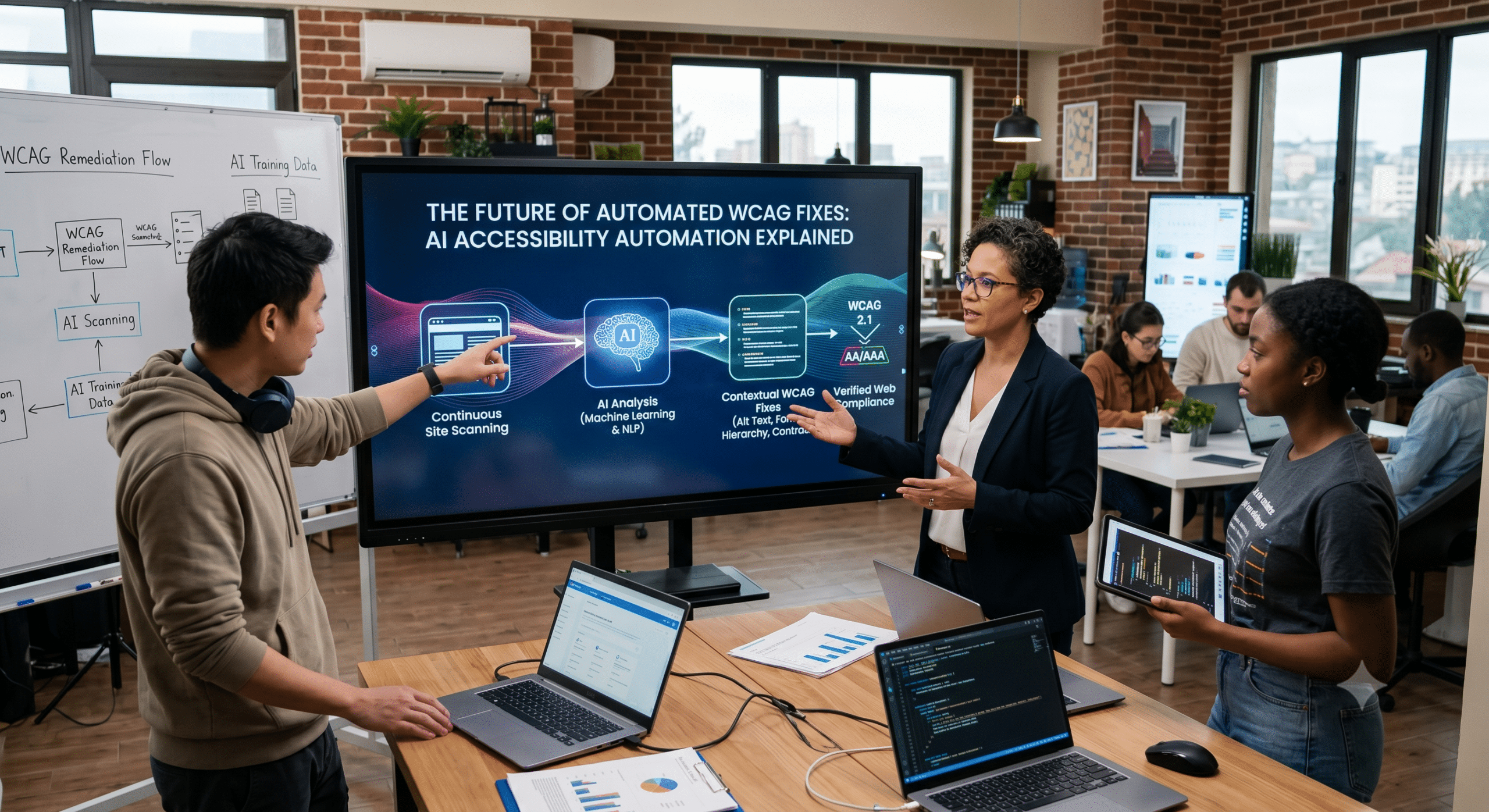
Digital accessibility has rapidly evolved from a technical consideration into a business necessity. Today, organizations across every industry are under increasing pressure to provide inclusive online experiences while simultaneously meeting growing compliance requirements. As a result, businesses are searching for faster, smarter, and more scalable ways to achieve accessibility compliance without overwhelming their development teams.
This shift explains why interest in automated WCAG fixes has surged over the past few years. Companies are no longer asking whether accessibility matters. Instead, they are asking how they can remediate accessibility issues efficiently, reduce legal exposure, and maintain compliance across complex digital ecosystems.
Furthermore, the rise of artificial intelligence is transforming how organizations approach accessibility remediation. Traditional manual remediation projects often require extensive audits, months of development work, and significant financial investment. By contrast, AI accessibility automation is helping organizations identify, prioritize, and resolve accessibility issues at a speed that was previously impossible.
From my experience working in accessibility automation and remediation initiatives, one thing has become increasingly clear. Organizations that embrace intelligent accessibility automation gain a substantial advantage over those that continue relying solely on manual processes. However, understanding where automation works, where human expertise remains essential, and how both can work together is critical for long-term success.
Why Accessibility Has Become a Business Priority
Only a few years ago, accessibility was often viewed as a niche technical requirement. Consequently, many organizations treated accessibility as a secondary concern that could be addressed later in the development cycle. Today, that mindset has changed dramatically.
Several factors are driving this transformation. First, digital experiences have become central to how businesses interact with customers. Whether someone is purchasing products, scheduling appointments, accessing healthcare services, applying for jobs, or consuming content, accessibility directly impacts their ability to engage with an organization.
Second, regulatory requirements continue to evolve worldwide. Organizations operating in the United States face growing ADA-related litigation, while companies serving customers in Europe must prepare for the European Accessibility Act. Therefore, accessibility compliance is no longer simply a best practice. It has become a legal and operational requirement for many businesses.
Most importantly, accessibility affects real people. Millions of individuals rely on screen readers, keyboard navigation, voice controls, magnification software, and other assistive technologies to access digital content. When websites fail to meet accessibility standards, they create unnecessary barriers that exclude users from participating fully in digital experiences.
Consequently, organizations are increasingly recognizing that accessibility is both a compliance obligation and a business opportunity.
The Growing Challenge of Manual Accessibility Remediation
Although accessibility audits are valuable, many organizations quickly discover that identifying issues is only the beginning of the journey.
After completing an audit, teams often receive reports containing hundreds or even thousands of accessibility violations. These issues may include missing alternative text, poor heading structures, insufficient color contrast, inaccessible forms, keyboard navigation failures, and improperly implemented ARIA attributes.
At first glance, fixing these issues may seem straightforward. However, large websites often contain hundreds of templates, thousands of pages, and countless user interactions. As a result, remediation projects can become extremely time-consuming.
Meanwhile, development teams are already balancing feature releases, security updates, performance improvements, and customer requests. Adding accessibility remediation to an already crowded backlog often delays progress significantly.
Furthermore, accessibility issues frequently reappear after updates or redesigns. Even after completing a major remediation effort, organizations may find themselves repeating the same process months later.
Therefore, many businesses have begun exploring AI accessibility automation as a more sustainable solution.
Understanding Automated WCAG Fixes
Simply put, automated WCAG fixes use artificial intelligence, machine learning, accessibility testing engines, and workflow automation to identify and remediate accessibility issues more efficiently.
Rather than requiring developers to manually inspect every page and correct each issue individually, automated systems can analyze entire digital properties at scale. Additionally, these systems can recognize recurring patterns, generate recommendations, and in some cases implement corrective actions automatically.
For example, an AI remediation platform might identify missing alternative text across thousands of images. Instead of requiring manual review of every image, the system can generate contextual descriptions and flag them for validation.
Similarly, automated systems can detect improper heading structures, identify form-labeling issues, validate ARIA implementations, and locate color contrast failures throughout an entire website.
As a result, organizations can dramatically reduce the amount of repetitive remediation work while improving overall accessibility performance.
Why Searches for Automated WCAG Fixes Are Increasing
The growing popularity of automated WCAG fixes is not happening by accident. Instead, it reflects several powerful market trends.
First and foremost, accessibility lawsuits continue to increase. Consequently, businesses are looking for proactive solutions that help reduce compliance risks before problems escalate.
At the same time, digital ecosystems are becoming more complex. Organizations now manage websites, mobile applications, customer portals, employee intranets, e-commerce platforms, and software products simultaneously. Therefore, manual accessibility management becomes increasingly difficult as digital assets expand.
Additionally, customers expect seamless digital experiences. When accessibility barriers prevent users from completing tasks, organizations risk losing revenue and damaging their reputation.
Furthermore, executive leadership teams are demanding greater operational efficiency. AI accessibility automation helps organizations achieve compliance objectives while controlling costs and improving scalability.
For these reasons, accessibility automation is quickly becoming a strategic investment rather than a purely technical initiative.
Accessibility Automation Versus Accessibility Overlays
One of the most common misconceptions in the accessibility industry involves confusing accessibility automation with accessibility overlays.
Although the terms are sometimes used interchangeably, they represent fundamentally different approaches.
Accessibility overlays typically rely on front-end scripts or widgets that attempt to modify user experiences after a page loads. These tools often promise instant compliance with minimal effort.
However, accessibility automation focuses on addressing underlying accessibility issues directly within the source code, content structure, and user interface architecture.
For example, an overlay may offer users customization options such as text resizing or color adjustments. While those features can be helpful, they do not necessarily correct missing labels, improper semantic markup, inaccessible forms, or keyboard navigation failures.
By contrast, AI-powered remediation tools seek to identify and resolve the root causes of accessibility barriers.
Therefore, organizations pursuing sustainable compliance should prioritize remediation strategies that improve the underlying accessibility of their digital properties rather than relying exclusively on surface-level adjustments.
How AI Accessibility Automation Works
Modern accessibility automation platforms combine several advanced technologies to streamline remediation workflows.
Initially, automated scanners continuously monitor websites and applications for potential accessibility violations. These scans evaluate pages against established WCAG success criteria and identify potential issues.
Next, machine learning models analyze patterns across the identified violations. Rather than treating every issue as unique, AI systems recognize common defects that appear repeatedly throughout a digital ecosystem.
For instance, if a specific component generates the same accessibility error across hundreds of pages, the platform can identify the source of the problem and recommend a scalable solution.
Subsequently, remediation engines may generate code recommendations, suggest corrective actions, or integrate directly into development workflows.
Meanwhile, accessibility teams can focus their attention on higher-level usability concerns and complex issues requiring human judgment.
As a result, organizations can significantly accelerate remediation efforts while maintaining quality and consistency.
Where Automated WCAG Fixes Deliver the Greatest Value
Although artificial intelligence continues to improve rapidly, some accessibility issues are particularly well-suited for automation.
For example, automated systems excel at identifying repetitive technical violations that follow predictable patterns. Missing image descriptions, invalid ARIA attributes, form association errors, heading structure problems, and contrast deficiencies are often excellent candidates for automated remediation.
Furthermore, AI systems can continuously monitor digital environments and detect accessibility regressions before they become widespread.
This proactive approach helps organizations maintain compliance over time rather than relying solely on periodic audits.
Additionally, automated remediation improves consistency across large digital ecosystems. Since the same logic is applied uniformly, organizations can reduce variations in how accessibility issues are addressed.
Consequently, accessibility teams spend less time fixing repetitive problems and more time improving overall user experiences.
Why Human Expertise Still Matters
Despite the impressive capabilities of modern AI systems, accessibility cannot be fully automated.
Accessibility involves understanding context, intent, language, usability, and human behavior. Therefore, certain aspects of accessibility require human judgment.
For example, AI may generate alternative text for an image. Nevertheless, determining whether that description accurately conveys the image’s purpose often requires human review.
Similarly, evaluating content clarity, cognitive accessibility, reading order, user expectations, and assistive technology experiences typically requires expert assessment.
Moreover, real users interact with websites in ways that automated testing tools cannot always predict.
For this reason, the most successful accessibility programs combine AI-powered automation with accessibility specialists, developers, designers, quality assurance teams, and user testing.
Rather than replacing accessibility professionals, automation enhances their effectiveness.
Creating a Sustainable Accessibility Strategy
Organizations that achieve long-term accessibility success rarely treat accessibility as a one-time project.
Instead, they integrate accessibility into every stage of the digital lifecycle.
From planning and design to development, testing, deployment, and ongoing maintenance, accessibility becomes part of standard operating procedures.
Additionally, accessibility monitoring continues long after a website launches. Continuous scanning, automated remediation, developer education, and periodic audits help ensure compliance remains consistent over time.
Furthermore, integrating accessibility into CI/CD pipelines allows organizations to identify and address issues before they reach production environments.
As a result, accessibility shifts from reactive remediation to proactive prevention.
This approach not only reduces compliance risks but also creates a more efficient and scalable accessibility program.
The Future of AI Accessibility Automation
Looking ahead, AI accessibility automation is expected to become even more sophisticated.
Future systems will likely provide deeper code analysis, improved contextual understanding, and more accurate remediation recommendations. Additionally, advances in large language models and intelligent development assistants may enable real-time accessibility guidance directly within coding environments.
Meanwhile, organizations will continue facing increasing regulatory expectations and user demands for inclusive digital experiences.
Therefore, businesses that invest in accessibility automation today will be better positioned to adapt to future requirements.
More importantly, these organizations will be able to deliver digital experiences that serve a broader audience while reducing operational burdens.
Ultimately, accessibility automation is not about finding shortcuts. Instead, it is about creating smarter workflows that allow organizations to scale accessibility efforts effectively and sustainably.
Final Thoughts
The rapid growth of automated WCAG fixes reflects a broader shift in how organizations approach accessibility compliance. Traditional remediation methods remain valuable. However, they often struggle to keep pace with the size and complexity of modern digital ecosystems.
Fortunately, AI accessibility automation is changing that reality.
By combining intelligent scanning, pattern recognition, automated remediation, and continuous monitoring, organizations can dramatically improve accessibility outcomes while reducing remediation costs and timelines.
At the same time, human expertise remains essential for evaluating usability, context, and real-world user experiences.
Therefore, the future belongs to organizations that successfully combine automation with accessibility expertise. Those businesses will not only meet compliance requirements more efficiently but will also create digital experiences that are truly inclusive for every user.
Frequently Asked Questions
What are automated WCAG fixes?
Automated WCAG fixes use artificial intelligence and accessibility automation tools to identify, prioritize, and remediate accessibility issues that violate WCAG standards.
Can AI make a website fully accessible?
No. Although AI can resolve many technical accessibility issues, human testing and expert review remain necessary for achieving comprehensive accessibility compliance.
Are automated WCAG fixes better than manual remediation?
The best approach combines both methods. Automation accelerates repetitive remediation tasks, while human experts validate usability, context, and accessibility quality.
Why are businesses investing in AI accessibility automation?
Businesses are investing in AI accessibility automation because it reduces remediation costs, accelerates compliance efforts, improves scalability, and helps manage growing regulatory requirements.
What accessibility issues can AI fix automatically?
AI can often address missing alt text, color contrast problems, heading structure issues, ARIA errors, form-labeling deficiencies, and other repetitive technical accessibility violations.
For your References and Further Reading section, I recommend replacing generic resource pages with actual high-authority blog articles that directly support your topic of AI Accessibility Automation, Accessibility Remediation, WCAG Compliance, and Automated WCAG Fixes.
These articles are more relevant, provide stronger E-E-A-T signals, and help readers continue learning after reading your article.
References and Further Reading
1. WebAIM – Ask AIMee: An Accessible Accessibility-Focused AI Chatbot
One of the most respected accessibility organizations discusses how AI is being used to support accessibility education and guidance while maintaining accessibility best practices. WebAIM is considered one of the most authoritative resources in the accessibility industry. (WebAIM)
Link: WebAIM Blog – Ask AIMee: An Accessible Accessibility-Focused AI Chatbot
2. Accessible.org – How AI Accessibility Remediation Works in Accessibility Tracker
A practical article explaining how AI translates accessibility audit findings into developer-friendly remediation guidance, helping teams close the gap between detection and implementation. (Accessible.org)
Link: How AI Accessibility Remediation Works in Accessibility Tracker
3. TestParty – AI Web Accessibility Remediation: How It Works
An in-depth technical guide explaining the difference between AI remediation architectures, source-code remediation, and accessibility overlays. Particularly valuable for organizations evaluating automation solutions. (TestParty)
Link: AI Web Accessibility Remediation: How It Works
4. AccessHawk – Integrating AI-Powered WCAG Scanning into Your CI/CD Pipeline
An excellent article for development teams looking to shift accessibility testing left and integrate automated WCAG scanning directly into DevOps workflows. (AccessHawk)
Link: Integrating AI-Powered WCAG Scanning into Your CI/CD Pipeline
5. Deque Systems – How Do You Measure Accessibility?
Deque is one of the most recognized accessibility companies globally. This article provides foundational knowledge about WCAG conformance levels and accessibility compliance measurement. (Deque)
Link: Deque Systems – Accessibility Compliance Guide
6. Research Study: Automated LLM-Based Accessibility Remediation
One of the most relevant academic studies on automated accessibility remediation. Researchers reported that LLM-powered remediation systems successfully fixed approximately 80% of identified accessibility issues on tested websites and 86% on Angular applications. (arXiv)
Link: Automated LLM-Based Accessibility Remediation Research Paper
7. Research Study: LLM-Based Web Accessibility Repair
A recent study evaluating the effectiveness of AI-generated accessibility fixes. The research found that AI can significantly reduce accessibility violations but still performs best when combined with rule-based validation and human review. (arXiv)
Link: LLM Based Web Accessibility Repair Research Paper
Best Three References for SEO and Authority
If you only want three references that provide the strongest authority signals for Google and readers, use:
- WebAIM Blog (WebAIM)
- Deque Accessibility Compliance Guide (Deque)
- Automated LLM-Based Accessibility Remediation Research Paper (arXiv)
These provide a strong combination of industry authority, practical implementation guidance, and academic research that aligns directly with your article’s focus on automated WCAG fixes and AI accessibility automation.