


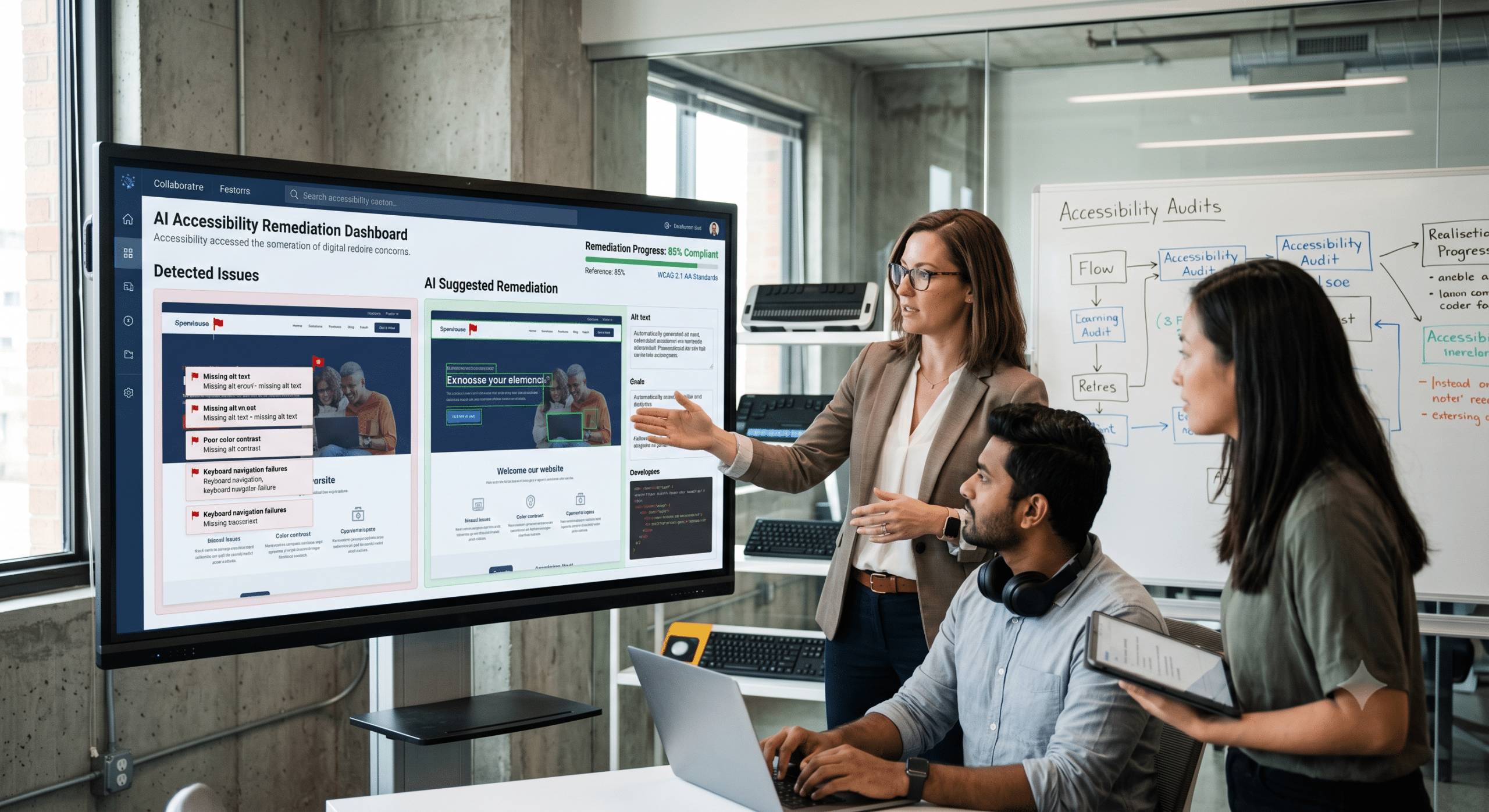
Digital accessibility has changed dramatically over the past few years. What was once considered a niche compliance initiative has now become a major business priority for organizations of all sizes. As companies continue to expand their digital presence, they are discovering that accessibility is no longer something that can be addressed once and forgotten. Instead, it requires continuous attention, ongoing monitoring, and a scalable strategy that can keep up with rapidly changing digital experiences.
At the same time, regulatory pressure is increasing around the world. Organizations must navigate accessibility requirements such as the Americans with Disabilities Act (ADA), Section 508, WCAG standards, and the European Accessibility Act (EAA). Consequently, many businesses are looking for faster and more efficient ways to achieve compliance without overwhelming their internal development teams.
This growing demand has fueled the rise of ai accessibility remediation, one of the most significant innovations in digital accessibility today.
As someone who has worked extensively in accessibility automation and remediation projects, I have witnessed firsthand how artificial intelligence is transforming compliance workflows. Traditional accessibility remediation often required weeks of audits, manual coding adjustments, extensive testing, and repeated quality assurance reviews. Today, however, intelligent automation can significantly reduce that burden while helping organizations maintain a higher level of compliance over time.
More importantly, AI is not replacing accessibility experts. Instead, it is empowering them to work more efficiently, focus on complex issues, and deliver better outcomes for users with disabilities.
Why Accessibility Has Become a Business-Critical Issue
Not long ago, many organizations viewed accessibility as a legal checkbox. While compliance was important, it was rarely treated as a strategic business initiative. However, that mindset has changed dramatically.
Today, websites, mobile applications, SaaS platforms, ecommerce stores, online banking systems, healthcare portals, and educational platforms serve millions of users every day. Because of this digital dependence, accessibility barriers can prevent individuals with disabilities from accessing critical services, making purchases, completing transactions, or consuming information.
As a result, businesses face more than just compliance concerns. They also risk losing customers, damaging their reputation, and limiting their market reach.
Furthermore, accessibility lawsuits continue to increase year after year. Organizations that fail to address accessibility issues often discover that remediation becomes significantly more expensive after legal action has already begun. Therefore, many companies are shifting toward proactive accessibility management rather than reactive compliance efforts.
Beyond legal considerations, accessibility offers substantial business benefits. Accessible websites often provide better usability, improved user engagement, stronger customer satisfaction, and enhanced search engine visibility. In other words, accessibility improvements frequently benefit every visitor, not just those with disabilities.
Understanding AI Accessibility Remediation
At its core, ai accessibility remediation refers to the use of artificial intelligence, machine learning, and automation technologies to identify, prioritize, recommend, and sometimes automatically correct accessibility issues within digital environments.
Traditionally, accessibility remediation followed a fairly predictable process. First, an accessibility audit identified compliance violations. Next, developers reviewed lengthy reports and implemented fixes. After that, quality assurance teams validated changes, and accessibility specialists conducted additional testing. Finally, organizations repeated the process until compliance goals were achieved.
Although this approach remains effective, it can become extremely time-consuming when applied to large websites or enterprise applications.
This is where AI introduces a significant advantage.
Instead of merely identifying accessibility violations, modern AI-powered solutions can analyze patterns, recognize recurring issues, generate remediation suggestions, prioritize fixes based on severity, and automate portions of the remediation workflow.
Consequently, organizations can resolve accessibility issues much faster while reducing operational costs and resource demands.
Moreover, AI can continuously monitor digital assets and detect new accessibility issues as they emerge. Therefore, businesses are no longer forced to rely solely on periodic audits that may only occur once or twice per year.
The Growing Demand for Accessibility Automation
The rapid growth of ai accessibility remediation is being driven by several powerful trends.
First, digital ecosystems are becoming increasingly complex. Modern websites often include dynamic content, third-party integrations, interactive applications, custom components, and AI-generated experiences. Because of this complexity, maintaining accessibility manually becomes increasingly difficult.
Second, development teams are expected to release new features faster than ever before. As organizations embrace agile development practices, accessibility often struggles to keep pace with accelerated release cycles. Therefore, automation provides a practical solution that helps integrate accessibility into continuous development workflows.
Third, accessibility regulations continue to expand globally. While organizations once focused primarily on ADA compliance, they now must consider additional requirements such as the European Accessibility Act and other international standards. Consequently, compliance teams are seeking scalable approaches that can support multiple regulatory frameworks simultaneously.
Finally, customer expectations continue to evolve. Today’s consumers expect digital experiences to be inclusive, accessible, and easy to use. As a result, accessibility has become an important component of overall customer experience strategy.
The Hidden Costs of Manual Remediation
Many organizations underestimate the true cost of accessibility remediation.
At first glance, fixing accessibility issues may appear relatively straightforward. However, the reality is often much more complicated.
A single enterprise website can contain thousands of pages, hundreds of templates, numerous integrations, and countless interactive elements. Consequently, accessibility violations can quickly accumulate across an organization’s digital ecosystem.
Developers must review audit findings, understand compliance requirements, implement code changes, and verify that fixes do not introduce new problems. Meanwhile, quality assurance teams must conduct extensive testing to ensure functionality remains intact.
In addition, accessibility specialists must validate compliance, provide guidance, and document remediation efforts. Project managers, content creators, designers, and stakeholders frequently become involved as well.
Because so many resources are required, manual remediation can become expensive very quickly.
Furthermore, accessibility is not a one-time project. New content, features, and updates can introduce fresh accessibility issues at any time. Therefore, organizations often find themselves trapped in an ongoing cycle of audits and remediation efforts.
By contrast, ai accessibility remediation helps automate repetitive tasks, streamline workflows, and reduce the overall burden on development teams.
What AI Can Automate Successfully
One of the most exciting aspects of ai accessibility remediation is its ability to automate many common compliance tasks.
For example, AI-powered systems can identify missing alternative text, detect improper heading structures, recognize form-labeling issues, locate color contrast problems, and identify semantic markup errors. Additionally, advanced platforms can analyze code patterns and suggest specific remediation actions.
In many cases, AI can automatically correct certain technical violations without requiring direct developer intervention.
Moreover, intelligent systems can prioritize issues based on user impact and compliance risk. As a result, organizations can focus their resources on addressing the most critical barriers first.
Another significant advantage involves consistency. Human reviewers may occasionally interpret issues differently depending on their experience or workload. AI systems, however, apply the same rules consistently across thousands of pages and components.
Consequently, organizations often achieve more predictable remediation outcomes.
Nevertheless, automation is not a complete replacement for human expertise.
Where Human Accessibility Experts Remain Essential
Despite impressive advances in artificial intelligence, accessibility remains fundamentally human-centered.
Although AI excels at identifying technical violations, it cannot fully understand human experiences, context, intent, or usability.
For example, an automated tool may confirm that an image contains alternative text. However, it cannot always determine whether that description accurately conveys the intended meaning.
Similarly, AI may recognize that headings are present on a page. Nevertheless, it may struggle to evaluate whether those headings create a logical and intuitive navigation structure.
Furthermore, cognitive accessibility, readability, user comprehension, and overall user experience often require human judgment.
Because of these limitations, successful accessibility programs combine automation with expert oversight.
Accessibility specialists provide context, validate AI-generated recommendations, perform manual testing, and ensure that remediation efforts truly improve user experiences rather than simply satisfy technical requirements.
Therefore, the most effective approach is not AI versus human expertise. Instead, it is AI working alongside accessibility professionals to achieve better results.
Why Continuous Accessibility Monitoring Matters
One of the biggest mistakes organizations make is treating accessibility as a project with a defined finish line.
In reality, accessibility is an ongoing responsibility.
Websites evolve constantly. New content is published daily. Applications receive updates weekly. Third-party integrations change frequently. Consequently, even organizations that achieve compliance today may encounter new accessibility issues tomorrow.
This is precisely why continuous monitoring has become such a critical component of modern accessibility programs.
AI-powered monitoring systems can scan websites continuously, identify emerging issues, and alert teams before compliance problems become widespread.
Moreover, automated monitoring provides visibility into trends, recurring problem areas, and overall compliance performance.
As a result, organizations can transition from reactive remediation to proactive accessibility management.
Ultimately, this proactive approach reduces risk, improves efficiency, and supports long-term compliance goals.
How AI Accessibility Remediation Supports ADA Compliance
For organizations operating in the United States, digital accessibility is closely connected to compliance with the Americans with Disabilities Act (ADA). Although the ADA does not specifically mention websites or mobile applications in its original text, courts have increasingly interpreted digital accessibility as part of providing equal access to services and information.
Because of this legal trend, organizations across nearly every industry are paying closer attention to their accessibility obligations.
Traditionally, companies often waited until they received a complaint, demand letter, or lawsuit before addressing accessibility concerns. Unfortunately, this reactive approach frequently resulted in rushed remediation projects, higher costs, and significant business disruption.
Today, however, businesses are taking a more proactive approach.
AI accessibility remediation enables organizations to identify and resolve accessibility issues before they become legal liabilities. Furthermore, automated monitoring systems help maintain ongoing compliance by continuously scanning digital properties for emerging issues.
As a result, businesses can demonstrate a stronger commitment to accessibility while reducing their exposure to legal risks.
More importantly, organizations that invest in accessibility often discover benefits that extend far beyond compliance. Improved usability, better customer experiences, and increased digital inclusivity frequently lead to stronger engagement and customer loyalty.
Therefore, ADA compliance should not be viewed solely as a legal requirement. Instead, it should be considered an opportunity to create digital experiences that serve all users effectively.
The European Accessibility Act Is Changing the Compliance Landscape
While ADA compliance remains a primary concern for many organizations, global accessibility regulations are becoming increasingly important.
The European Accessibility Act (EAA) represents one of the most significant accessibility developments in recent years. As implementation deadlines take effect, organizations serving European consumers must ensure that their digital products and services meet accessibility requirements.
Consequently, businesses operating internationally can no longer afford to treat accessibility as an optional initiative.
The EAA affects a wide range of industries, including ecommerce, banking, telecommunications, transportation, software platforms, and digital service providers. Because many organizations serve customers across multiple regions, compliance efforts often extend well beyond a single jurisdiction.
This growing complexity has accelerated demand for ai accessibility remediation solutions.
Instead of manually managing accessibility across multiple websites, applications, and digital services, organizations can leverage AI-powered platforms to identify compliance gaps, prioritize remediation activities, and maintain continuous oversight.
Furthermore, automation allows teams to scale accessibility efforts without dramatically increasing staffing requirements.
As regulations continue to evolve globally, businesses that embrace accessibility automation today will be better positioned to adapt to future compliance demands.
Why Accessibility Overlays Are Not a Long-Term Solution
As awareness of accessibility continues to grow, many organizations search for quick fixes that promise instant compliance.
Unfortunately, accessibility overlays are often marketed as simple solutions that can supposedly solve complex accessibility challenges with minimal effort.
While overlays may provide certain user interface enhancements, they do not address the underlying accessibility barriers within a website’s code, content structure, navigation, or functionality.
Consequently, many accessibility experts caution organizations against relying solely on overlays as a compliance strategy.
True accessibility requires meaningful remediation.
For example, if a form lacks proper labels, a navigation menu cannot be operated using a keyboard, or a website contains structural issues that confuse screen readers, these problems must be corrected at the source.
Simply placing an overlay on top of the website does not eliminate those underlying barriers.
By contrast, ai accessibility remediation focuses on identifying and fixing root causes rather than masking symptoms.
As a result, organizations can achieve more sustainable compliance outcomes while creating genuinely accessible experiences for users with disabilities.
Ultimately, accessibility should be built into the digital experience itself rather than added as an afterthought.
Building a Successful AI Accessibility Remediation Strategy
Implementing accessibility automation successfully requires more than simply purchasing software.
Instead, organizations should develop a comprehensive accessibility strategy that combines technology, expertise, governance, and continuous improvement.
The process typically begins with establishing a baseline understanding of current accessibility performance. Therefore, organizations should conduct comprehensive accessibility assessments that include automated testing, manual audits, assistive technology evaluations, and user experience reviews.
Once baseline findings are established, teams can prioritize remediation efforts based on risk, severity, and user impact.
At this stage, AI accessibility remediation platforms become particularly valuable. These solutions can help identify recurring issues, automate routine fixes, and provide actionable recommendations for developers.
Meanwhile, accessibility specialists can focus on validating results, resolving complex issues, and ensuring that remediation efforts align with both compliance standards and user needs.
Additionally, organizations should integrate accessibility directly into their development lifecycle.
Rather than waiting until projects are completed, accessibility checks should occur throughout design, development, testing, and deployment stages. Consequently, accessibility becomes a natural part of the workflow instead of a costly corrective process.
Most importantly, leadership support is essential.
When executives view accessibility as a strategic priority rather than a compliance burden, organizations are far more likely to achieve long-term success.
The Future of AI Accessibility Remediation
The future of accessibility automation is exceptionally promising.
As artificial intelligence continues to evolve, remediation platforms are becoming increasingly sophisticated. Machine learning algorithms can now recognize complex accessibility patterns, analyze large volumes of code, and generate increasingly accurate recommendations.
Furthermore, advancements in natural language processing are improving the ability of AI systems to evaluate content quality, readability, and user comprehension.
Computer vision technologies are also helping organizations better understand image accessibility and visual content requirements.
Meanwhile, predictive analytics is beginning to play a larger role in accessibility management. Rather than simply identifying existing issues, future AI systems may predict where accessibility problems are most likely to occur before they reach production environments.
As a result, organizations will be able to prevent many accessibility issues before users ever encounter them.
Nevertheless, technology alone will never guarantee accessibility.
Human expertise, inclusive design principles, user testing, and organizational commitment will continue to play critical roles in successful accessibility programs.
Therefore, the future of accessibility is not fully automated and it is not fully manual. Instead, it is a collaborative partnership between intelligent technology and experienced accessibility professionals.
Final Thoughts
The rapid growth of ai accessibility remediation reflects a broader shift in how organizations approach digital accessibility.
In the past, accessibility was often viewed as a reactive compliance exercise. Today, however, it has become an essential component of business strategy, customer experience, and digital inclusion.
At the same time, increasing ADA lawsuits, expanding global regulations, and growing user expectations have created new challenges for organizations seeking to maintain compliance at scale.
Fortunately, artificial intelligence is helping businesses address these challenges more effectively than ever before.
By automating repetitive tasks, accelerating issue detection, supporting continuous monitoring, and enhancing remediation workflows, AI accessibility remediation enables organizations to achieve stronger accessibility outcomes with greater efficiency.
However, the most successful organizations understand that technology is only part of the solution.
True accessibility requires ongoing commitment, expert oversight, inclusive design practices, and a genuine desire to create digital experiences that work for everyone.
Ultimately, businesses that invest in accessibility today are not simply reducing compliance risk. They are building stronger brands, expanding their audiences, improving customer satisfaction, and creating a more inclusive digital future.
As accessibility expectations continue to evolve, organizations that embrace ai accessibility remediation will be better prepared to meet regulatory requirements, support diverse user needs, and maintain a competitive advantage in an increasingly digital world.
Frequently Asked Questions
What is AI accessibility remediation?
AI accessibility remediation is the process of using artificial intelligence to identify, prioritize, recommend, and sometimes automatically fix digital accessibility issues on websites, applications, and digital platforms.
Why is AI accessibility remediation becoming popular?
Organizations are adopting AI accessibility remediation because manual remediation can be expensive, time-consuming, and difficult to scale. Additionally, increasing ADA lawsuits and European Accessibility Act requirements are driving demand for faster compliance solutions.
Can AI fix all accessibility issues automatically?
No. While AI can automate many technical accessibility fixes, human accessibility experts remain essential for evaluating usability, content quality, context, cognitive accessibility, and overall user experience.
Does AI accessibility remediation help with ADA compliance?
Yes. AI accessibility remediation helps organizations identify and resolve accessibility barriers before they become legal risks, supporting ongoing ADA compliance efforts and improving accessibility for users with disabilities.
What types of accessibility issues can AI identify?
AI can identify issues such as missing alternative text, color contrast failures, improper heading structures, form labeling problems, semantic HTML errors, ARIA implementation issues, and various WCAG compliance violations.
Is AI accessibility remediation better than accessibility overlays?
Yes. Accessibility overlays typically provide surface-level adjustments, whereas AI accessibility remediation focuses on identifying and correcting the underlying accessibility issues within the website or application itself.
Can small businesses benefit from AI accessibility remediation?
Absolutely. Small businesses often have limited development resources. Therefore, AI-powered accessibility tools can help them improve compliance and accessibility without requiring large internal teams.
How often should accessibility testing be performed?
Accessibility testing should be an ongoing process. Because websites and applications change frequently, continuous monitoring combined with periodic manual audits provides the most effective long-term strategy.
References and Further Reading
For readers who want to deepen their understanding of accessibility standards, compliance requirements, and remediation strategies, the following resources provide authoritative guidance:
These sources have strong authority, industry recognition, and are frequently referenced by accessibility professionals. (Vispero)
- Website: https://webaim.org/
- Recommended reading: WebAIM Million Report and Accessibility Blog
TPGi Accessibility Solutions
Why read it: TPGi is widely recognized for accessibility auditing, remediation support, WCAG expertise, and accessibility program development. Their content is particularly useful for enterprise accessibility initiatives. (Vispero)
- Website: https://www.tpgi.com/
- Recommended reading: Accessibility Solutions and Technical Blog
W3C Web Accessibility Initiative (WAI)
Why read it: The official source for WCAG standards and accessibility guidance used globally. Every accessibility professional should be familiar with W3C resources.
- Website: https://www.w3.org/WAI/
AI Web Accessibility Remediation: How It Works
Why read it: A detailed technical guide explaining how modern AI accessibility remediation systems operate and where automation succeeds or falls short. (TestParty)
- Source: TestParty
- Focus: AI remediation architecture and WCAG compliance
Secure AI for Accessibility Remediation
Why read it: Discusses the growing role of AI in accessibility remediation while addressing data privacy and security concerns. (Magic EdTech)
- Source: Magic EdTech
- Focus: Enterprise AI accessibility remediation
Automated LLM-Based Accessibility Remediation
Why read it: Academic research demonstrating how large language models can automatically fix a substantial percentage of accessibility violations across websites and applications. (arXiv)
- Source: arXiv Research Paper
- Focus: Automated AI remediation effectiveness
LLM-Based Web Accessibility Repair: Detection, Remediation, and Cost
Why read it: One of the newest studies evaluating how AI performs in real-world accessibility repair scenarios and where human oversight remains necessary. (arXiv)
- Source: arXiv Research Paper
- Focus: AI remediation limitations and opportunities
WebAIM Blog
Why read it: Regular updates from leading accessibility experts covering WCAG, compliance trends, usability, and emerging accessibility technologies. (WebAIM)
- Website: https://webaim.org/blog/
AI-Powered Web Accessibility: How Machine Learning Is Revolutionizing WCAG Compliance
Why read it: Explains how machine learning, computer vision, and automation are improving accessibility testing and remediation processes. (allaccessible.org)
- Source: AllAccessible
- Focus: AI-driven WCAG compliance