


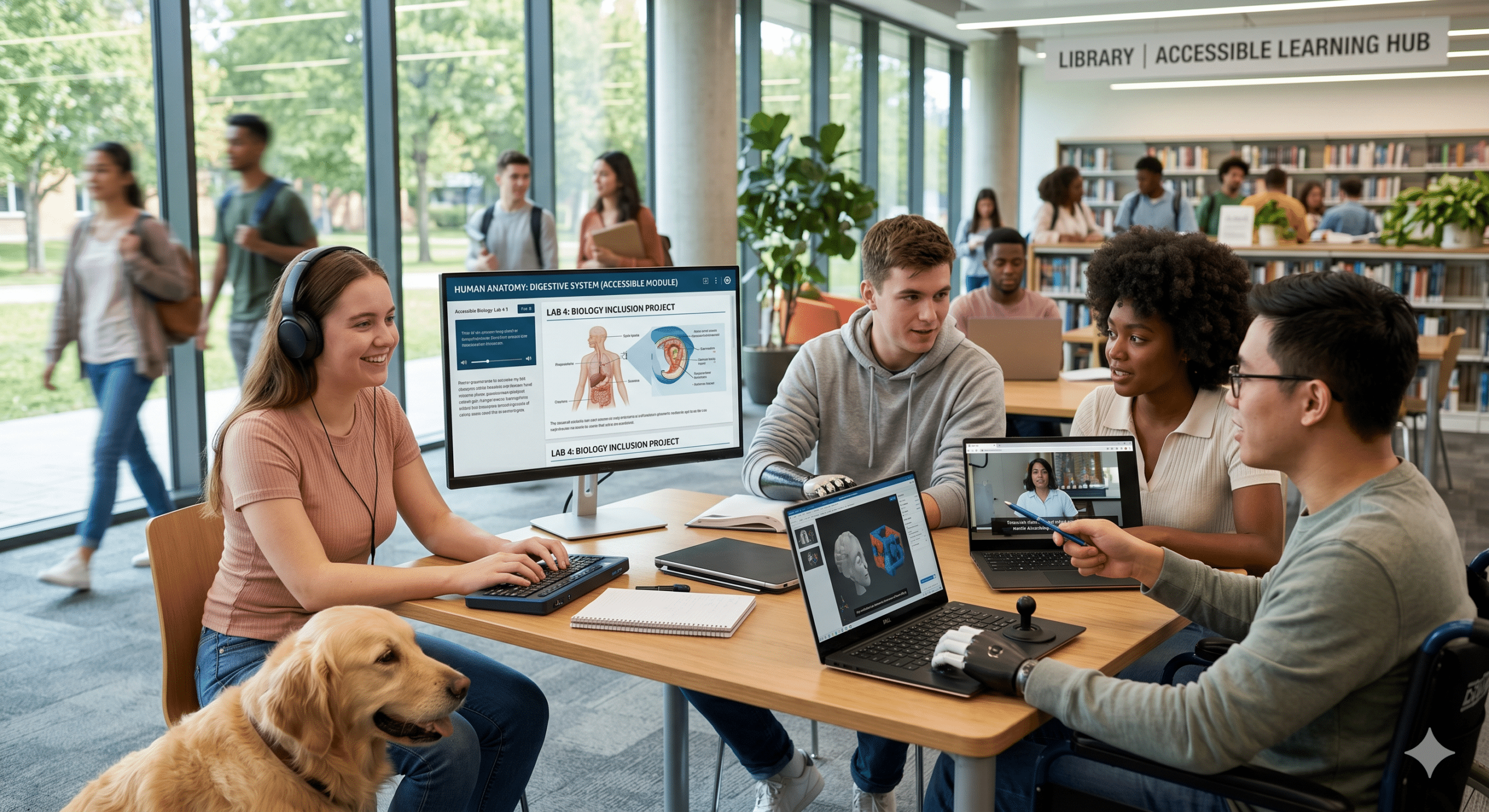
Digital accessibility in education is no longer a “nice-to-have” initiative buried under IT priorities or compliance checklists. It has become a foundational part of how modern schools, universities, eLearning companies, and training organizations deliver meaningful learning experiences.
Over the last several years, I’ve worked with organizations that believed accessibility only mattered for a small group of users. In practice, the opposite turned out to be true. The institutions that invested in accessibility tools for education often saw improvements far beyond compliance. Student engagement increased. Course completion rates improved. Search visibility strengthened. Support tickets dropped. Faculty adoption improved. Most importantly, learners who previously struggled with digital barriers finally gained equal access to information.
Today’s educational environment is deeply digital. Students learn through LMS platforms, mobile apps, virtual classrooms, online assessments, recorded lectures, PDFs, and interactive learning systems. If those experiences are not accessible, entire groups of learners are unintentionally excluded.
That is why accessibility tools for education have become essential for educational institutions, edtech startups, online academies, universities, corporate training teams, and government learning programs.
In this guide, we’ll explore how accessibility technologies are transforming modern education, the industries and departments benefiting from them, and how AI-powered accessibility tools are shaping the future of inclusive learning.
What Are Accessibility Tools for Education?
Accessibility tools for education are technologies, software platforms, and digital strategies designed to help all learners access educational content regardless of disability, learning differences, age, device limitations, or temporary impairments.
These tools help remove barriers that make digital learning difficult for students with:
- visual impairments,
- hearing impairments,
- mobility challenges,
- cognitive disabilities,
- learning disorders,
- neurological conditions,
- language-processing difficulties,
- temporary injuries,
- and even situational limitations like poor internet connectivity or noisy environments.
Modern digital accessibility solutions include:
- screen reader compatibility tools,
- AI-generated captions and transcripts,
- keyboard navigation systems,
- text resizing features,
- dyslexia-friendly interfaces,
- voice navigation,
- accessible LMS integrations,
- color contrast analyzers,
- automated WCAG testing software,
- accessible document remediation tools,
- and accessibility automation tools for ongoing monitoring.
Educational accessibility is not simply about compliance. It is about creating inclusive digital experiences where every learner can participate independently and confidently.
Why Accessibility Matters More Than Ever
Education has changed dramatically since remote learning accelerated worldwide. Institutions that once relied primarily on physical classrooms now operate hybrid digital ecosystems.
That shift exposed major accessibility gaps.
Many schools discovered that:
- PDFs were unreadable for screen readers,
- online exams could not be completed with keyboards,
- video lectures lacked captions,
- LMS navigation confused students with cognitive disabilities,
- and mobile learning apps failed basic accessibility standards.
At the same time, regulations and legal expectations became stricter.
Educational organizations increasingly face scrutiny under accessibility laws and standards including:
- the Americans with Disabilities Act (ADA),
- Section 508,
- WCAG accessibility guidelines,
- the Equality Act in the UK,
- and other international digital accessibility regulations.
However, compliance is only one piece of the picture.
The strongest accessibility programs usually emerge because organizations realize accessibility improves the experience for everyone.
For example:
- Captions help multilingual students.
- Keyboard shortcuts improve productivity.
- Clear layouts reduce cognitive overload.
- Mobile-friendly accessible interfaces improve usability.
- Better semantic structure improves SEO performance.
- Readable typography improves retention and focus.
Accessibility ultimately improves learning outcomes.
Accessibility Solutions in Ecommerce Education Platforms
One growing sector using accessibility tools for education is ecommerce-based learning.
This includes:
- online course marketplaces,
- coaching platforms,
- membership sites,
- certification programs,
- digital training subscriptions,
- and creator-led education businesses.
Many course creators unintentionally launch inaccessible learning experiences because they prioritize marketing and content delivery first.
Common issues include:
- inaccessible checkout forms,
- low-contrast course dashboards,
- videos without captions,
- inaccessible quiz interfaces,
- and poor mobile navigation.
I recently worked with an online certification provider whose students were abandoning courses at unusually high rates. After auditing the platform, we discovered that learners using screen readers struggled to navigate lesson structures. Additionally, video transcripts were missing, and quiz timers created barriers for neurodivergent learners.
After implementing accessibility compliance solutions, the company saw measurable improvements in:
- course completion,
- learner satisfaction,
- support reduction,
- and organic search visibility.
That’s the hidden business value of accessibility.
Accessible ecommerce learning systems create smoother learning journeys for all users, not just those with disabilities.
Accessibility in Healthcare and Telemedicine Training
Healthcare organizations increasingly depend on digital education systems for:
- patient education,
- staff onboarding,
- compliance training,
- telemedicine guidance,
- and continuing medical education.
Unfortunately, healthcare platforms often struggle with accessibility because of legacy systems and highly technical interfaces.
Accessibility software for companies in healthcare environments helps organizations ensure critical information remains accessible during stressful or time-sensitive situations.
For example, hospitals now use enterprise accessibility tools to improve:
- patient portals,
- online medical forms,
- prescription instructions,
- appointment scheduling systems,
- and digital learning portals for staff training.
One healthcare client I worked with discovered that visually impaired patients could not independently complete online intake forms because labels were improperly coded. This created not only accessibility barriers but operational inefficiencies for staff.
After implementing WCAG accessibility solutions and accessible form architecture, completion rates improved significantly while staff assistance requests declined.
Healthcare accessibility is ultimately about trust, independence, and safety.
Accessibility for Education and eLearning Platforms
Educational institutions are among the largest adopters of digital accessibility solutions today.
Schools, colleges, universities, and online academies now rely heavily on:
- LMS platforms,
- virtual classrooms,
- digital assignments,
- multimedia lessons,
- discussion forums,
- mobile apps,
- and cloud-based collaboration tools.
Without accessibility, these systems create exclusion at scale.
Learning Management Systems (LMS)
Popular LMS platforms often require customization to meet accessibility standards.
Educational organizations now use accessibility tools for education to audit:
- navigation structure,
- ARIA labeling,
- keyboard accessibility,
- heading hierarchy,
- semantic HTML,
- and screen reader compatibility.
Accessible LMS experiences improve usability for all students, especially those using assistive technologies.
Video Accessibility
Video-based learning has exploded in recent years.
However, inaccessible video content remains one of the biggest problems in education.
AI accessibility software now helps institutions generate:
- captions,
- transcripts,
- audio descriptions,
- and multilingual translations at scale.
This dramatically improves learning accessibility while reducing manual production costs.
Accessible Documents
Educational institutions frequently upload inaccessible PDFs and presentation files.
Modern website accessibility services and remediation tools help schools convert:
- scanned PDFs,
- PowerPoint presentations,
- Word documents,
- and course handouts
into accessible formats compatible with assistive technologies.
This area alone creates enormous improvements for students using screen readers.
Accessibility in HR and Recruitment Systems
Educational organizations are also employers, which means accessibility matters internally as well.
HR systems within universities and educational companies often contain accessibility barriers during:
- hiring,
- onboarding,
- benefits enrollment,
- internal training,
- and employee development.
Accessible recruitment systems help institutions attract diverse talent while reducing legal risk.
For example, inaccessible application portals may unintentionally exclude qualified candidates with disabilities.
Accessibility automation tools can continuously monitor HR platforms for:
- inaccessible forms,
- keyboard traps,
- missing labels,
- and screen reader issues.
Inclusive hiring processes strengthen educational institutions both culturally and operationally.
Financial Services and Inclusive Banking Education
Financial literacy programs increasingly rely on digital education platforms.
Banks, fintech companies, and financial institutions now use accessibility tools for education to make learning resources inclusive for:
- seniors,
- visually impaired users,
- neurodivergent learners,
- and multilingual audiences.
This includes accessible:
- budgeting tools,
- financial literacy courses,
- mortgage education portals,
- investment learning systems,
- and fraud prevention training.
Financial accessibility improves confidence and reduces exclusion for vulnerable populations.
Additionally, accessible educational content often performs better in SEO because of improved structure, readability, and semantic organization.
Accessibility for SaaS and Technology Companies
SaaS companies increasingly integrate educational systems directly into their products.
This includes:
- onboarding tutorials,
- product walkthroughs,
- knowledge bases,
- certification academies,
- and customer training systems.
The problem is that many SaaS environments are built rapidly without accessibility considerations.
I frequently see:
- inaccessible modal windows,
- poor keyboard support,
- missing focus indicators,
- auto-playing content,
- and inconsistent navigation structures.
Technology companies that invest early in accessibility software for companies often gain competitive advantages because inclusive products scale more effectively across diverse audiences.
Accessibility also improves overall UX maturity.
The best SaaS experiences are usually both highly usable and highly accessible.
Hospitality and Travel Accessibility Solutions
Hospitality organizations increasingly use digital education systems to train employees and support travelers.
Accessibility solutions for business environments in hospitality now include:
- accessible booking systems,
- multilingual travel resources,
- employee learning portals,
- accessible tourism guides,
- and hospitality onboarding platforms.
For example, hotels use accessibility automation tools to ensure online booking flows remain keyboard accessible and screen-reader friendly.
Travel companies also provide accessible educational resources helping travelers understand:
- accessibility accommodations,
- transportation options,
- and destination accessibility services.
This is especially important for aging populations and travelers with disabilities.
AI-Powered Accessibility Tools for Modern Businesses
Artificial intelligence is rapidly transforming accessibility.
AI accessibility software is helping organizations scale accessibility efforts more efficiently than ever before.
However, AI should enhance human accessibility strategy, not replace it entirely.
AI Captioning and Transcription
Educational institutions now use AI to generate captions and transcripts for thousands of hours of learning content.
This improves accessibility while significantly reducing production time.
Automated Accessibility Testing
Accessibility automation tools can now scan websites, LMS platforms, and applications for common WCAG issues including:
- missing alt text,
- poor contrast ratios,
- heading structure problems,
- inaccessible buttons,
- and form labeling errors.
While automated tools cannot catch everything, they help organizations identify issues earlier in development.
AI-Powered Reading Assistance
Some platforms now use AI to:
- simplify complex text,
- generate reading summaries,
- support multilingual translation,
- and personalize learning experiences.
This benefits learners with cognitive disabilities, ADHD, dyslexia, and language barriers.
Voice and Conversational Interfaces
Voice-enabled educational interfaces continue growing across learning environments.
Students increasingly interact with learning systems using:
- voice search,
- screen readers,
- AI tutors,
- and conversational assistants.
This shift makes accessible UX architecture even more important.
ADA, WCAG, and Accessibility Compliance
Accessibility compliance is often the starting point for organizations investing in accessibility tools for education.
The most widely recognized accessibility framework is the Web Content Accessibility Guidelines (WCAG).
WCAG focuses on four core principles:
- Perceivable
- Operable
- Understandable
- Robust
These principles guide how digital experiences should function for users with disabilities.
Educational organizations often aim for WCAG 2.1 AA compliance, which covers areas like:
- keyboard accessibility,
- text alternatives,
- contrast ratios,
- responsive layouts,
- error identification,
- and screen reader compatibility.
ADA compliant websites are becoming increasingly important as digital accessibility lawsuits continue rising globally.
However, compliance alone should not be the goal.
Organizations that treat accessibility purely as legal protection often create shallow solutions that fail real users.
True accessibility requires:
- inclusive design thinking,
- user testing,
- accessible content governance,
- and ongoing accessibility monitoring.
Common Accessibility Mistakes Businesses Make
Even organizations with good intentions often make avoidable accessibility mistakes.
Treating Accessibility as a One-Time Project
Accessibility is not a checkbox.
Websites, LMS platforms, and applications constantly evolve. Accessibility requires ongoing governance and monitoring.
Relying Only on Automated Tools
Automated scans help identify technical issues, but they cannot fully evaluate user experience.
Human testing remains essential.
Ignoring Mobile Accessibility
Many educational users access learning content primarily through mobile devices.
Yet mobile accessibility is often overlooked during development.
Poor Document Accessibility
One of the most common failures in education involves inaccessible PDFs and uploaded documents.
Overlay-Only Solutions
Some organizations rely entirely on accessibility overlays instead of fixing underlying UX problems.
Overlays alone rarely solve structural accessibility issues and may even create additional barriers.
Lack of Accessibility Training
Accessibility cannot succeed if internal teams lack awareness.
Faculty, content creators, developers, designers, HR teams, and marketers all need accessibility education.
The SEO Benefits of Accessibility
One area businesses often underestimate is the relationship between accessibility and SEO.
Many accessibility best practices directly support search engine optimization.
For example:
- semantic headings improve crawlability,
- alt text improves image indexing,
- transcripts increase keyword relevance,
- readable layouts reduce bounce rates,
- accessible navigation improves engagement metrics,
- and mobile accessibility supports search performance.
Google increasingly rewards strong user experience signals, and accessibility plays a major role in that experience.
In many cases, improving accessibility also improves discoverability.
The Business Impact of Inclusive Digital Experiences
Organizations that prioritize inclusive digital experiences often see measurable business improvements.
These include:
- broader audience reach,
- increased engagement,
- stronger customer loyalty,
- lower support costs,
- improved usability,
- reduced legal exposure,
- and better brand reputation.
In education specifically, accessible systems improve:
- learner retention,
- student success,
- faculty efficiency,
- and institutional credibility.
Accessibility is ultimately about creating environments where people can participate fully without unnecessary barriers.
That benefits everyone.
The Future of Accessibility in Business
The future of accessibility solutions for business is moving toward proactive, integrated accessibility ecosystems.
We are already seeing:
- AI-assisted accessibility remediation,
- real-time accessibility monitoring,
- personalized learning experiences,
- voice-first interfaces,
- adaptive UX systems,
- and accessibility integrated directly into development workflows.
Organizations that embed accessibility early into strategy, design, procurement, and development will move faster than competitors still treating accessibility as an afterthought.
Accessibility is becoming a core business maturity indicator.
Much like cybersecurity or privacy, accessibility is transitioning from optional enhancement to operational expectation.
The organizations leading this shift are not simply avoiding compliance risk. They are building better digital experiences altogether.
Final Thoughts
Accessibility tools for education are no longer niche technologies designed for a small percentage of users. They are foundational systems that improve learning, usability, engagement, and inclusion across entire digital ecosystems.
Whether you operate a university, SaaS platform, healthcare organization, ecommerce learning business, or enterprise training environment, accessibility directly impacts user experience and organizational performance.
The most successful organizations approach accessibility strategically rather than reactively.
They invest in:
- digital accessibility solutions,
- accessibility compliance solutions,
- enterprise accessibility tools,
- accessible UX design,
- AI accessibility software,
- and ongoing accessibility governance.
Most importantly, they recognize that accessibility is not just about compliance.
It is about people.
When educational experiences become more accessible, they become more effective, more scalable, and more human-centered for everyone involved.
Recommended Blog Resources
Here are several helpful resources covering accessibility strategy, WCAG standards, inclusive UX, and accessible education technologies:
- W3C Web Accessibility Initiative (WAI)
- WebAIM Accessibility Articles and Guides
- Deque Accessibility Blog
- Nielsen Norman Group Accessibility UX Articles
- Microsoft Inclusive Design Resources
- Harvard Digital Accessibility Services
- Google Accessibility Blog
- The A11Y Project
Further Reading and Reference Links
- WCAG 2.2 Guidelines Overview
- ADA.gov Accessibility Guidance
- Section 508 Accessibility Requirements
- UNESCO Digital Learning Accessibility Resources
- IBM Equal Access Toolkit