


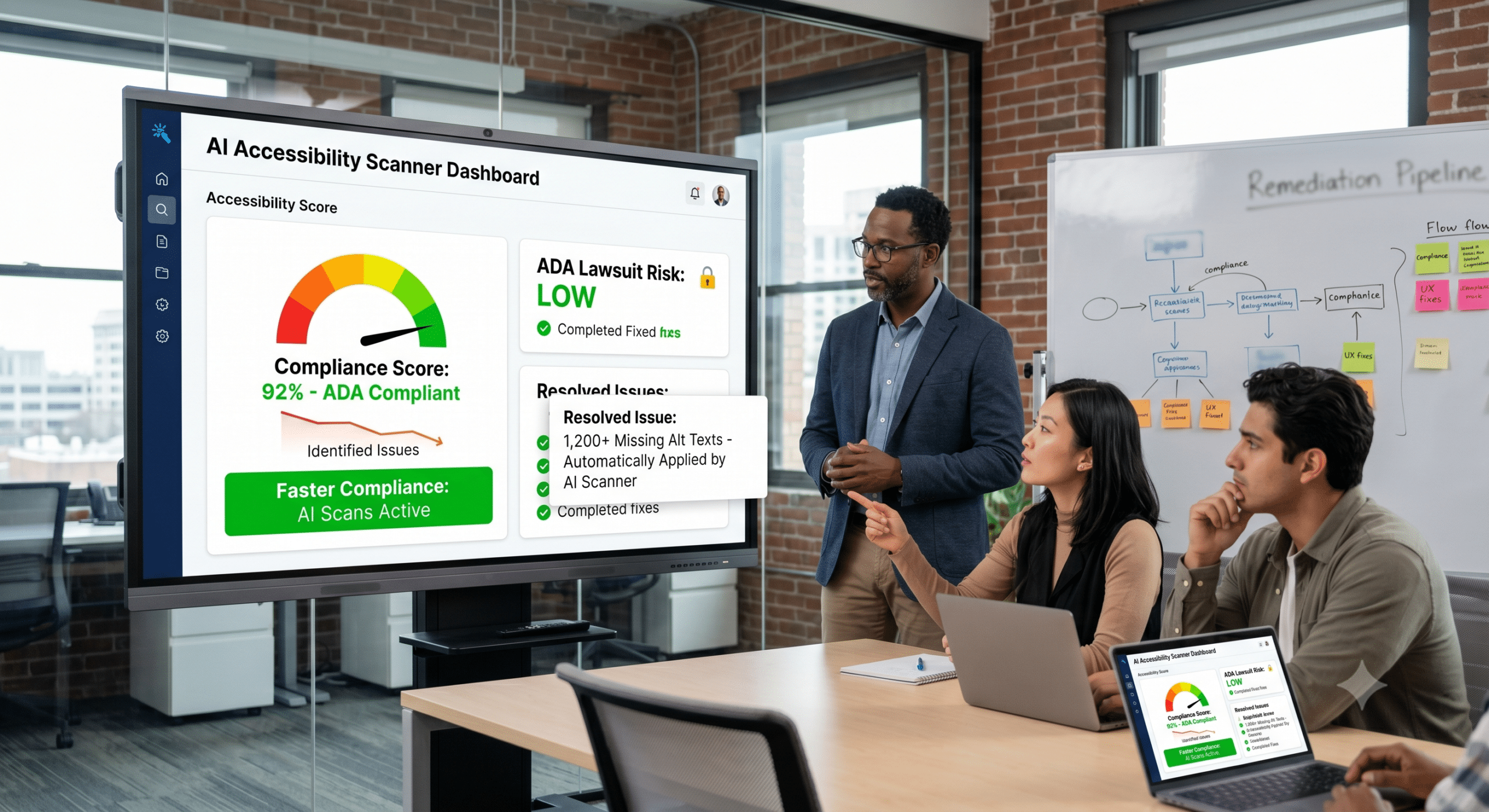
Digital accessibility is no longer a niche concern reserved for government agencies and large corporations. Today, it has become a business necessity, a legal requirement, and an essential part of creating an inclusive online experience. As someone who has spent years working in accessibility automation and remediation, I have watched the industry undergo a dramatic transformation. What once required months of manual audits and remediation can now be accelerated through intelligent automation, AI-powered analysis, and continuous accessibility monitoring.
The rapid rise of the AI accessibility scanner is not happening by accident. Businesses around the world are facing increasing pressure from ADA litigation, WCAG compliance requirements, Section 508 standards, and the enforcement of the European Accessibility Act (EAA). At the same time, websites are becoming more complex, with dynamic content, AI-generated pages, e-commerce platforms, and single-page applications creating new accessibility challenges every day.
Organizations are realizing that traditional accessibility audits alone are no longer enough. They need faster detection, smarter remediation workflows, and ongoing monitoring that scales with their digital growth. This is where AI accessibility automation and remediation are changing the game.
Why Accessibility Has Become a Boardroom-Level Priority
A few years ago, many organizations viewed accessibility as a compliance checkbox. Today, executives are treating accessibility as a business risk management strategy.
The reason is simple. Regulatory scrutiny is increasing, lawsuits continue to rise, and consumers expect digital experiences that are inclusive for everyone. Recent accessibility reports show that the overwhelming majority of websites still contain detectable WCAG failures, despite years of awareness campaigns and legal actions. Furthermore, accessibility lawsuits continue to grow across industries, making compliance a critical business concern rather than an optional enhancement.
For organizations operating internationally, the situation becomes even more complex. The European Accessibility Act has introduced additional compliance obligations for businesses serving customers in Europe, while ADA-related website litigation remains active across the United States. (webability.io)
As a result, business leaders are searching for practical solutions that reduce compliance risks while improving user experiences. This growing demand is one of the primary reasons searches for AI accessibility scanners have surged over the past year.
What Is an AI Accessibility Scanner?
An AI accessibility scanner is an advanced accessibility assessment tool that uses artificial intelligence, machine learning, automated rule engines, and contextual analysis to identify potential accessibility barriers across websites, web applications, and digital content.
Traditional accessibility scanners primarily focus on detecting predefined WCAG violations. They examine source code, page structures, color contrast, heading hierarchies, form labels, image alternative text, keyboard navigation issues, and other measurable accessibility criteria.
An AI accessibility scanner takes this process several steps further.
Instead of simply identifying technical errors, modern AI-driven systems can evaluate context, prioritize issues by severity, generate remediation recommendations, and in some cases automatically apply fixes within the source code or content management system. Emerging AI remediation systems have demonstrated significant success in automatically correcting accessibility issues while preserving website functionality and design consistency. (arXiv)
This shift from detection to remediation represents one of the most important advancements in accessibility technology.
The Limitations of Traditional Accessibility Audits
Before discussing automation, it is important to understand why many organizations struggle with accessibility compliance in the first place.
Traditional accessibility remediation often follows a familiar pattern. An organization hires an accessibility consultant who performs an audit. The audit generates a lengthy report containing hundreds or even thousands of findings. Developers then spend weeks or months addressing the issues. After remediation, another audit is conducted.
While this approach can be effective, it creates several challenges.
The first challenge is cost. Manual audits require significant time and expertise. Large websites with thousands of pages may require extensive testing and validation.
The second challenge is speed. Modern websites evolve constantly. New pages, products, blog posts, and features can introduce accessibility issues immediately after an audit is completed.
The third challenge is scalability. Organizations often struggle to maintain accessibility across multiple websites, applications, and digital properties.
Most importantly, automated accessibility issues can reappear at any time due to content updates, plugin changes, third-party integrations, or development releases.
This is why many accessibility professionals now recommend combining human expertise with AI-driven accessibility automation rather than relying solely on periodic manual audits. Automated tools typically identify only a portion of accessibility barriers, making human testing and ongoing monitoring essential components of a comprehensive strategy. (webability.io)
How AI Accessibility Automation Works
Modern accessibility automation follows a continuous cycle rather than a one-time audit process.
The process typically begins with automated scanning. The AI accessibility scanner crawls website pages, analyzes code structures, evaluates visual elements, and identifies potential WCAG violations.
Once issues are detected, machine learning models categorize findings based on severity, impact, and remediation complexity.
The system then generates recommendations that may include:
- Alternative text improvements
- Form accessibility enhancements
- Color contrast corrections
- ARIA attribute adjustments
- Heading structure improvements
- Keyboard navigation fixes
- Screen reader optimization suggestions
Some advanced platforms can even create remediation scripts or automatically implement approved corrections directly within the website codebase. Recent research demonstrates that AI-assisted remediation systems can successfully address a significant percentage of accessibility violations while reducing manual workload. (arXiv)
The result is a faster and more sustainable accessibility workflow.
Common Accessibility Issues AI Scanners Detect
One of the biggest advantages of an AI accessibility scanner is its ability to identify issues consistently across large websites.
Among the most common violations detected are missing alternative text for images, insufficient color contrast, unlabeled form fields, inaccessible buttons, empty links, missing document language declarations, and keyboard navigation failures. These issues continue to appear across millions of websites despite growing awareness of accessibility standards. (Accessibility Assistant)
Many businesses are surprised to discover how frequently these errors occur.
For example, a website may appear visually perfect while remaining nearly unusable for screen reader users. Likewise, a navigation menu may function correctly with a mouse but become impossible to access using only a keyboard.
AI-powered scanners help uncover these hidden barriers before they affect customers or trigger compliance concerns.
Why Businesses Are Investing in AI Accessibility Remediation
The conversation has shifted from simply finding accessibility issues to resolving them efficiently.
Organizations are realizing that identifying problems without a remediation strategy provides limited value. This is why AI accessibility remediation platforms have gained significant momentum.
Accessibility teams can now focus their expertise on complex issues while automation handles repetitive tasks.
Developers benefit because they receive actionable remediation guidance instead of lengthy technical reports.
Business leaders benefit because compliance efforts become more measurable and cost-effective.
Most importantly, users with disabilities benefit because accessibility improvements can be implemented much faster than traditional remediation cycles.
The combination of automation and expert oversight creates a practical path toward long-term accessibility maturity.
AI Accessibility Scanner Versus Accessibility Overlays
One area that often creates confusion involves accessibility overlays.
Many businesses assume that adding an accessibility widget automatically makes a website compliant.
Unfortunately, accessibility professionals generally recognize that overlays alone cannot solve underlying code-level accessibility problems. WCAG compliance requires proper implementation within the website’s structure, content, and functionality rather than relying solely on interface overlays. (IT Pro)
An AI accessibility scanner serves a different purpose.
Instead of masking issues, it identifies root causes and supports remediation efforts within the actual website code and content.
This distinction is critical for organizations pursuing meaningful accessibility improvements rather than superficial compliance measures.
The Role of Human Accessibility Experts
Despite impressive advances in automation, accessibility remains a human-centered discipline.
AI can identify patterns, detect violations, and accelerate remediation workflows. However, accessibility ultimately involves understanding real user experiences.
For example, a scanner may confirm that alternative text exists for an image. It cannot always determine whether that description provides meaningful context.
Similarly, an automated tool may verify that a page satisfies technical requirements while missing usability challenges experienced by people using assistive technologies.
This is why experienced accessibility specialists continue to play a vital role in the remediation process. The most successful accessibility programs combine automated scanning, manual testing, screen reader validation, and user-centered evaluation. (webability.io)
Automation should enhance human expertise, not replace it.
Accessibility and SEO: A Powerful Connection
Many organizations initially pursue accessibility to reduce legal risk.
However, they quickly discover additional benefits.
Accessible websites often perform better in search engines because accessibility best practices align closely with technical SEO fundamentals.
Clear heading structures improve content organization.
Alternative text enhances image understanding.
Descriptive link text improves navigation.
Proper semantic HTML helps search engines interpret content more effectively.
Improved usability can also increase engagement, reduce bounce rates, and improve conversion performance.
While accessibility and SEO are not identical disciplines, they frequently complement each other in meaningful ways.
The Future of AI Accessibility Automation
The future of accessibility technology is moving toward intelligent remediation ecosystems.
Instead of conducting occasional audits, organizations will increasingly adopt continuous accessibility monitoring integrated directly into development workflows.
AI systems will automatically detect issues during content creation, website updates, and software deployments.
Developers will receive accessibility recommendations in real time.
Content creators will receive automated guidance before publishing new pages.
Quality assurance teams will integrate accessibility testing into every release cycle.
Research into large language models and accessibility remediation continues to demonstrate promising results, suggesting that AI-powered accessibility support will become increasingly sophisticated over the coming years. (arXiv)
Accessibility is evolving from a reactive process into a proactive discipline.
Choosing the Right AI Accessibility Scanner
Not all accessibility scanners provide the same value.
When evaluating solutions, organizations should prioritize tools that offer comprehensive WCAG testing, actionable remediation guidance, continuous monitoring, and integration with existing development workflows.
The best platforms do more than generate reports. They help organizations understand why issues occur and how to fix them effectively.
Businesses should also look for scanners that support manual testing workflows because no automated solution can identify every accessibility barrier.
Accessibility success comes from combining technology, expertise, and organizational commitment.
Conclusion
The rise of the AI accessibility scanner represents one of the most significant advancements in digital accessibility over the past decade.
As ADA litigation increases, EAA enforcement expands, and user expectations continue to evolve, organizations can no longer rely solely on manual audits and reactive remediation strategies.
AI accessibility automation provides a smarter approach. It accelerates issue detection, streamlines remediation, reduces operational costs, and supports continuous compliance efforts.
Yet technology alone is not the answer.
The most effective accessibility programs combine AI-powered automation with expert oversight, user-centered design, and a long-term commitment to inclusive digital experiences.
Organizations that embrace this balanced approach will not only reduce compliance risks but also create websites that genuinely serve every visitor, regardless of ability.
In the years ahead, accessibility will no longer be viewed as an optional enhancement. It will be recognized as a core component of digital excellence, and AI accessibility scanners will play a central role in making that vision a reality.
Frequently Asked Questions
What is an AI accessibility scanner?
An AI accessibility scanner is a tool that automatically analyzes websites for accessibility issues based on standards such as WCAG, ADA, Section 508, and other accessibility guidelines. Advanced scanners also provide remediation recommendations and automation features.
Can an AI accessibility scanner make my website fully ADA compliant?
No. An AI accessibility scanner can identify many accessibility issues and assist with remediation, but manual testing and expert review remain necessary for full compliance and usability validation. (webability.io)
How many accessibility issues can automated tools detect?
Research and industry audits suggest automated scanners typically detect only a portion of accessibility issues. Human testing remains essential for identifying usability barriers and assistive technology challenges. (webability.io)
Why are businesses adopting AI accessibility remediation?
Businesses are using AI remediation to reduce compliance risks, lower remediation costs, improve operational efficiency, and maintain accessibility across constantly evolving websites and applications. (TestParty)
Does accessibility help SEO?
Yes. Accessibility improvements often support better technical SEO by improving site structure, semantic markup, navigation, content clarity, and user experience.
Further Reading
For readers who want to dive deeper into accessibility automation, compliance, and remediation, these high-authority resources provide excellent insights:
- Website Accessibility Audit: Complete 2026 Guide – Webability
- Website Accessibility Checker: Complete 2026 Guide – Webability
- The Ultimate Digital Accessibility Audit Guide (ADA, WCAG & Section 508) – ADA Compliance Pros
- WordPress ADA Compliance: Complete Guide for Site Owners – Accessify
- AI Web Accessibility Remediation: How It Works – TestParty
- Common ADA Website Accessibility Errors and How to Fix Them – Accessibility Assistant