
I have sat through more accessibility vendor pitches than I can count. Over nine years, I have built and run digital accessibility programs at scale. I started as a program lead, and today I own this function for the whole company. In that time I have learned one thing clearly. Picking a WCAG audit services partner is one of the highest impact decisions an accessibility leader makes. Get it right, and you get a partner who catches real barriers before customers do. Get it wrong, and you get a binder full of automated scan output. Instead, nobody on your engineering team can act on it.
This is not a theoretical framework from a certification course. It is the process my team actually uses when we bring in outside WCAG audit services. It is also what I wish someone had told me the first time I signed a six figure accessibility contract.
Why Enterprises Need Outside Help
Our organization runs dozens of digital properties. That includes web, native mobile apps, and a document library customers rely on for account and billing information. No single internal team can test all of that at the depth a launch or a regulatory deadline demands. As a result, external WCAG audit services exist as a category to close that gap.
Most companies treat vendor selection as a procurement checkbox. That is the mistake. In fact, choosing a provider is due diligence on a partner who will shape how accessible your product actually is for years.
Why WCAG Audit Services Matter More in 2026
Two things changed the calculus for enterprises this year.
First, the European Accessibility Act enters full enforcement territory. Companies with service contracts signed before June 28, 2025 must reach compliance by June 28, 2027. EN 301 549 version 4.1.1 folds in WCAG 2.2. The EU is expected to cite that standard in its Official Journal around November 2026. The new version adds nine success criteria covering focus indicators, authentication, drag and drop interactions, and data entry. As a result, if your organization sells into the EU, a legacy WCAG 2.1 audit is already out of date.
Second, litigation in the United States rebounded hard. Federal courts saw 3,117 ADA website accessibility lawsuits in 2025. That is a 27 percent jump from 2024’s 2,452 cases. Seyfarth Shaw’s ADA Title III team tracks the litigation. Website cases now make up 36 percent of all ADA Title III federal filings. That is up from 28 percent the year before. Florida alone saw filings nearly double year over year. This is not abstract risk. It is the reason my legal team now sits in on WCAG audit services vendor selection meetings.
Put those two forces together, and the reality gets simple. A shallow, automated only scan is not a defensible compliance posture anymore. In fact, it probably never was.
What a Real WCAG Audit Service Delivers
Many vendors sell WCAG audits that are really just a Lighthouse or axe scan. A company logo on the cover does not make it rigorous. Automated tools are useful, but they are not the whole job.
An independent coverage analysis studied more than 13,000 pages and nearly 300,000 flagged issues. It found that automated tools reliably detect only about 16 of the 50 WCAG 2.1 Level AA success criteria. That is roughly 32 percent, measured criterion by criterion. Automated testing still catches a meaningful share of real world problems by raw volume. That same analysis puts the figure north of 57 percent. It excels at specific, high frequency issues too. For example, it found 83 percent of contrast problems, 90 percent of parsing errors, and 92 percent of missing language declarations. But contrast ratios and missing alt attributes are the easy half of the job. Keyboard traps, focus order, and meaningful reading sequence rarely show up in an automated report. Neither does whether a screen reader actually announces an error message at the moment it matters.
That is why the WCAG audit services worth paying for combine three things. Automated scanning catches mechanical, high volume issues quickly. Manual testing by people who use screen readers, switch access, and voice control every day catches what automation cannot. Consultants who merely learned the keyboard shortcuts for the audit will not. And a strong report maps every finding to a specific WCAG success criterion, a severity rating, and a concrete fix. It skips the generic remediation guide copied from a template.
The Six Things I Check Before Signing
Every RFP I run for WCAG audit services comes down to the same six questions. I ask them directly, and I ask for evidence, not marketing language.
Testing Rigor and Reporting
- Do they test with real assistive technology users, not just consultants. A vendor whose testing bench includes blind, low vision, deaf, and motor impaired testers catches problems. A sighted consultant will miss them. For example, ask how many testers rely on assistive technology daily, not just during audits.
- Can they show a sample report from a site your size. I do not want a two page summary. I want the full document. For a large site, that means a finding count in the hundreds, mapped to specific pages, components, and success criteria.
- Do they separate must fix issues from nice to fix ones. A report treating a missing skip link the same as a broken checkout form is not prioritizing risk. Instead, it is just listing everything it found.
Support, Scale, and Legal Standing
- What happens after delivery. Some WCAG audit services stop at the PDF. Instead, the ones worth the money offer a remediation retest and office hours with your engineering team. They give you a real path to closing findings.
- How do they handle scale. A vendor built for one marketing site will not have the workflow to manage 40 properties across five brands.
- What is their legal posture if you get sued anyway. This sounds cynical, but it is practical. I want their audit methodology and documentation to hold up in court. They should show evidence of good faith effort if we ever need it.
I have walked away from vendors who could not answer the second and sixth questions convincingly. Regardless of how polished the sales deck was, it did not matter.
Red Flags That End the Conversation
A few things get a vendor cut before we even discuss pricing.
Any promise of “100 percent WCAG compliant” or “fully ADA compliant” software. Compliance is a moving target tied to your content, your third party embeds, and your release cadence. Nobody can guarantee a permanent state. In other words, a vendor claiming otherwise either misunderstands the standard or is selling something else, usually an overlay widget.
A vendor who leads with an accessibility overlay as the primary remediation path, rather than actual code fixes. In fact, overlays have lost repeatedly in court and drawn sustained public criticism from disability advocacy groups. If overlays come up before manual testing methodology, I end the call.
No named accessibility specialists on the account. If a firm cannot tell you who will test your product, and what their background is, you are buying a brand. You are not buying expertise.
Pricing based purely on page count with no scoping conversation. A ten page marketing site is one audit. A ten page checkout flow, with a payment form and dynamic error states, is a very different one. In short, quoting a flat per page rate without a scoping conversation means nobody actually scoped the work.
No experience testing across languages and locales, when your product ships in more than one. For example, a checkout flow that works for an English speaking screen reader user can still fail elsewhere. It can break in a right to left layout, or in a locale with a different form field order. A single language testing bench cannot credibly audit a global product.
How We Run the Selection Process
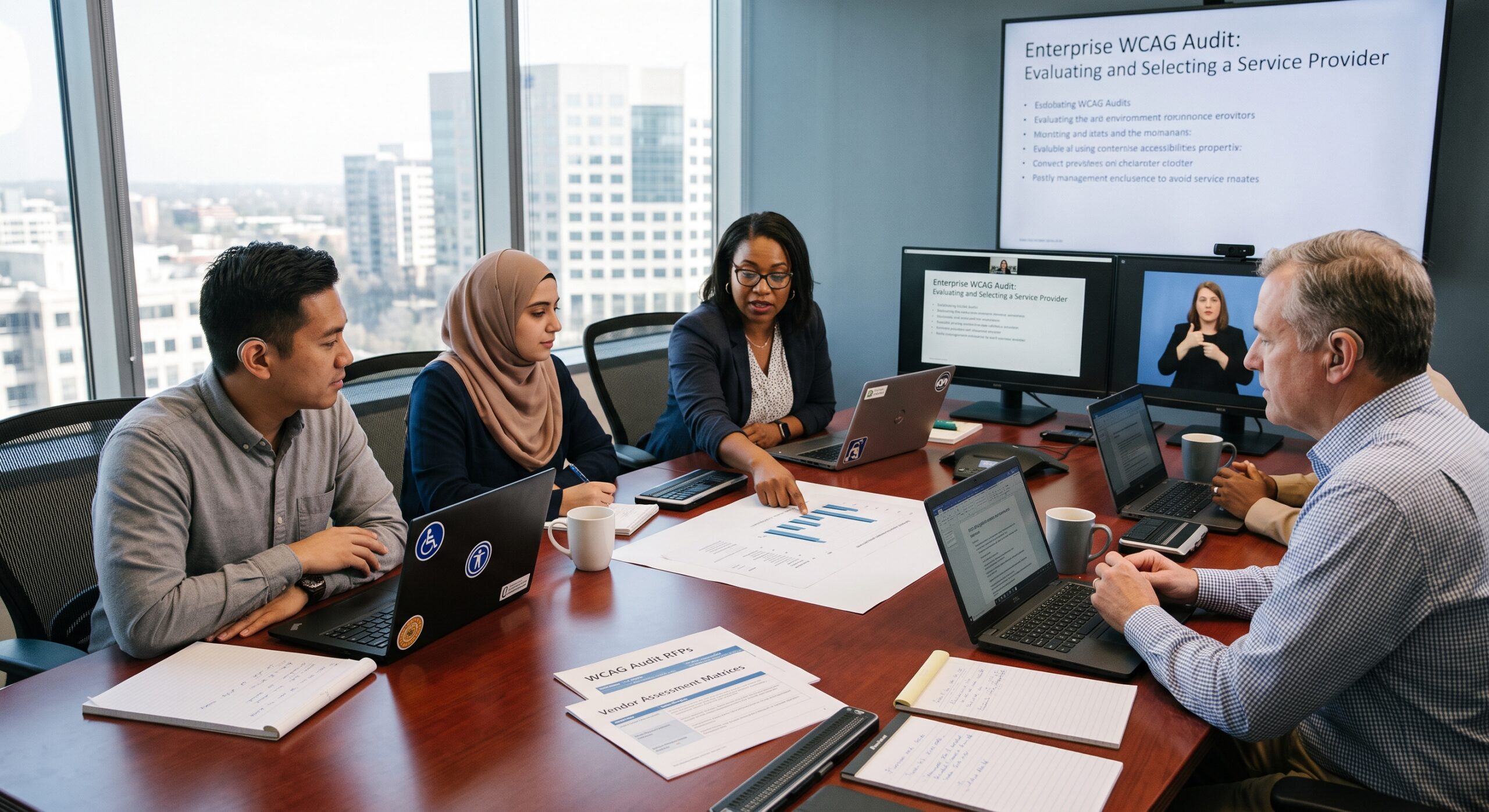
Once we build a shortlist, usually three to five WCAG audit services vendors, we go beyond comparing proposals on paper. Instead, we run a paid pilot audit on one core user flow, like account creation or checkout. That happens before we commit to the full engagement.
The pilot tells us more than any reference call. First, we check turnaround time against what the vendor promised. We compare their findings against what our internal accessibility team already suspected. A vendor who misses issues we already know about is a bad sign. We also watch how clearly the report speaks to an engineer who has never heard of WCAG. Finally, we ask the pilot team to test with keyboard only navigation and at least one screen reader. That single step filters out firms running scan and forward operations with no real human testing behind them.
Reference calls still matter. Specifically, I ask pointed questions. How many retesting rounds were included. Did estimated remediation hours match reality. Would the client run another RFP today, or renew without one. A client who says they never revisit vendor selection because it still works is worth listening to closely.
What Enterprise Budgets Should Expect to Pay
I will not pretend there is a universal number, because scope varies too much. A single application audit, combining manual and automated testing across core flows, typically costs tens of thousands of dollars. The exact number depends on page and component count. A full enterprise engagement across multiple properties, mobile apps, and document libraries, with a retest cycle included, costs considerably more. Ongoing monitoring, rather than a one time engagement, usually comes as a separate subscription.
I tell my finance partners the real comparison every budget cycle. It is not between vendor quotes. It is between the cost of a properly scoped audit and the cost of a lawsuit or a settlement. Or it is the engineering hours spent retrofitting accessibility into a product nobody designed with it in mind. That framing wins budget faster than any ethics argument does. The ethics argument is still the one that actually matters to me personally.
I also budget separately for a Voluntary Product Accessibility Statement, often called a VPAT, or the resulting Accessibility Conformance Report. Enterprise procurement teams increasingly require one before signing any software contract. If your own product sells into other enterprises, an audit that skips this documentation hurts your sales team. Customers will ask for it. I ask every WCAG audit services provider up front whether conformance reporting comes standard or costs extra. I have seen contracts where it quietly did not.
After the Audit: What Separates Real Progress From a Stalled Program
The audit itself is the easy part. I have seen organizations spend real money on excellent WCAG audit services. Then the findings sit in a spreadsheet for a year because nobody owns remediation.
Treat the audit as the start of a governance cycle, not a deliverable to file away. Assign every finding an owner and a due date. Use the same ticketing system your engineers already use, not a separate accessibility tracker nobody checks. Then ask the audit vendor to retest a sample of fixed issues. A closed ticket does not always mean the fix works for a real assistive technology user. Build accessibility checks into design review and code review so the next audit finds fewer repeat problems.
A good vendor will raise this themselves. If a WCAG audit services provider never asks about your ticketing workflow, your design system, or how you assign findings, take note. They are optimizing to sell you the next audit, not to make you more accessible.
Building Internal Capability Alongside External Vendors
The best outcome from any external engagement is a sharper internal team, not just a filed report. I ask every WCAG audit services provider to run at least one working session. For example, their testers walk our designers and engineers through two or three findings live. They show exactly how a screen reader user hits the problem and why the fix works. That single hour teaches more than any internal training deck I have ever commissioned.
Over time this shifts what we send out for audit. Early on, we sent nearly everything to the outside provider, because we lacked the in house expertise to test rigorously. Now our internal accessibility engineers handle routine checks during development. We reserve external WCAG audit services for full conformance audits ahead of major launches and for the EU market, given the EAA timeline. We also use them for an annual independent check that keeps our own team honest. A vendor relationship that only ever grows, and never shrinks as your internal skills mature, is a warning sign. It usually means the vendor is not trying to make you self sufficient.
Closing Thought
Choosing a WCAG audit services partner is not a procurement exercise you finish once. Standards keep moving; WCAG 2.2 is already here and WCAG 3.0 is in development. Meanwhile, litigation patterns shift year to year, and your own product surface keeps growing. The vendors worth keeping tell you when your last audit goes stale. They do not just show up when the contract renews.
If you take one thing from this piece, take this. In short, ask for evidence, not assurances. A vendor confident in their own methodology will hand you a sample report and name their testers. They will walk you through a real finding without flinching. That conversation tells you more than any proposal deck ever will.
Frequently Asked Questions
Scope and Standards
What exactly does a WCAG audit check for? A proper audit evaluates a website, app, or document against the WCAG success criteria. For example, that covers keyboard operability, color contrast, screen reader compatibility, form labeling, and focus management. The bar is whichever conformance level your organization has committed to, usually AA. The W3C’s own WCAG 2.2 documentation lists the full set of criteria a credible audit should check: https://www.w3.org/TR/WCAG22/
Is WCAG 2.2 required for compliance in 2026? It depends on jurisdiction, but momentum clearly points that direction. The European Accessibility Act’s supporting standard, EN 301 549 v4.1.1, incorporates WCAG 2.2. It should become the reference standard later in 2026. An audit still scoped only to WCAG 2.1 is already behind. Details on the EAA timeline are here: https://www.levelaccess.com/compliance-overview/european-accessibility-act-eaa/
Can automated tools replace manual testing for a WCAG audit? No. Automated tools reliably cover only around a third of WCAG success criteria on their own. They do catch a large share of issues by raw volume, though. Deque’s published analysis of real audit data breaks this down: https://www.deque.com/automated-accessibility-coverage-report/
Vendor Evaluation and Risk
How do I know if a vendor’s manual testing is actually rigorous? Ask whether their testers use assistive technology as their primary means of access. Also, request a sample report from an engagement similar in size to yours. Confirm findings map to specific success criteria rather than generic categories. AudioEye’s vendor evaluation guide covers similar questions to ask before signing: https://www.audioeye.com/post/how-to-choose-the-right-ada-accessibility-vendor/
What is the real legal risk of skipping a professional audit? Federal ADA website accessibility lawsuits rose sharply in 2025. As a result, website related claims now make up more than a third of all ADA Title III filings. Seyfarth Shaw’s litigation tracker is worth reviewing if you need to build an internal business case for audit budget: https://www.adatitleiii.com/2026/03/federal-court-website-accessibility-lawsuit-filings-bounce-back-in-2025/
How do I compare multiple WCAG audit services vendors fairly? Score every vendor on the same rubric: testing methodology, tester qualifications, and report clarity. Also weigh remediation support, scalability across your portfolio, and the legal defensibility of their documentation. This independent comparison of vendor evaluation criteria is a useful starting point: https://www.accessibility.works/blog/best-ada-testing-wcag-website-auditing-consultants/
References
W3C. Web Content Accessibility Guidelines (WCAG) 2.2. https://www.w3.org/TR/WCAG22/
Deque Systems. The Automated Accessibility Coverage Report. https://www.deque.com/automated-accessibility-coverage-report/
Deque Systems. What to Look for in an Accessibility Audit. https://www.deque.com/blog/what-to-look-for-in-an-accessibility-audit/
Level Access. European Accessibility Act (EAA) Compliance Overview. https://www.levelaccess.com/compliance-overview/european-accessibility-act-eaa/
AudioEye. How to Choose the Right ADA Accessibility Vendor. https://www.audioeye.com/post/how-to-choose-the-right-ada-accessibility-vendor/
Seyfarth Shaw, ADA Title III. Federal Court Website Accessibility Lawsuit Filings Bounce Back in 2025. https://www.adatitleiii.com/2026/03/federal-court-website-accessibility-lawsuit-filings-bounce-back-in-2025/
Accessibility.Works. Choosing the Best WCAG Web Accessibility Auditing Consultants. https://www.accessibility.works/blog/best-ada-testing-wcag-website-auditing-consultants/