

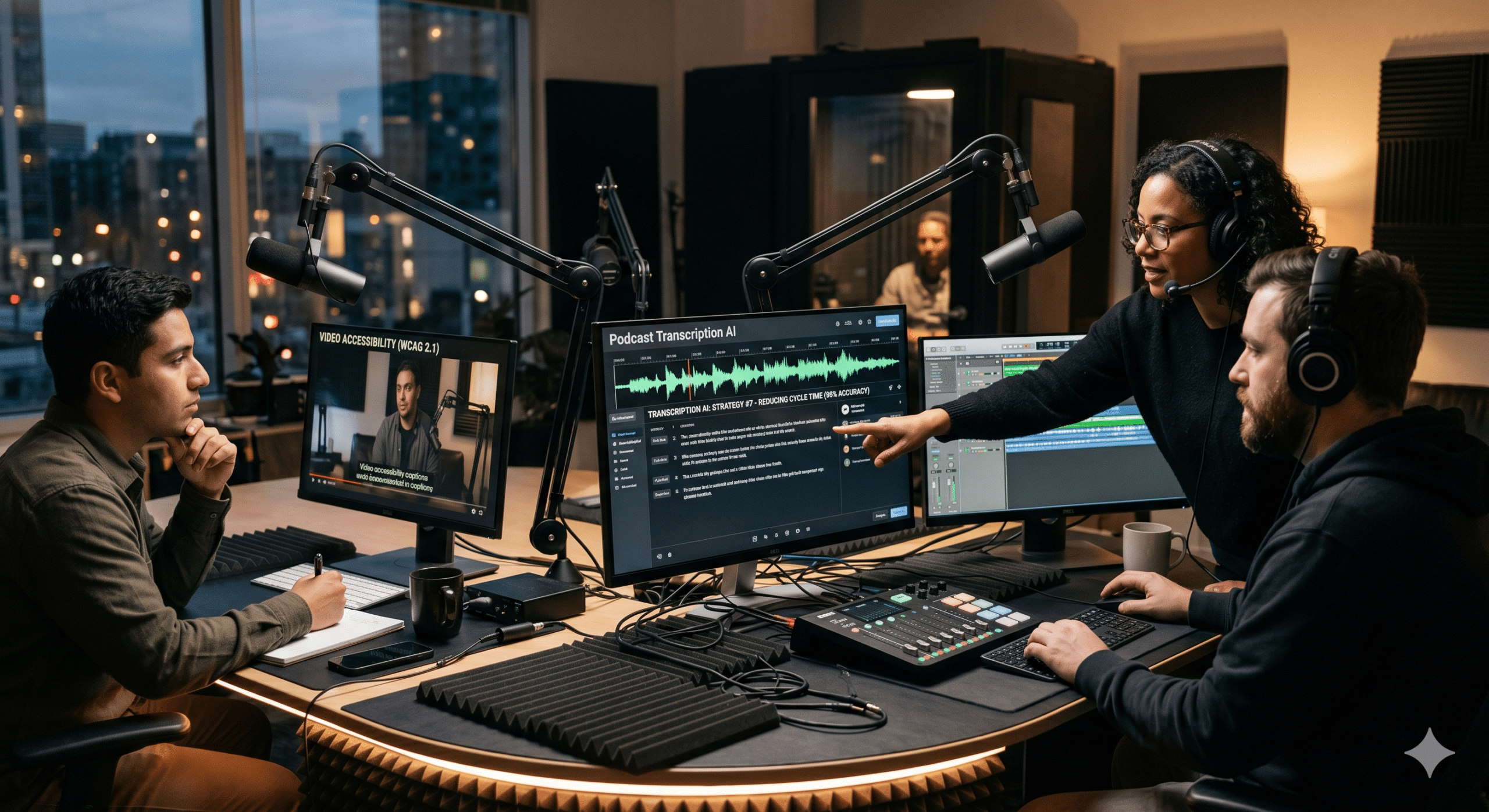
Podcasting has changed dramatically over the last few years. What started as an audio-first medium has evolved into a content ecosystem that includes YouTube videos, short-form clips, online courses, social media snippets, blog posts, newsletters, and multilingual content. As a result, creators are no longer producing a single piece of content. Instead, they are building content pipelines that need to move quickly without sacrificing quality.
At the same time, accessibility expectations have increased. Audiences expect captions. Search engines prefer indexable text. Educational organizations require accessible learning materials. Businesses need searchable knowledge archives. Consequently, podcast transcription has shifted from a nice-to-have feature into a critical production asset.
This is where Podcast transcription AI is making a measurable impact. From the perspective of Video Editors and Post-Production Specialists, as well as Instructional Designers and EdTech Specialists, AI-powered transcription is not simply about converting speech into text. More importantly, it is about increasing throughput, reducing cycle time, and minimizing scrap rate throughout the content production workflow.
When used strategically, Podcast transcription AI can help teams publish more content, repurpose assets faster, improve accessibility compliance, and reduce costly revisions. However, success depends on how the technology is integrated into the production process.
Let’s explore thirteen practical strategies that help content teams get the most value from Podcast transcription AI while maintaining high production standards.
Why Podcast Transcription AI Matters More Than Ever
The demand for transcription continues to grow because podcasts are no longer consumed exclusively through audio apps. Many podcast episodes now appear on YouTube, LinkedIn, TikTok, learning management systems, membership platforms, and corporate training portals.
Furthermore, searchable transcripts improve content discoverability. Researchers, students, employees, and general audiences can quickly find information without listening to an entire episode. Automatic transcripts also help people with hearing impairments access content more effectively. Searchable podcast transcripts have become increasingly valuable for accessibility and knowledge sharing across digital platforms. (Lifewire)
As production volumes increase, manual transcription simply cannot keep pace. Therefore, Podcast transcription AI becomes a practical solution for modern content operations.
1. Use Transcription as the First Step in the Production Workflow
Many creators still treat transcription as a final deliverable. However, the most efficient teams place transcription at the beginning of the workflow.
As soon as a podcast recording is complete, the audio is automatically transcribed. This transcript then becomes the foundation for editing, caption creation, content repurposing, and accessibility compliance.
Because the transcript exists immediately, editors can identify filler words, repetitive sections, and off-topic discussions before investing time in detailed video editing. As a result, production teams reduce wasted effort and accelerate decision-making.
This simple shift dramatically improves throughput because every downstream task benefits from having searchable text available from the start.
2. Eliminate Manual Note-Taking During Editing
Traditional podcast editing often requires editors to repeatedly scrub through audio timelines while taking notes.
That process consumes valuable production time.
With Podcast transcription AI, editors can search transcripts for keywords, phrases, sponsor mentions, or discussion segments instantly. Instead of hunting through a sixty-minute recording, they can jump directly to the exact section they need.
Consequently, cycle time decreases while editor productivity increases.
The reduction in repetitive timeline searching also minimizes editor fatigue, which helps improve overall content quality.
3. Create Captions Simultaneously
Accessibility and caption creation should not be separate workflows.
One of the biggest advantages of Podcast transcription AI is that caption generation can happen immediately after transcription.
Rather than waiting days for manual caption preparation, creators can produce synchronized captions within minutes. This accelerated workflow is particularly valuable for YouTube creators, course developers, webinar producers, and social media teams.
Moreover, audiences increasingly consume content with sound muted. Captions help maintain engagement while supporting accessibility goals.
Because captions originate from the same transcript source, consistency improves across all content formats.
4. Reduce Scrap Rate Through Early Error Detection
Every production team understands the cost of revisions.
A single missed sponsor mention, incorrect statistic, or speaker identification mistake can trigger multiple rounds of editing.
Podcast transcription AI allows teams to review content earlier in the process. Instead of discovering issues after publication, teams can identify inaccuracies while editing is still underway.
This early detection approach reduces scrap rate because fewer assets require rework later.
Although human review remains important, catching errors earlier significantly lowers overall production costs.
5. Repurpose Content Faster Across Multiple Channels
A podcast episode should never remain a single piece of content.
One transcript can become:
- Blog articles
- Social media posts
- Email newsletters
- Training materials
- Course modules
- Video descriptions
- Knowledge base articles
This dramatically increases content output without requiring additional recording sessions.
From an operational standpoint, this approach maximizes asset utilization. Instead of producing more content, teams generate greater value from content they have already created.
That is one of the most effective ways to improve throughput without increasing workload.
6. Improve Searchability and Content Discovery
Audio content is difficult for search engines to understand.
Text content is much easier to index.
When Podcast transcription AI creates accurate transcripts, podcast episodes become searchable both internally and externally. Users can locate specific information quickly, while search engines gain a clearer understanding of the content.
Research has shown that podcast transcripts improve information accessibility and make large collections of spoken content easier to search and utilize. (Lifewire)
As a result, content gains a longer lifespan and greater organic visibility.
7. Accelerate Educational Content Development
Instructional Designers frequently transform podcasts into learning resources.
Without transcription, converting a one-hour discussion into a structured lesson can take several hours.
Podcast transcription AI shortens this process considerably.
Learning designers can quickly identify learning objectives, extract key concepts, develop assessments, and create supporting materials using transcript data.
Therefore, educational teams can launch courses faster while maintaining instructional quality.
For organizations producing ongoing training content, this reduction in cycle time creates substantial efficiency gains.
8. Support Multilingual Accessibility Efforts
Global audiences continue to grow.
Consequently, content creators increasingly need multilingual accessibility solutions.
Podcast transcription AI provides a text foundation that can be translated into multiple languages. Once a transcript exists, localization becomes far easier than translating directly from audio.
This process supports:
- Multilingual captions
- International course content
- Global training programs
- Cross-border marketing campaigns
Instead of recreating content for every language, teams can leverage existing transcripts to serve broader audiences more efficiently.
9. Improve Speaker Identification Accuracy
Multi-speaker podcasts often create challenges during editing and transcription.
Fortunately, modern Podcast transcription AI systems have improved significantly in speaker separation and identification.
Accurate speaker labeling helps editors navigate discussions faster. It also improves transcript readability and accessibility.
For educational content, speaker identification is particularly important because learners need to understand who is presenting specific information.
Clear speaker attribution reduces confusion and improves the overall user experience.
10. Build Searchable Knowledge Libraries
Organizations increasingly use podcasts for internal communication and training.
However, recorded conversations have limited value if employees cannot find information later.
Podcast transcription AI transforms spoken content into searchable organizational knowledge.
Teams can quickly locate discussions about policies, procedures, product updates, or strategic initiatives.
Rather than repeatedly answering the same questions, organizations can direct employees to searchable transcript archives.
This approach reduces information retrieval time and increases operational efficiency.
11. Automate Content Summaries
Podcast episodes often contain valuable insights that are buried inside lengthy discussions.
AI-generated transcripts make automated summarization possible.
Teams can create:
- Executive summaries
- Episode highlights
- Learning objectives
- Key takeaways
- Meeting notes
Podcast summarization research has demonstrated how transcript-based workflows can effectively identify and surface important information from long-form discussions. (arXiv)
Because summaries originate from transcript data, content teams spend less time manually extracting key points.
12. Maintain Human Quality Control
While Podcast transcription AI is extremely powerful, human oversight remains essential.
Background noise, accents, technical terminology, industry jargon, and speaker overlap can still create transcription errors.
Experts continue to emphasize that human review improves accuracy, particularly for specialized content and high-stakes applications. (New York Post)
The most efficient workflow combines AI speed with targeted human quality assurance.
Rather than manually transcribing every word, reviewers focus only on validation and correction.
This hybrid model delivers both speed and accuracy.
13. Design Workflows Around Continuous Improvement
The highest-performing content teams treat transcription as a production system rather than a standalone tool.
They measure:
- Turnaround time
- Caption accuracy
- Revision frequency
- Content reuse rates
- Accessibility compliance
- Publishing speed
By tracking these metrics, teams identify bottlenecks and continuously optimize workflows.
Over time, even small improvements compound into significant gains in productivity.
This operational mindset transforms Podcast transcription AI from a convenience feature into a strategic asset.
The Throughput Advantage of Podcast Transcription AI
From a production perspective, throughput is the rate at which finished content moves through the system.
Podcast transcription AI increases throughput because it reduces manual work at nearly every stage.
Editors spend less time searching footage. Designers spend less time creating learning materials. Marketing teams spend less time repurposing content. Accessibility specialists spend less time generating captions.
As a result, more content reaches audiences in less time.
How Podcast Transcription AI Reduces Cycle Time
Cycle time measures how long it takes to move from recording to publication.
Traditional workflows often involve multiple handoffs between transcription providers, editors, caption specialists, and content marketers.
Podcast transcription AI removes many of these delays.
Because transcripts are generated almost immediately, downstream teams can begin work sooner. Consequently, projects move through production faster and publication timelines shrink.
For creators producing frequent content, these savings accumulate rapidly.
How Podcast Transcription AI Minimizes Scrap Rate
Scrap rate represents wasted work that must be corrected or discarded.
Late-stage transcription errors, caption mistakes, accessibility issues, and missing content elements all contribute to scrap.
Podcast transcription AI reduces these risks by making content review possible earlier in the workflow.
When teams detect problems sooner, fewer resources are wasted on revisions.
Therefore, overall production efficiency improves significantly.
Conclusion
The future of content production is not about creating more work. It is about building smarter systems.
Podcast transcription AI sits at the center of that transformation. It helps teams move faster, improve accessibility, reduce waste, and unlock new opportunities for content reuse.
For Video Editors and Post-Production Specialists, it eliminates repetitive tasks and accelerates editing workflows. For Instructional Designers and EdTech Specialists, it simplifies course development and improves learning accessibility.
Most importantly, Podcast transcription AI enables organizations to maximize throughput, reduce cycle time, and minimize scrap rate without sacrificing quality.
As podcasting, video content, online learning, and multilingual publishing continue to expand, the teams that integrate transcription strategically will gain a significant operational advantage.
FAQ
What is Podcast transcription AI?
Podcast transcription AI is technology that automatically converts spoken podcast audio into written text using speech recognition and machine learning systems.
How accurate is Podcast transcription AI?
Accuracy varies depending on audio quality, speaker clarity, accents, background noise, and technical terminology. Modern systems can achieve very high accuracy, although human review remains important for final quality assurance. (New York Post)
Why is Podcast transcription AI important for accessibility?
Transcripts and captions help people with hearing impairments access content. They also improve searchability, translation, and content discoverability. (Lifewire)
Can Podcast transcription AI improve SEO?
Yes. Search engines can index transcript text more effectively than audio alone, which can improve content discoverability and organic visibility.
Can Podcast transcription AI create captions automatically?
Yes. Many transcription platforms can generate synchronized captions directly from podcast transcripts, helping creators publish accessible video content more quickly.
References and Further Reading
- Buzzsprout – Podcast Transcriptions: How to Transcribe Your Audio
A comprehensive guide explaining how podcast transcripts improve accessibility, SEO, audience growth, and content discoverability. - Descript – AI Video & Podcast Editor Resources
Excellent resource for understanding transcript-based podcast editing, caption generation, and content repurposing workflows. - Chris Chinchilla – Transcription Tools for Podcasters and Video Creators
Practical comparison of modern transcription tools used by podcasters and video production teams. - 3Play Media – Accessibility, Captions, and Transcription Blog
One of the most respected accessibility-focused resources covering captioning standards, ADA compliance, transcripts, and video accessibility best practices. - AssemblyAI – Speech AI and Transcription Guides
Detailed articles covering AI transcription, speech recognition technology, multilingual transcription, and accessibility applications.