
I’ve spent the better part of my career sitting between two worlds. One is the world of engineers who build products. The other is the world of users who get locked out of them. My job title changes depending on who’s signing the paycheck. Sometimes it’s accessibility engineer, sometimes digital accessibility specialist. The work stays the same either way. I run screen readers against production sites. I file tickets that say “this button has no accessible name.” Lately I spend a lot of my week testing whether the newest wave of AI accessibility tools actually holds up under real conditions, or whether it just looks good in a vendor demo.
This guide lays out, plainly and without the marketing gloss, what AI accessibility tools can genuinely do for you in 2026. I’ll tell you which ones are worth your budget and where they still fall short. Not every tool on this list is perfect. I use several of them daily. I actively warn clients away from a few others. I’ll tell you which is which.
Why This Topic Isn’t Optional Anymore
The scale of the problem
The World Health Organization estimates that 1.3 billion people live with a significant disability. That’s roughly 1 in 6 of us worldwide. That number alone should be reason enough to care about accessible design. Here’s a second reason. Recent scans of the open web found that 53.1 percent of webpages were still missing alt text on images. More than half. In 2026. Teams have had two decades of WCAG guidance telling them exactly how to fix this.
That gap is why AI accessibility tools have moved from “nice to have” to standard practice on any team I work with. A human accessibility audit is still the gold standard. I’ll say that more than once in this guide because it matters. But a human can’t manually review ten thousand images across a product catalog before a launch deadline. AI can flag the obvious problems in minutes. That frees up humans for the judgment calls that actually need a human.
The regulatory push
There’s also a regulatory push behind this. The European Accessibility Act took effect in mid 2025. Most companies selling digital products or services into the EU must now meet its requirements or face real penalties. I’ve had more calls this year from legal and compliance teams than from design teams. That tells you something about where the pressure is coming from. In the United States, plaintiffs’ firms have kept filing ADA related web accessibility lawsuits at a steady pace. I’ve sat in on more than one settlement conversation where the company’s first question was simply how fast they could show progress. Whatever your motivation, ethical, legal, or commercial, the tools below are the ones actually doing the work right now.
Accessibility isn’t one size fits all
I’ll also say this, because it gets lost in most write ups on this topic. The disabled users I’ve worked with over the years are not a monolith. A tool that works beautifully for one person can be nearly useless for another. Someone who has been blind since birth navigates a screen reader very differently than someone who lost their vision later in life. Voice control tools assume the user can speak clearly and consistently. That assumption rules the tool out entirely for some people with motor or speech disabilities. Keep that variation in mind as you read the recommendations below. None of these tools are universal solutions. The best deployments I’ve seen offer more than one option instead of betting everything on a single piece of software.
How I Group These Tools
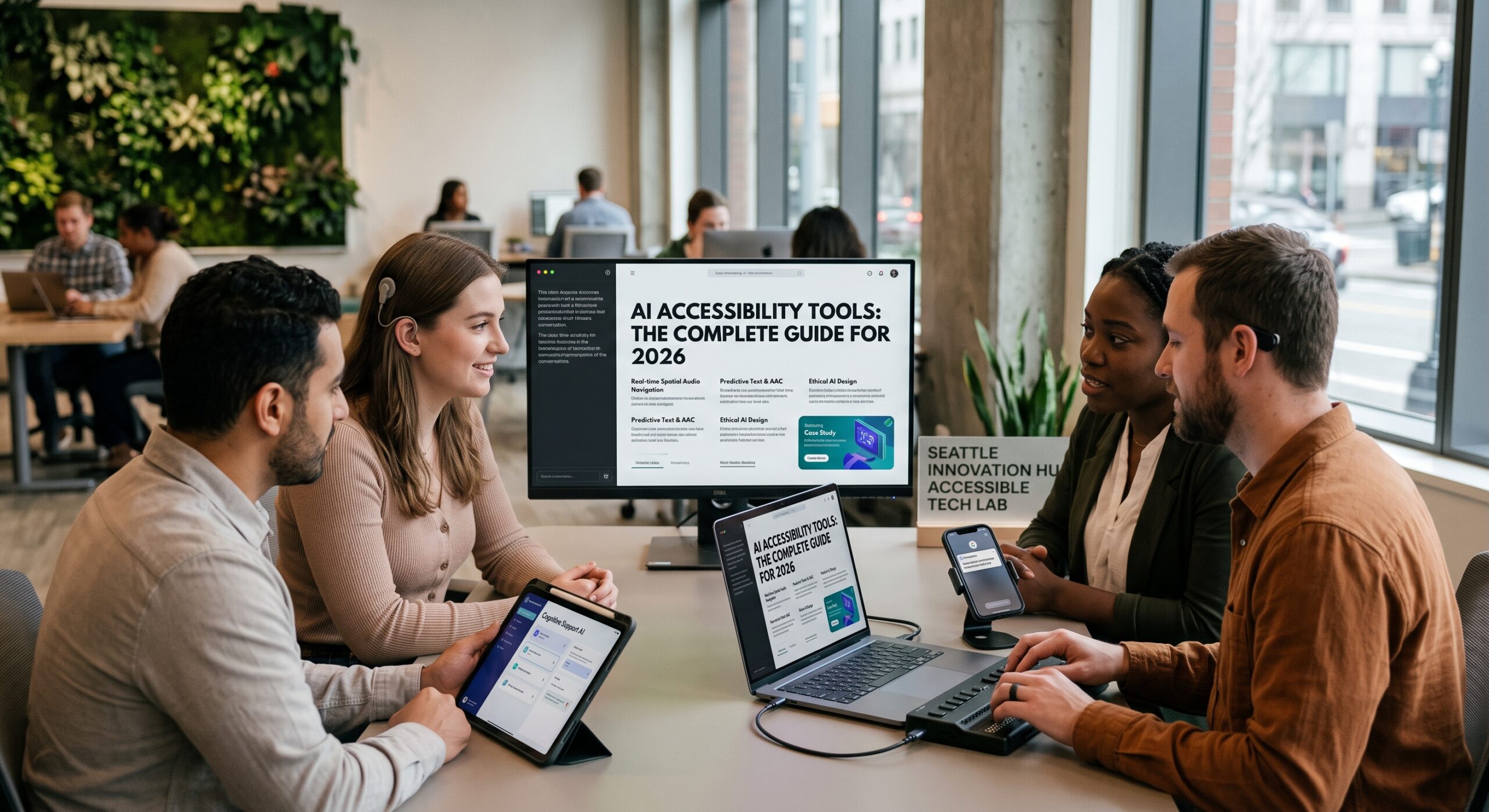
WCAG organizes accessibility work around the POUR framework: content should be Perceivable, Operable, Understandable, and Robust. Day to day, I find it more useful to group AI accessibility tools by who they’re built for. That’s how procurement conversations actually happen. So I’ll walk through five groups: tools for people who are blind or have low vision, tools for people who are deaf or hard of hearing, tools for people with motor or speech differences, tools for cognitive and literacy support, and tools that engineers and auditors like me use to catch problems before they reach any of the above.
None of these categories are fully separate in practice. A captioning tool helps a deaf user and a user in a loud warehouse alike. A screen reader helps a blind user and a user driving with a phone in the cup holder. Good accessibility work tends to help far more people than the label on the box suggests.
13 AI Accessibility Tools Worth Knowing in 2026
I’ve narrowed this down to 13 AI accessibility tools I actually recommend, use, or test against regularly. This isn’t an exhaustive market scan. I built this list from what I actually put in front of clients.
For blindness and low vision
Microsoft Seeing AI remains one of the most impressive free tools in this space. Point a phone camera at a scene and it narrates what’s there: text, currency, products by their barcode, even a rough description of a person’s expression. I watched it read a restaurant menu aloud in real time for a client. It occasionally mangles a font or misreads a crumpled label. Even so, the hit rate is high enough that it’s become a genuine daily tool rather than a novelty.
Be My Eyes started as a service connecting blind users with sighted volunteers over video call, and it still offers that. It added an AI assistant that can answer visual questions instantly, without waiting for a volunteer to pick up. For quick tasks, like checking an expiration date or reading a thermostat, it’s often faster than the human option. I still recommend keeping the volunteer feature on for anything nuanced or safety related.
JAWS, the screen reader many of us grew up testing against, has quietly folded machine learning into its image recognition features. It now describes unlabeled graphics on the fly when a developer never bothered to add alt text. It’s not a replacement for proper markup, and I say that to every client who thinks it lets them off the hook. But it’s a meaningful safety net.
NVDA, the free and open source screen reader, has followed a similar path. Community developers build add-ons that use AI models to interpret images and complex layouts. I recommend NVDA constantly for smaller organizations that can’t afford a JAWS license. The AI-assisted add-ons have narrowed the functional gap between the two considerably.
For deafness and hearing differences
Google Live Transcribe turns spoken conversation into real time text on a phone screen. In quiet rooms, its accuracy comes close to a professional stenographer. I’ve used it in client meetings where a deaf colleague needed to follow along without scheduling an interpreter in advance, and it held up well. Background noise and overlapping speakers still trip it up. Keep that in mind before you rely on it for a noisy conference hall.
Otter.ai does something similar but leans harder into meeting transcription, speaker labeling, and searchable transcripts afterward. I use it constantly for accessibility audit interviews. It lets me focus on the conversation instead of taking notes, and the transcript becomes a usable record for the client afterward.
Sign-Speak and similar AI sign language platforms are newer to this list, and I include them with a caveat. AI generated ASL avatars have improved a lot. They can translate captions or speech into signed video in near real time. But the Deaf community has been vocal, and rightly so, about quality concerns. An avatar that signs grammatically incorrect ASL isn’t accessibility. It’s a liability. I recommend these tools for supplementary content, not as a replacement for a human interpreter in a high-stakes setting like a medical appointment or legal proceeding.
For motor and speech differences
Dragon Professional, Nuance’s long-running voice control software, now runs on more modern speech models. The accuracy improvement is noticeable for users with motor disabilities who rely entirely on voice navigation. I’ve watched users who type maybe five words a minute by hand navigate an entire spreadsheet by voice at a conversational pace.
Voiceitt deserves more attention than it gets. The tool recognizes atypical speech patterns, the kind that cerebral palsy, ALS, stroke recovery, or Parkinson’s can produce. It learns an individual user’s speech over time instead of expecting them to conform to a generic model. I consider this one of the more quietly important tools on this list, because so much mainstream voice tech simply fails these users outright.
For cognitive and literacy support
Read&Write by Texthelp bundles text to speech, word prediction, and simplification tools into a browser extension. I recommend it constantly for users with dyslexia or other reading differences. Its newer AI summarization feature condenses a dense document into plain language on request. Students and professionals I’ve supported request that feature more than almost any other.
For developers and auditors
axe DevTools from Deque is the automated scanner I open first on nearly every audit. It catches roughly a third to half of WCAG violations automatically: contrast failures, missing labels, structural issues. Its AI-assisted rules have gotten noticeably better at flagging context-dependent problems that older static scanners missed entirely.
Siteimprove operates at a larger scale. It continuously scans entire domains and combines automated detection with optional expert human review. For enterprise clients managing thousands of pages, this ongoing monitoring catches regressions that a single point-in-time audit would miss.
ChatGPT, somewhat surprisingly to people outside this field, has become a genuinely useful tool in an accessibility workflow. I use it to draft first-pass alt text descriptions, explain a WCAG success criterion in plain language, or generate a starting point for an accessibility statement. It’s absolutely not a substitute for expert review. I’ve seen it produce alt text that’s technically accurate but contextually useless. Even so, as a drafting assistant, it saves real time.
That’s 13 tools spanning five categories. I’d rather hand a client that focused list than a hundred-tool spreadsheet nobody actually reads.
Where AI Accessibility Tools Still Fall Short
I need to be direct about something the marketing in this category tends to obscure. A subset of tools, most notably the automated “accessibility overlay” widgets, promise instant compliance with a single line of code. Disabled users and accessibility professionals alike have criticized them, and for good reason. These widgets often layer a visual interface on top of an inaccessible site instead of fixing the underlying code. In some documented cases, they’ve actually made a site harder to navigate with a screen reader than it was before someone installed the widget. I don’t recommend overlay-only solutions to any client. If a vendor pitches you “instant WCAG compliance” without mentioning the underlying markup at all, treat that as a warning sign rather than a selling point.
More broadly, every AI tool on this list shares the same structural limitation. These models learn patterns from existing data, and accessibility failures often fall outside those patterns. An AI captioning tool can transcribe clear speech reliably. But it will stumble on a speaker with a strong accent or an unusual speech pattern. That’s precisely the situation where accurate captioning matters most. An AI alt text generator can describe a stock photo of a laptop well enough. But it has no way of knowing that the chart in your annual report needs a data table alternative rather than a generic description.
Human review remains essential, not as a courtesy but as a requirement. I tell every team I work with the same thing. Use AI to find problems faster and handle the repetitive first draft. But keep a person with lived disability experience, or at minimum trained accessibility expertise, in the loop before anything ships.
How to Actually Choose a Tool
When a client asks me where to start with AI accessibility tools, I usually walk through the same short set of questions. I don’t just point at a single “best” product, because the right answer depends heavily on context.
Start with what you’re building
A marketing site with mostly static content has very different needs than a web application with complex interactive components. Automated scanners like axe DevTools catch a meaningful share of problems on either one. But interactive applications need more manual keyboard and screen reader testing, regardless of what tooling you buy.
Match the tool to your team’s skill level
Consider your team’s existing skill level. If you already have an internal accessibility specialist, developer-facing tools that integrate into your CI pipeline will deliver more value than a consumer-facing overlay. If you don’t have that expertise in house yet, choose a tool that pairs automated scanning with access to human auditors. Siteimprove’s hybrid model is a good example. That combination buys you real expertise rather than a false sense of coverage.
Weigh budget against coverage
Budget matters, obviously. But I’d rather see a smaller organization run NVDA and axe DevTools well, both free, than spend thousands on an enterprise overlay platform and skip manual testing entirely. Coverage and depth matter more than the size of the invoice. Finally, ask every vendor directly how they tested their tool with actual disabled users, and ask for specifics. A vague answer is itself useful information.
Pilot before you commit
I’d also add a step most teams skip entirely: pilot the tool on a small, representative slice of your product before rolling it out everywhere. I’ve seen organizations license an enterprise scanning platform, point it at their entire site on day one, and get buried under thousands of flagged issues with no sense of priority. A better approach starts smaller. Pick one high traffic page or one core user flow. Run the tool against it. Triage what comes back with someone who understands WCAG severity levels. Use that smaller exercise to build a realistic sense of how much ongoing effort the tool actually saves you, before you commit budget at scale.
Where This Is Heading
A few developments in AI accessibility tools are worth watching if you’re planning further ahead than this year. Brain-computer interfaces let users control a device by reading neural signals directly. They’re moving from research labs toward early consumer availability, aimed initially at people with severe paralysis. Wearable AI is also advancing. Smart glasses that narrate a wearer’s surroundings continuously, rather than on request, are getting lighter and more capable each product cycle. WCAG itself is evolving too. The next generation of the standard uses a more flexible, outcomes-based structure instead of the current pass or fail checklist. That change should eventually make it easier to tell whether AI-assisted fixes are actually improving the experience for real users, rather than just checking a compliance box.
None of that changes my core advice for this year. Pick tools that solve a real, specific access problem for your users. Keep humans, especially disabled humans, in the review process. Treat “AI powered” as a starting point in the conversation, not the end of it.
If you take one thing away from this guide, let it be this: the goal was never full automation. Every accessibility engineer I respect in this field treats AI accessibility tools as a force multiplier for the tedious, repetitive parts of the job: the first pass scan, the rough draft caption, the bulk alt text suggestion. That frees the limited hours of skilled human review for the problems that genuinely need a person’s judgment. Organizations that understand this distinction tend to build products that actually work for disabled users. Organizations that buy a tool expecting it to make the whole problem disappear tend to end up with a lawsuit and a worse product than when they started.
Frequently Asked Questions
Are AI accessibility tools a replacement for manual accessibility audits? No. AI tools excel at catching repetitive, pattern-based issues quickly across large volumes of content. But they miss context-dependent problems that require human judgment. The Web Content Accessibility Guidelines build around outcomes that often require a person to evaluate them, not just a scanner.
Do accessibility overlay widgets actually achieve WCAG compliance? Generally, no. Disability advocacy groups have criticized overlay-only tools for masking underlying code problems instead of fixing them. Some have even drawn legal complaints instead of protection from them. Fixing the source code remains the more reliable path.
Which AI accessibility tools should a small business start with? For a small team with a limited budget, I usually recommend starting with a free automated scanner such as axe DevTools, alongside manual testing with NVDA, the free screen reader. Together, these two AI accessibility tools catch a large share of common issues without any licensing cost.
Is the European Accessibility Act relevant if my company is based outside the EU? Yes, if you sell digital products or services to customers in the EU. The European Accessibility Act applies based on where your users live, not where your company is headquartered.
Can I trust AI generated captions and alt text without review? Not fully. AI drafts are a useful starting point, particularly for high volume content. But someone trained to catch inaccurate or contextually inappropriate descriptions should still review them before publishing, especially for data visualizations, charts, or safety information.
What does WCAG’s POUR framework actually mean? It stands for Perceivable, Operable, Understandable, and Robust. The W3C’s accessibility guidelines organize around these four core principles. Every accessibility tool or fix ultimately maps back to one of these four.
References
World Health Organization, Disability fact sheet: https://www.who.int/news-room/fact-sheets/detail/disability-and-health
HubSpot, AI for web accessibility: Tools, audits, and WCAG help: https://blog.hubspot.com/website/ai-for-web-accessibility
Level Access, AI and assistive tech: Key advancements in accessibility: https://www.levelaccess.com/blog/ai-and-assistive-tech-key-advancements-in-accessibility/
Level Access, European Accessibility Act (EAA) compliance overview: https://www.levelaccess.com/compliance-overview/european-accessibility-act-eaa/
World Wide Web Consortium (W3C), Web Content Accessibility Guidelines (WCAG) 2.2: https://www.w3.org/WAI/standards-guidelines/wcag/
Deque Systems, axe DevTools documentation: https://www.deque.com/axe/devtools/
Microsoft, Seeing AI overview: https://www.microsoft.com/en-us/ai/seeing-ai
Be My Eyes, About the platform: https://www.bemyeyes.com/