
Video content is everywhere. Whether someone is listening to a podcast on YouTube, scrolling through TikTok during a lunch break, taking an online course after work, or watching training videos inside a company learning portal, video has become the preferred way to consume information.
However, creating great videos is only part of the challenge. Today, viewers expect content to be accessible, searchable, easy to understand, and available in multiple languages. As a result, businesses, educators, creators, and marketers are paying far more attention to captions, transcripts, and accessibility than ever before.
This growing demand explains why searches related to video accessibility continue to rise. On one hand, audiences want content they can consume without turning on sound. On the other hand, organizations want to reach larger audiences while maintaining efficient production workflows. Meanwhile, content teams are being asked to publish more videos than ever before.
Consequently, many production teams are turning to an AI caption generator to solve a problem that continues to grow with every new video they publish.
From the perspective of Video Editors and Post-Production Specialists, accessibility is no longer a final checkbox before publication. Instead, it has become an essential component of modern production workflows. Likewise, Instructional Designers and EdTech Specialists view captions and transcripts as powerful learning tools that improve comprehension and engagement.
More importantly, when we analyze the situation through the lens of maximizing throughput, reducing cycle time, and minimizing scrap rate, the value of an AI caption generator becomes even clearer.
Every minute spent manually transcribing videos reduces throughput. Every correction made after publication increases cycle time. Every accessibility issue discovered late in production creates unnecessary rework.
Therefore, the organizations that build accessibility directly into their workflows are often the organizations that publish faster, reach larger audiences, and operate more efficiently.
Why Accessibility Has Become a Core Business Strategy
Not long ago, captions were often treated as optional.
Many creators added them only when required by regulations or client requests. However, audience behavior has changed dramatically over the last few years.
For example, millions of people now watch videos in public places where audio is inconvenient. Furthermore, many users browse social media with sound muted by default. In addition, global audiences frequently rely on captions when consuming content in a second language.
At the same time, online education has expanded rapidly. Students often need transcripts to review lessons, revisit concepts, and search for specific information quickly. Therefore, captions are no longer serving only individuals with hearing impairments. Instead, they are improving the experience for almost everyone.
As a result, accessibility has evolved from a compliance requirement into a competitive advantage.
Organizations that make their content easier to consume can often attract more viewers, increase watch time, and improve audience retention. Meanwhile, organizations that ignore accessibility risk limiting their reach and reducing the value of every video they create.
Consequently, the conversation has shifted from “Should we add captions?” to “How can we scale captions efficiently?”
This is precisely where an AI caption generator creates measurable value.
1. Use an AI Caption Generator to Eliminate Production Bottlenecks
Every editor understands how quickly transcription can become a bottleneck.
Traditionally, creating captions required listening to audio, typing spoken words, synchronizing text with video timelines, and reviewing everything for accuracy. Depending on the length of the content, this process could consume several hours.
Moreover, the workload increases rapidly as content volume grows.
A creator publishing one video each month may manage manual captioning without major difficulties. However, a podcast network releasing daily episodes faces an entirely different challenge.
Likewise, educational institutions producing hundreds of training videos cannot afford to spend excessive time on repetitive transcription tasks.
An AI caption generator changes this equation significantly.
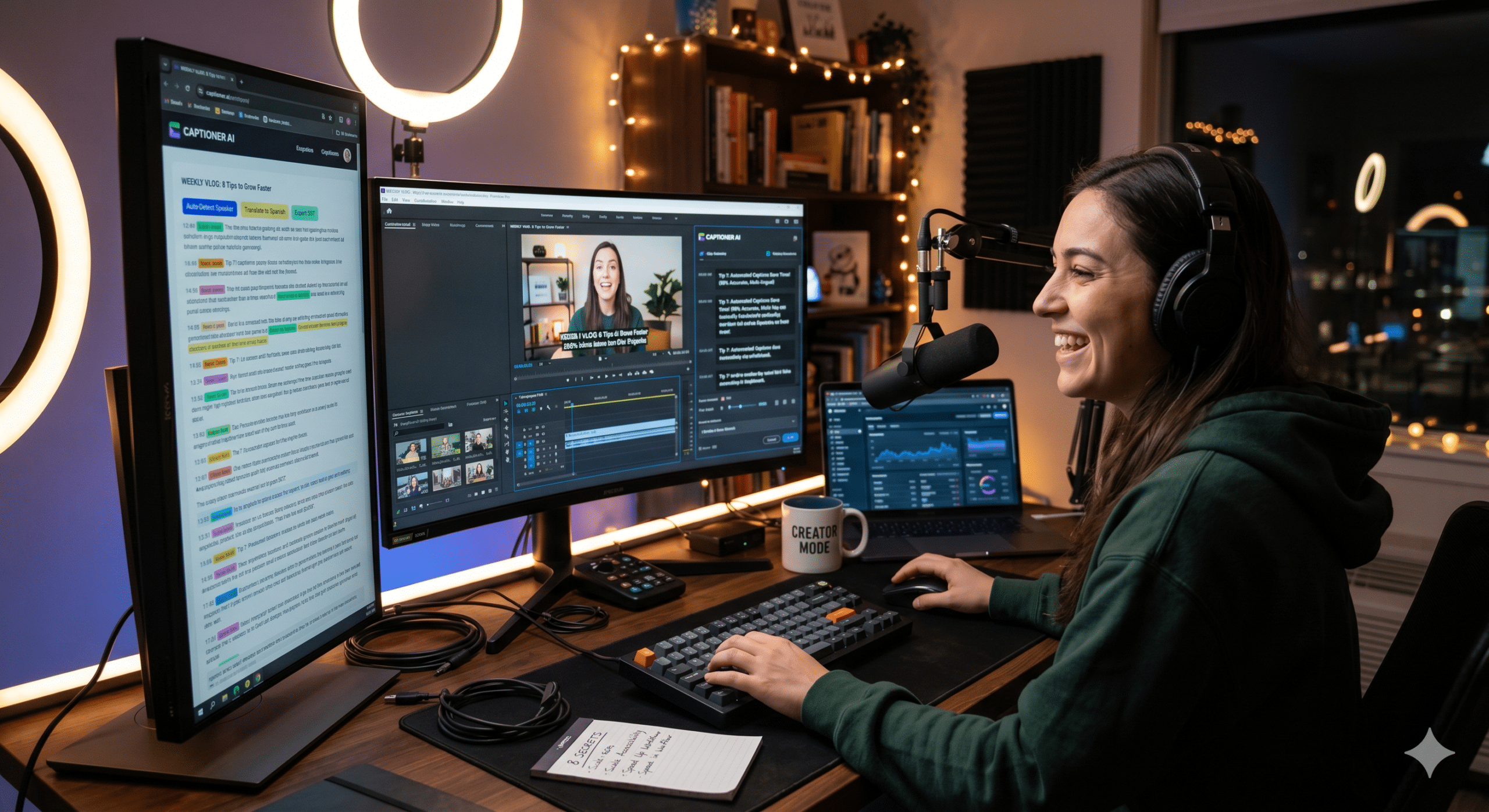
Instead of creating captions manually, editors can generate an initial transcript within minutes. Afterward, they can focus on reviewing and refining content rather than building captions from scratch.
As a result, production bottlenecks shrink considerably.
Furthermore, editors gain more time for creative tasks that directly improve viewer experience. Rather than spending hours typing dialogue, they can concentrate on pacing, storytelling, transitions, graphics, and overall presentation quality.
Therefore, accessibility becomes part of the workflow without slowing down production.
2. Increase Throughput Without Expanding Your Team
One of the biggest challenges facing content teams today is scale.
Businesses want more training content. Marketing departments want more social videos. Educators want larger course libraries. Meanwhile, audiences expect fresh content on a regular basis.
Unfortunately, hiring additional staff is not always possible.
Consequently, teams must find ways to increase output without significantly increasing costs.
An AI caption generator helps accomplish exactly that.
Because caption creation becomes largely automated, organizations can process more content using existing resources. Furthermore, automated workflows allow teams to maintain consistent production standards across large content libraries.
For example, a training department producing twenty videos per month may eventually need to produce fifty or one hundred. Without automation, captioning requirements would increase proportionally.
However, automated transcription systems allow production capacity to expand without creating equivalent increases in labor requirements.
As a result, throughput improves dramatically.
Moreover, team members spend more time on high-value work and less time on repetitive administrative tasks. Consequently, organizations achieve greater efficiency while maintaining quality.
3. Reduce Scrap Rate by Catching Errors Earlier
Many organizations underestimate how expensive rework can be.
Every correction made after publication consumes time, resources, and attention. Furthermore, post-publication fixes often require multiple team members to revisit completed projects.
From an operational perspective, this is scrap.
In manufacturing, scrap refers to wasted materials and unnecessary rework. In video production, scrap often appears as inaccurate captions, missing subtitles, incorrect terminology, or accessibility issues discovered late in the process.
Fortunately, captions can help identify problems much earlier.
When transcripts are generated automatically, stakeholders can review spoken content immediately. As a result, errors become easier to spot before publication.
For instance, an instructor may notice incorrect terminology. A subject matter expert may identify inaccurate technical language. Meanwhile, an editor may discover audio issues that were previously overlooked.
Consequently, corrections occur earlier when they are less expensive to fix.
Therefore, an AI caption generator not only speeds up production but also reduces waste throughout the content lifecycle.
4. Improve Audience Retention Through Better Accessibility
Producing a video is important. However, keeping viewers engaged is even more important.
After all, a video that nobody watches provides little value regardless of how much effort went into production.
Captions play a significant role in viewer retention because they support multiple viewing scenarios simultaneously.
For example, some viewers watch videos in noisy environments. Others consume content while commuting. Meanwhile, many social media users browse content with muted audio.
Without captions, these viewers may leave quickly.
With captions, however, they can continue consuming content regardless of their environment.
Furthermore, captions reinforce spoken information visually. As a result, viewers often absorb information more effectively.
This benefit becomes particularly valuable in educational settings.
Students frequently revisit lessons to review key concepts. In addition, searchable transcripts help learners locate specific information without rewatching entire videos.
Consequently, learning becomes more efficient.
Moreover, improved comprehension often leads to better course completion rates and higher learner satisfaction.
Therefore, accessibility contributes directly to audience engagement and educational success.
5. Expand Global Reach Through Multilingual Content
Perhaps one of the most exciting opportunities created by modern captioning technology is multilingual accessibility.
Today, a video uploaded in one country can be viewed almost instantly around the world.
However, language barriers still limit audience growth.
Without translated captions, valuable content remains inaccessible to large portions of the global population.
Fortunately, modern AI caption generator platforms increasingly support multilingual workflows.
As a result, organizations can translate captions into multiple languages without recreating content from scratch.
For businesses, this means entering new markets more efficiently.
For educators, it means serving diverse student populations.
For creators, it means reaching audiences they may never have considered previously.
Most importantly, multilingual accessibility increases the value of every video asset.
Rather than creating separate productions for different regions, organizations can maximize the impact of existing content.
Consequently, output increases while production costs remain under control.
6. Strengthen SEO Performance with Searchable Video Content
Many creators focus heavily on thumbnails, titles, and descriptions when trying to improve video visibility. While those elements certainly matter, they represent only part of the SEO picture.
Search engines can easily understand text. However, they cannot fully understand spoken content unless that content is converted into readable text.
Therefore, captions and transcripts provide a major advantage.
When an AI caption generator creates accurate transcripts, search engines gain additional context about the topics discussed within a video. Consequently, videos become easier to index and understand.
Furthermore, transcripts naturally include relevant keywords, phrases, questions, and explanations that viewers are searching for online. As a result, video content has a better opportunity to appear in search results.
The benefits do not stop there.
Because transcripts already contain the spoken content, they can be repurposed into multiple content formats. For example, a single podcast episode can become a blog post, newsletter, social media update, FAQ page, knowledge base article, or training document.
Meanwhile, marketing teams can extract quotes, insights, and discussion points without manually reviewing hours of footage.
Consequently, every video creates multiple opportunities for content distribution.
From an operational standpoint, this dramatically improves throughput because one content asset generates several additional assets. Moreover, the content creation cycle becomes shorter because much of the source material already exists in transcript form.
Therefore, an AI caption generator does more than improve accessibility. It also helps maximize the value of every video produced.
7. Improve Learning Outcomes Across Online Education Platforms
Online learning continues to grow rapidly. At the same time, learner expectations continue to evolve.
Students want content that is flexible, searchable, and easy to revisit. Furthermore, organizations delivering training programs want higher completion rates and better learning outcomes.
As a result, accessibility has become a critical component of instructional design.
Captions help learners absorb information in multiple ways. While some individuals learn best through listening, others retain information more effectively through reading. Meanwhile, many learners benefit from experiencing both formats simultaneously.
Therefore, captions support a broader range of learning preferences.
In addition, transcripts make studying more efficient. Instead of searching through an entire video, learners can quickly locate specific topics, terms, or explanations.
Consequently, frustration decreases and engagement increases.
For corporate training departments, this creates additional benefits.
Employees can revisit important information without rewatching lengthy training sessions. Likewise, onboarding programs become easier to navigate because transcripts provide searchable access to key content.
Furthermore, multilingual captions help international teams learn from the same materials regardless of their primary language.
As a result, organizations can standardize training across multiple locations while maintaining accessibility.
From a throughput perspective, training content becomes more reusable. Instead of repeatedly answering the same questions, organizations can direct learners to searchable resources that already contain the necessary information.
Therefore, an AI caption generator helps educational teams scale learning initiatives more efficiently.
8. Build a Future-Proof Accessibility Workflow
Many organizations still approach accessibility as a final production task.
Unfortunately, that approach often creates delays.
When captions are added at the end of a project, teams frequently encounter last-minute corrections, missed deadlines, and additional review cycles. Consequently, production schedules become less predictable.
However, organizations that integrate accessibility into their workflow from the beginning experience very different results.
When an AI caption generator is incorporated into the standard production process, captions are generated immediately after recording. As a result, transcripts become available earlier, reviews happen sooner, and corrections are identified before they become expensive problems.
Furthermore, production teams gain greater visibility into content quality throughout the workflow.
Editors can review transcripts during editing. Subject matter experts can verify terminology. Instructional designers can confirm learning objectives. Meanwhile, accessibility teams can validate compliance requirements before publication.
Because of this collaborative approach, fewer issues reach the final stages of production.
Consequently, scrap rate decreases significantly.
More importantly, organizations create a scalable system that supports future growth.
As video libraries expand from dozens of assets to hundreds or even thousands, standardized accessibility processes become increasingly valuable. Without automation, growth often creates operational chaos. With automation, however, growth becomes manageable.
Therefore, building accessibility into production workflows is not merely a short-term improvement. Instead, it represents a long-term investment in operational efficiency.
The Future of AI Caption Generator Technology
The capabilities of captioning technology continue to evolve.
Every year, speech recognition systems become more accurate. Furthermore, language support continues to expand, making multilingual content more accessible than ever before.
At the same time, integrations with editing platforms are becoming increasingly seamless.
Consequently, editors can move content through production with fewer manual steps.
Real-time captioning is also improving rapidly. As a result, live events, webinars, virtual classrooms, and online conferences can deliver accessible experiences to audiences in real time.
However, despite these technological advances, human expertise remains essential.
AI can generate captions quickly. Nevertheless, editors, instructional designers, and accessibility specialists provide the judgment, context, and quality control that technology alone cannot replicate.
For example, humans understand tone, nuance, industry terminology, and audience expectations. Likewise, they recognize when captions require refinement to improve clarity and readability.
Therefore, the future is not about replacing professionals.
Instead, the future is about allowing professionals to spend less time on repetitive tasks and more time on meaningful work.
Editors can focus on storytelling.
Instructional designers can focus on learning outcomes.
Content strategists can focus on audience growth.
Meanwhile, AI handles the repetitive transcription work that previously consumed valuable production time.
As a result, organizations achieve both efficiency and quality.
Common Mistakes That Slow Down Accessibility Workflows
Even with modern tools available, some organizations still struggle to achieve efficient accessibility processes.
One common mistake is waiting until the end of production to create captions. Consequently, errors are discovered too late and publishing schedules become compressed.
Another mistake is treating captions as a compliance task rather than a business asset. While compliance remains important, captions also improve engagement, discoverability, and audience reach.
Furthermore, some teams fail to establish standardized review procedures. As a result, caption quality varies from project to project.
Likewise, organizations sometimes overlook multilingual opportunities. Consequently, valuable content reaches only a fraction of its potential audience.
Most importantly, some teams continue relying entirely on manual workflows despite increasing content demands.
While manual methods may work at small scales, they often become unsustainable as production volume grows.
Therefore, organizations should evaluate accessibility processes regularly and identify opportunities for automation and improvement.
Final Thoughts
The rise of podcasts, YouTube automation channels, TikTok content, online learning platforms, webinars, and multilingual media has transformed how audiences consume information.
Today, viewers expect content to be accessible. Furthermore, they expect information to be searchable, flexible, and easy to understand regardless of where or how they are watching.
At the same time, organizations face increasing pressure to produce more content without increasing costs or extending production timelines.
Consequently, accessibility can no longer be treated as an afterthought.
An AI caption generator helps solve this challenge by supporting three critical operational objectives.
First, it maximizes throughput by accelerating caption creation and allowing teams to process more content efficiently.
Second, it reduces cycle time by eliminating manual transcription bottlenecks and enabling faster publishing workflows.
Third, it minimizes scrap rate by helping teams identify errors earlier and reducing costly rework after production.
Moreover, it strengthens SEO, improves learner outcomes, expands multilingual reach, and enhances audience engagement.
Most importantly, it transforms accessibility from a compliance requirement into a strategic advantage.
Organizations that embrace accessible workflows today will not only serve their audiences better, but they will also build production systems that are more scalable, more efficient, and better prepared for future growth.
Ultimately, an AI caption generator is no longer just a helpful tool. Instead, it has become a critical component of modern video production, digital learning, and content marketing success.
Frequently Asked Questions
What is an AI caption generator?
An AI caption generator is a software tool that automatically converts spoken audio into synchronized captions and transcripts using speech recognition technology. As a result, creators can produce accessible video content much faster than with manual transcription methods.
Why is an AI caption generator important for video accessibility?
Captions help viewers understand content regardless of their hearing ability, language background, or viewing environment. Furthermore, they make content more inclusive and easier to consume across different platforms.
Does an AI caption generator improve SEO?
Yes. Because captions and transcripts provide searchable text, search engines gain a better understanding of video content. Consequently, videos often become easier to discover through organic search.
Can AI-generated captions be translated into multiple languages?
Yes. Many modern platforms support multilingual caption creation and translation. Therefore, organizations can reach global audiences without producing separate videos for every language.
Are AI-generated captions completely accurate?
AI captioning technology is highly accurate; however, human review is still recommended for professional, educational, legal, and compliance-sensitive content. As a result, organizations can maintain quality while still benefiting from automation.
How does an AI caption generator reduce production costs?
By automating transcription and caption creation, organizations spend less time on repetitive manual work. Consequently, production teams can create more content without proportionally increasing labor costs.
References and Further Reading
- . Vimeo – Best AI Subtitle Generators: 11 Efficient Captioning Tools – An in-depth comparison of leading AI subtitle and captioning platforms, including accessibility, multilingual support, workflow automation, and content engagement benefits.
- W3C Web Accessibility Initiative (WAI) – Captions and Subtitles – The gold-standard accessibility resource explaining caption requirements, subtitle best practices, and accessibility standards for video content.
- Section508.gov – Captions and Transcripts – Official U.S. government accessibility guidance covering captions, transcripts, audio descriptions, and compliance considerations.
- Harvard Digital Accessibility Services – Captions for Videos – Practical guidance from Harvard on creating accessible video experiences for education, training, and online learning environments.
- Bird Eats Bug – 15 Video Captioning Best Practices to Improve Accessibility – A detailed guide covering caption accuracy, formatting, timing, accessibility standards, and production workflows.
- Wordly – AI Caption Generator: Boost Video Engagement and Accessibility – Focuses specifically on AI caption generator technology, multilingual captioning, engagement improvements, and scalable video accessibility workflows.
- Maricopa Community Colleges – Accessibility Handbook for Teaching and Learning: Video Accessibility – Excellent resource for instructional designers, eLearning developers, and educators building accessible video-based learning experiences.
- Rev – Closed Captioning Guidelines and Rules – Covers captioning standards, accuracy expectations, platform requirements, and industry best practices.
- SpeakWrite – How to Do Closed Captioning: The Ultimate Step-by-Step Guide (2026) – A modern workflow-focused guide explaining how organizations can implement captioning efficiently while maintaining accessibility compliance.