
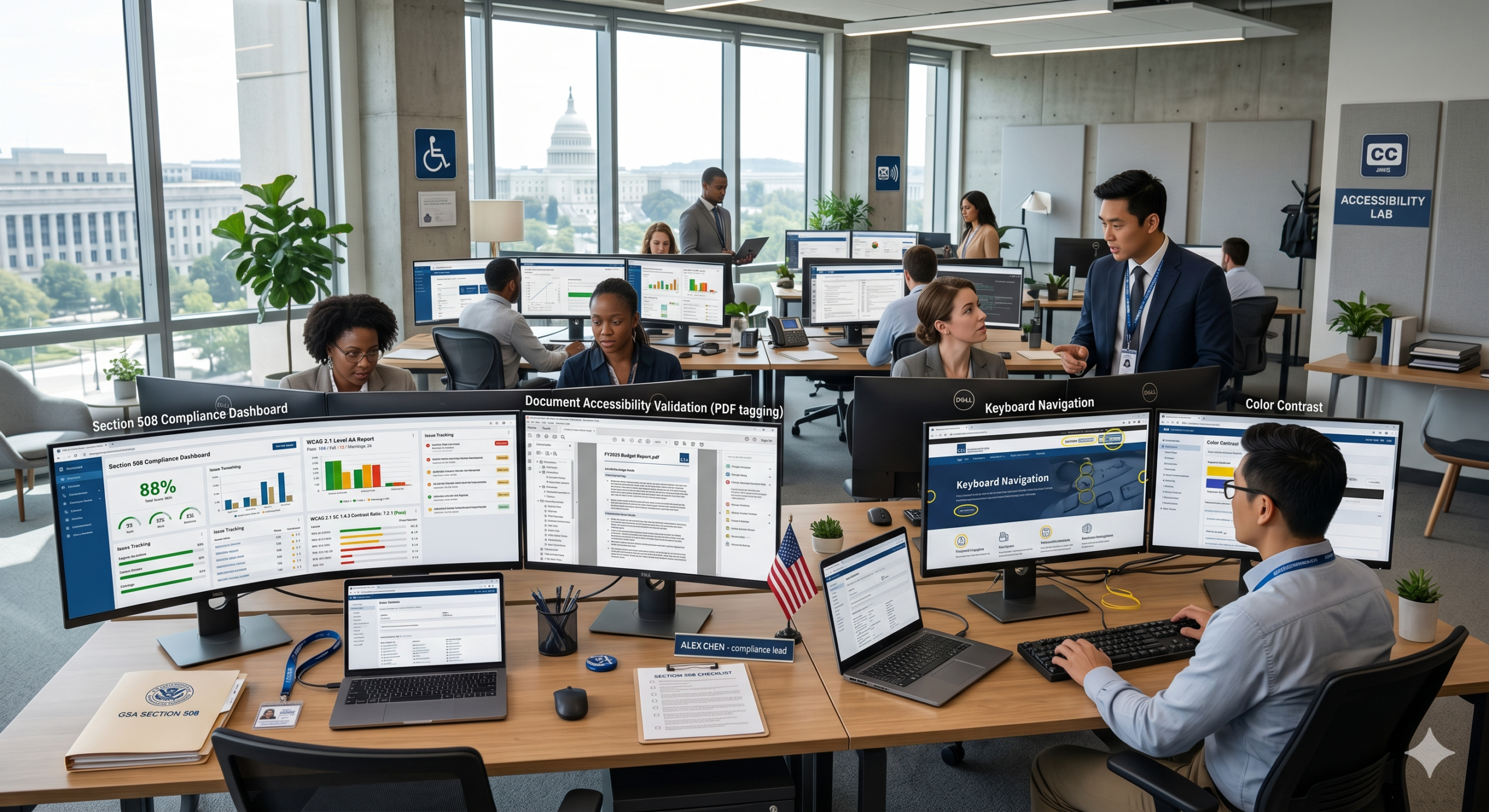
Section 508 compliance is a critical requirement for organizations that develop, maintain, or deliver digital content for U.S. federal agencies. As digital services continue to expand, ensuring accessibility for people with disabilities is no longer optional—it is a legal mandate. In particular, websites, software, and electronic documents must be usable by individuals with visual, auditory, motor, and cognitive impairments.
Originally introduced as part of the Rehabilitation Act, Section 508 has evolved to align with modern accessibility standards. According to the General Services Administration, these Section 508 compliance requirements define how federal agencies and contractors must ensure digital accessibility for all users.
This comprehensive guide explains everything you need to know about Section 508 compliance in 2026, including standards, requirements, tools, and best practices.
What Is Section 508 Compliance?
Section 508 compliance refers to the requirement that federal agencies make their electronic and information technology accessible to people with disabilities. In practice, this includes websites, mobile applications, software systems, and digital documents.
To meet these requirements, organizations follow the Web Content Accessibility Guidelines (WCAG). In essence, WCAG provides a structured framework for building accessible digital experiences.
These guidelines are based on four principles:
- Perceivable – Content must be visible and understandable
- Operable – Interfaces must be usable through different inputs
- Understandable – Information must be clear and predictable
- Robust – Content must work with assistive technologies
Together, these principles ensure that digital platforms are inclusive and accessible.
Why Section 508 Compliance Matters in 2026
Legal Requirement
Section 508 is a federal law. Therefore, agencies and contractors must comply with accessibility standards. Failure to comply can result in penalties, contract loss, and legal action.
Equal Access to Information
Accessibility ensures that all users can access digital content. For example, screen readers allow visually impaired users to navigate websites effectively.
Expanded Opportunities
Compliance opens doors to government contracts. In addition, accessible products can reach a wider audience beyond federal users.
Improved User Experience
Accessible design benefits everyone. Moreover, clear navigation and readable content improve usability for all users.
Section 508 Standards and Requirements
WCAG Alignment
The updated Section 508 standards align with WCAG 2.0 Level AA. However, many organizations now follow WCAG 2.1 or 2.2 for better compliance.
Key Requirements
To achieve Section 508 compliance, websites and systems must include:
- Text alternatives for images
- Keyboard accessibility
- Proper color contrast
- Clear navigation structure
- Accessible forms
- Compatibility with assistive technologies
In other words, accessibility must be built into both design and development.
Key Components of Section 508 Compliance
Accessible Web Content
Web pages must follow accessibility guidelines. For instance, images need alt text, and headings must be structured properly.
Software Accessibility
Applications must be usable with assistive technologies. Additionally, interfaces should support keyboard navigation.
Document Accessibility
PDFs, Word files, and other documents must be accessible. For example, they should include tags, headings, and readable text.
Multimedia Accessibility
Videos and audio must include captions or transcripts. As a result, users with hearing impairments can access content.
Common Section 508 Compliance Issues
Many organizations struggle with recurring accessibility problems. For instance, missing alt text and poor color contrast are common.
Other issues include:
- Inaccessible navigation
- Unlabeled form fields
- Improper heading structure
- Non-compliant PDFs
- Lack of keyboard support
Consequently, these issues create barriers for users and increase compliance risks.
Section 508 Compliance Tools
Using the right tools simplifies compliance efforts.
Automated Testing Tools
These tools scan websites for accessibility issues. As a result, teams can identify problems quickly.
Browser Extensions
Extensions allow developers to test pages in real time. In contrast, full platforms provide deeper insights.
Monitoring Platforms
Continuous monitoring tools track compliance over time. Therefore, organizations can maintain accessibility as content evolves.
Assistive Technology Testing
Testing with screen readers and other tools ensures real-world usability. In particular, it reveals issues that automation may miss.
How to Achieve Section 508 Compliance
Step 1: Conduct an Accessibility Audit
Start with a full audit of your digital assets. This way, you can identify gaps and prioritize fixes.
Step 2: Address Critical Issues
Focus on high-impact problems first. For example, navigation and form accessibility should be fixed immediately.
Step 3: Update Design and Development
Implement accessibility best practices. At the same time, ensure code and design align with WCAG standards.
Step 4: Integrate Accessibility into Workflow
Accessibility should be part of your development process. Therefore, include testing in your CI/CD pipeline.
Step 5: Maintain Compliance
Regular audits are essential. Otherwise, updates may introduce new issues.
Section 508 Compliance vs WCAG
| Feature | Section 508 | WCAG |
|---|---|---|
| Type | U.S. law | Global guideline |
| Scope | Federal agencies | Worldwide |
| Enforcement | Legal | Not enforced independently |
| Purpose | Ensure accessibility | Define standards |
In practice, WCAG provides the framework used to achieve Section 508 compliance.
Section 508 Compliance for Businesses
Government Contractors
Companies working with federal agencies must comply. Otherwise, they risk losing contracts.
Software Vendors
Vendors must ensure their products meet accessibility standards. In addition, accessibility improves product usability.
Digital Agencies
Agencies should deliver accessible websites to clients. As a result, they enhance value and reduce legal risks.
Future Trends in Section 508 Compliance
AI-Powered Accessibility
Artificial intelligence is improving accessibility testing. As a result, issue detection is faster and more accurate.
Real-Time Monitoring
Modern tools provide instant feedback. Therefore, developers can fix issues during development.
Accessibility-First Design
Design systems now prioritize accessibility. Consequently, fewer retroactive fixes are needed.
Advanced Assistive Technology
Assistive tools continue to evolve. In turn, websites must adapt to support new technologies.
Best Practices for Maintaining Section 508 Compliance
- Train teams on accessibility standards
- Test with real users
- Use semantic HTML
- Stay updated with WCAG changes
- Document accessibility processes
Section 508 Compliance Checklist
Use this checklist to evaluate your compliance:
- Images include alt text
- Website supports keyboard navigation
- Headings follow proper hierarchy
- Forms are accessible
- Color contrast meets standards
- Screen readers function correctly
Conclusion
Section 508 compliance is essential for creating accessible, inclusive digital experiences in 2026. More importantly, it ensures equal access to information for all users.
By following WCAG guidelines, using the right tools, and integrating accessibility into your workflow, you can achieve and maintain compliance. Ultimately, accessibility improves usability, expands opportunities, and strengthens your digital presence.