

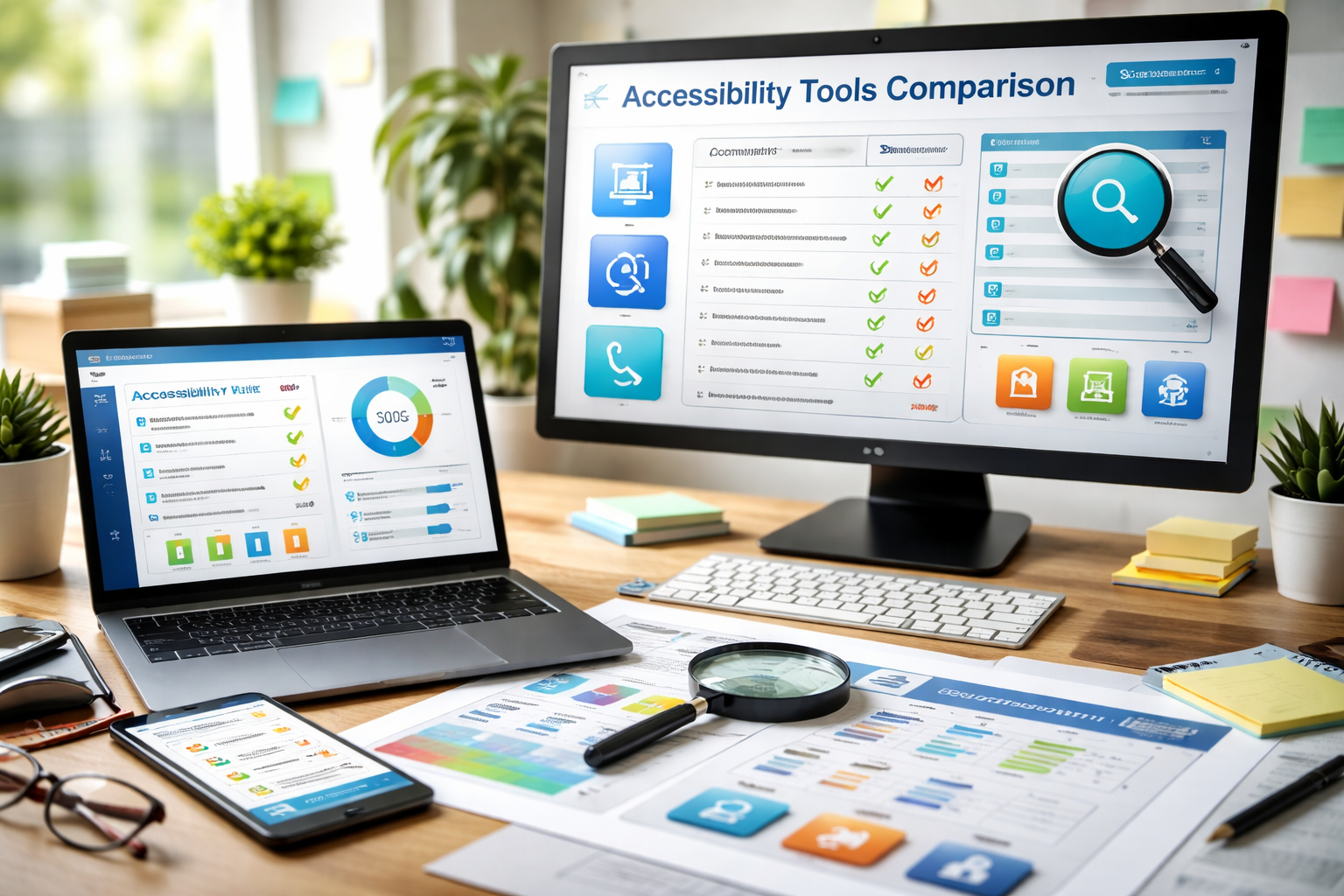
As digital platforms continue to evolve, ensuring accessibility has become a critical priority for businesses and developers. Accessibility tools comparison plays a key role in helping organizations identify the most effective solutions for improving usability and meeting compliance standards.
Moreover, the growing number of accessibility tools available today makes it increasingly difficult to choose the right one. Therefore, understanding how these tools differ in functionality, performance, and scalability is essential for building inclusive digital experiences in 2026. In fact, making the wrong choice can lead to inefficiencies and missed accessibility issues.
What Is an Accessibility Tools Comparison?
An accessibility tools comparison evaluates different tools based on their features, usability, and ability to meet accessibility standards such as WCAG. In other words, it helps organizations make informed decisions when selecting the right solution.
Instead of relying on a single tool, teams often compare multiple options to understand their strengths and weaknesses. Additionally, this process highlights how each tool performs in real-world scenarios.
Accessibility tools generally fall into three categories:
- Automated testing tools
- Manual testing tools
- AI-powered accessibility platforms
Each category serves a distinct purpose, and as a result, comparing them provides a more comprehensive understanding of available solutions.
Why Accessibility Tools Comparison Matters
Choosing the right tool directly impacts both user experience and compliance. For this reason, organizations must carefully evaluate their options before making a decision.
Furthermore, a structured accessibility tools comparison allows teams to streamline workflows and reduce development time. For example, automated tools can quickly detect common issues, while manual tools provide deeper insights.
As a result, teams can focus more on improving usability rather than repeatedly fixing the same problems. In addition, comparing tools helps businesses avoid unnecessary costs and select solutions that align with their goals.
Key Criteria for Comparing Accessibility Tools
When evaluating different tools, several important factors should be considered. To begin with, accuracy is essential.
1. Accuracy
First, accuracy determines how effectively a tool identifies real accessibility issues. In particular, tools with fewer false positives save time and effort.
2. Automation Capabilities
Next, automation plays a crucial role in scalability. As expected, automated tools can scan large websites quickly and efficiently.
3. Ease of Use
Equally important, ease of use ensures that teams can adopt the tool without difficulty. For instance, intuitive dashboards improve productivity.
4. Integration
Moreover, integration with development environments such as CI/CD pipelines is critical. Without this, workflows can become fragmented.
5. Reporting and Analytics
In addition, detailed reporting helps prioritize issues based on severity. Therefore, strong analytics features are highly valuable.
6. Pricing
Finally, pricing must be considered. While some tools are free, others offer advanced features through paid plans.
Accessibility Tools Comparison Table
| Tool | Type | Key Features | Best For |
|---|---|---|---|
| Google Lighthouse | Automated | Accessibility scoring, performance insights | Developers |
| axe DevTools | Automated | CI/CD integration, detailed reports | Engineers |
| WAVE Web Accessibility Evaluation Tool | Automated | Visual feedback, error detection | Designers |
| Accessibility Insights | Hybrid | Guided testing, issue tracking | QA teams |
| UserWay | AI-powered | Real-time fixes, accessibility widgets | SMBs |
| AudioEye | AI + Human | Automated + expert validation | Enterprises |
Before diving into specific tools, it’s helpful to review a broader list of available solutions. A list of the best accessibility tools for websites highlights popular platforms and their key features, making it easier to compare options effectively.
Detailed Comparison of Popular Tools
Google Lighthouse
Google Lighthouse is widely used for accessibility audits. Notably, it provides quick insights into accessibility performance.
Strengths:
- Free and easy to use
- Integrated into Chrome DevTools
- Provides accessibility scores
However, it focuses mainly on automated checks. Therefore, manual validation is still required.
axe DevTools
axe DevTools is designed for developers who need deeper accessibility testing. In particular, it excels in integration.
Strengths:
- High accuracy
- CI/CD integration
- Developer-friendly interface
On the other hand, some advanced features may require a paid version.
WAVE Web Accessibility Evaluation Tool
WAVE provides visual feedback directly on web pages. As a result, users can quickly identify issues.
Strengths:
- Easy to use
- Clear error highlighting
- Ideal for quick audits
Nevertheless, it offers limited automation compared to advanced tools.
Accessibility Insights
Accessibility Insights combines automated and manual testing. Consequently, it delivers more comprehensive results.
Strengths:
- Guided workflows
- Detailed analysis
- Free to use
However, it requires user input for deeper evaluations.
UserWay
UserWay offers AI-powered accessibility features. In particular, it focuses on ease of implementation.
Strengths:
- Quick setup
- Real-time adjustments
- AI-driven features
That said, it may not address all accessibility issues fully.
AudioEye
AudioEye combines AI with human expertise. As a result, it delivers higher compliance accuracy.
Strengths:
- Continuous monitoring
- Expert validation
- Enterprise-ready
On the downside, it tends to be more expensive.
Automated vs Manual vs AI Tools
Automation enables fast and scalable testing. However, it may miss complex usability issues.
In contrast, manual testing provides deeper insights. Nevertheless, it requires more time and resources.
Meanwhile, AI-powered tools combine both approaches. As a result, they offer a balanced solution. Even so, human oversight remains necessary.
How to Choose the Right Tool
Selecting the right tool depends on your specific needs. For example, developers often prefer automated tools like axe DevTools.
Similarly, small businesses may benefit from AI solutions like UserWay due to ease of use.
Meanwhile, enterprises typically require comprehensive platforms such as AudioEye. In most cases, combining multiple tools yields the best results.
Real-World Use Cases
In web development, accessibility tools help identify issues early. For instance, developers can run automated scans before deployment.
Likewise, e-commerce platforms use these tools to improve navigation. As a result, user satisfaction increases.
At the same time, corporate websites benefit from improved readability. Meanwhile, government platforms rely on these tools for compliance.
Challenges in Accessibility Tools Comparison
While comparisons are useful, they also present challenges. For example, tools vary in accuracy and features.
Additionally, pricing models can be complex. As a result, choosing the right tool becomes more difficult.
Therefore, organizations should use multiple tools. Ultimately, this approach ensures better coverage.
Conclusion
An effective accessibility tools comparison helps organizations choose the right solutions. By carefully evaluating options, teams can improve usability and compliance.
Moreover, combining different tools provides more comprehensive coverage. In the long run, this leads to better user experiences and stronger digital performance.